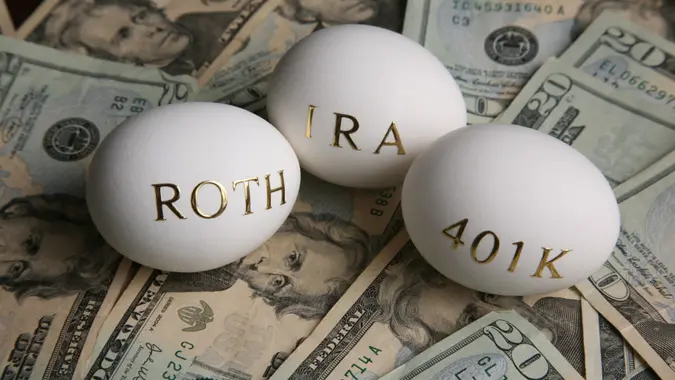
Borrowing From a 401(k): What To Know Before You Take a Loan
 Written by
Michael Keenan
Written by
Michael Keenan
 Edited by
Joe Evans, CFHC™
Edited by
Joe Evans, CFHC™

Commitment to Our Readers
GOBankingRates' editorial team is committed to bringing you unbiased reviews and information. We use data-driven methodologies to evaluate financial products and services - our reviews and ratings are not influenced by advertisers. You can read more about our editorial guidelines and our products and services review methodology.

20 Years
Helping You Live Richer

Reviewed
by Experts

Trusted by
Millions of Readers
Borrowing from a retirement account can be tempting when you need cash quickly. A 401(k) loan allows you to borrow money from your retirement savings and repay it over time with interest.
Unlike early withdrawals, 401(k) loans typically don’t trigger taxes or penalties as long as the loan is repaid according to the plan’s rules.
Still, borrowing from a 401(k) comes with trade-offs. The money you remove from the account stops earning investment returns, and failing to repay the loan can trigger taxes and penalties.
Before taking a loan from your retirement savings, it’s important to understand the rules, limits and potential long-term costs.
At a Glance: Borrowing From a 401(k)
Feature Details Maximum loan amount Up to $50,000 or 50% of vested balance Typical repayment period 5 years Repayment method Payroll deductions Interest Paid back to your own account Tax penalty if unpaid Loan treated as taxable distribution The Internal Revenue Service sets the basic rules governing retirement plan loans, including loan limits and repayment requirements.
How Borrowing From a 401(k) Works
A 401(k) loan allows you to borrow from your retirement account and repay the funds over time. Instead of applying through a lender, the loan is issued through your employer-sponsored retirement plan.
Once approved, the borrowed amount is removed from your investment portfolio and deposited into your bank account.
Repayments are usually made through automatic payroll deductions that include both principal and interest.
According to the U.S. Department of Labor, the interest paid on a 401(k) loan goes back into the borrower’s retirement account rather than to a lender.
401(k) Loan Limits
Federal rules place limits on how much you can borrow from your retirement account.
Maximum Borrowing Limits
| Loan limit | Amount |
|---|---|
| Maximum allowed | $50,000 |
| Percentage of balance | Up to 50% of vested account value |
| Minimum loan amount | Often $1,000 (varies by plan) |
For example:
- If your vested balance is $80,000, you could borrow up to $40,000
- If your balance is $200,000, the loan limit is $50,000
These limits are set by the Internal Revenue Service. However, some employer plans may set stricter limits or restrict loans entirely.
Repayment Rules for 401(k) Loans
Most 401(k) loans must be repaid within five years. Repayment usually happens through automatic deductions from your paycheck.
However, there is one major exception:
Home Purchase Exception
If the loan is used to purchase a primary residence, repayment periods may extend beyond five years. This rule is permitted under federal retirement plan regulations outlined by the Internal Revenue Service.
Interest on a 401(k) Loan
401(k) loan interest rates vary by plan but are often tied to the prime rate plus one or two percentage points. Unlike traditional loans, the interest payments go back into your retirement account.
While that sounds beneficial, there’s still an opportunity cost because the borrowed money is no longer invested in the market.
Research from the Employee Benefit Research Institute suggests retirement account loans can reduce long-term savings growth if market returns exceed the loan interest rate.
What Happens if You Leave Your Job
One of the biggest risks of borrowing from a 401(k) occurs if you leave your employer. Many retirement plans require the loan to be repaid quickly after employment ends.
If the loan isn’t repaid within the allowed timeframe, the remaining balance may be treated as a taxable distribution.
This means:
- The unpaid balance becomes taxable income
- A 10% early withdrawal penalty may apply if you are under age 59½
These rules are established by the Internal Revenue Service.
Pros and Cons of Borrowing From a 401(k)
Instead of a standard pros-and-cons list, here’s how borrowing from a 401(k) typically plays out in real-world situations.
Where a 401(k) Loan Can Help
| Situation | Why it may work |
|---|---|
| Avoiding high-interest debt | Interest may be lower than credit cards |
| Short-term cash need | Access to funds quickly |
| Emergency expenses | No credit check required |
Where It Can Backfire
| Situation | Risk |
|---|---|
| Job loss or career change | Loan may become taxable |
| Market gains during loan | Missed investment growth |
| Long repayment periods | Reduced retirement savings momentum |
According to the Federal Reserve, retirement savings gaps are already a concern for many households, making withdrawals or loans potentially risky for long-term planning.
When Borrowing From a 401(k) Might Make Sense
Borrowing from a 401(k) may be worth considering when:
- You’re avoiding high-interest debt
- The loan amount is relatively small
- You have stable employment
- Repayment can happen quickly
For example, using a 401(k) loan to consolidate credit card debt charging 20% interest may make financial sense in some cases.
When It’s Usually a Bad Idea
Borrowing from retirement savings is generally discouraged when:
- The loan is used for discretionary spending
- Your job situation is uncertain
- You’re close to retirement
- The loan amount is large relative to savings
Financial planners often recommend treating retirement accounts as long-term assets rather than short-term funding sources.
The Financial Industry Regulatory Authority warns that borrowing from retirement accounts can disrupt long-term savings growth.
Quick Decision Guide
Need cash but want to avoid credit card interest? A small 401(k) loan may be an option.
Concerned about job stability? Avoid borrowing due to repayment risks.
Trying to protect long-term retirement savings? Consider other borrowing options first.
Final Take to GO
Borrowing from a 401(k) can provide quick access to cash without a credit check or a traditional lender. However, it also carries meaningful risks, including missed investment growth and potential tax penalties if the loan is not repaid.
Before taking money from retirement savings, review your plan’s rules and consider whether alternative funding sources may protect your long-term financial goals.
FAQ
Borrowing from a 401(k) is a common retirement plan feature, but the rules and risks can be confusing. Here are answers to common questions.- How much can you borrow from a 401(k)?
- You can typically borrow up to $50,000 or 50% of your vested account balance, whichever is less.
- Do you pay taxes on a 401(k) loan?
- No taxes apply if the loan is repaid according to plan rules. If it isn’t repaid, it may be treated as a taxable distribution.
- What happens if you quit your job with a 401(k) loan?
- The remaining balance may need to be repaid quickly. Otherwise, it could become taxable income and trigger penalties.
- Is borrowing from a 401(k) a good idea?
- It may help in certain situations, but it can reduce long-term retirement growth.
- Do you pay interest on a 401(k) loan?
- Yes, but the interest is typically paid back into your own retirement account.
- Does borrowing from a 401(k) hurt your credit score?
- No. 401(k) loans do not involve credit checks or appear on credit reports.
Data is accurate as of March 11, 2026, and is subject to change.
Our in-house research team and on-site financial experts work together to create content that’s accurate, impartial, and up to date. We fact-check every single statistic, quote and fact using trusted primary resources to make sure the information we provide is correct. You can learn more about GOBankingRates’ processes and standards in our editorial policy.
- IRS "Retirement topics - Plan loans"
- IRS "One-participant 401(k) plans"
- IRS "Retirement topics - Exceptions to tax on early distributions"
- IRS "Retirement topics - Hardship distributions"
- CFPB "Planning for retirement"
- Georgetown University Center for Retirement Initiatives "Financial Vulnerabilities Among Retirement Savers: Trends, Outcomes and State-Level Differences"
- The Employee Benefit Research Institute "New Personal Finance Research Report Finds Increases in Health Care and Home Expenses in Households With Defined Contribution Loans"
- IRS "Retirement plans FAQs regarding loans"
- IRS "Retirement topics - Plan loans"