






Stocks and options are two types of securities investors trade on the open market. While they do have similarities, they also differ in important ways that you should understand before you invest in either.
What Is a Stock?
A stock is a fractional share of ownership in a company. Investors buy stock with the hope that the share price will rise, making the stock more valuable than when the investors purchased it. In addition to the possibility of appreciation, stocks give shareholders voting rights that help shape the company’s direction. Some also pay dividends, which are a company’s way of returning a portion of its profits to shareholders.
Most stocks are traded on stock exchanges and have indefinite lifespans. As long as the business continues to operate and trade publicly, the stocks will continue to exist.
Stock prices are in constant flux due to a variety of factors, from the company’s financial performance to news about events that affect the economy. However, the overall performance of a stock usually tracks a company’s growth. Whereas ever-increasing stock prices are often a good sign for investors, falling prices can cost investors some or all of their investment.
What Is an Option?
Options give you the right to sell or purchase a stock or other asset at a specific price, called a strike price, by a specific date. They’re called “derivatives” because they derive their value by the underlying securities from which the investor hopes to profit.
Investors use options to gain a strategic advantage but are not obligated to buy or sell. If not executed by the expiration date, however, the option becomes worthless.
The two types of options are:
- Put options: Put options allow investors to sell a particular stock by a certain date at a specific price. Generally, investors who buy put options expect the actual price of the stock on the market to be lower than their options price so that they maintain the right to sell at above market value.
- Call options: A call option lets you buy the stock by a certain date at a specific price. Investors who buy call options usually expect the price of the stock to increase so that they can buy it below market value.
Many online brokers offer commission-free options trading, but you’ll typically pay a small fee per contract. Schwab, for example, charges $0.65 per contract.
The Pros of Investing in Stocks
Investing in stocks comes with several benefits:
- Stocks can last as long as the company operates
- Some pay dividends, providing income even when prices fall
- Many brokers offer commission-free trading
- Public stocks are highly liquid — you can sell anytime markets are open
- Holding for over a year can lower your capital gains tax
- Buy individual stocks or diversify easily through mutual funds and ETFs
Shortcomings of Stocks
Although stocks are an important part of any investment strategy, they have some disadvantages:
- Stock prices can swing wildly, so you may have to sell for less than you paid
- Stock funds aren’t insured — if prices drop or a company fails, you could lose your investment
- Picking the right stock takes research into a company’s performance
- Analyzing stocks can be time-consuming, requiring multiple metrics and reports
The Pros of Investing in Options
Here are some advantages of owning options:
- Options offer leverage — one contract controls 100 shares for far less capital than buying the stock outright
- Commission-free brokers keep trading costs low
- Holding options long term may qualify for lower capital gains tax rates, though longer contracts carry more risk
Shortcomings of Options
Since options can be even more volatile than stocks, there are a few disadvantages that you should know beforehand:
- Underlying asset prices can swing sharply, risking your entire investment
- Options aren’t insured — you could lose all your money
- Options expire — unused contracts become worthless
- Trading options requires broker approval due to their complexity and risk
The comparison table below summarizes the features of both investment types:
| Characteristic | Options | Stocks |
|---|---|---|
| Potential for profit | Very high | High |
| Risk | Generally, very high, but some strategies have lower risk | Moderate to high |
| Timeframe | Typically short, but can be long | Can be long or short depending on your investment objectives |
| Trading commissions | Usually none, but most brokers charge a small fee per contract | Usually none |
| Taxation | Short-term to long-term, depending on holding period; most options contracts, however, are short-term | Short-term to long-term, depending on holding period |
Which Is Better for You?
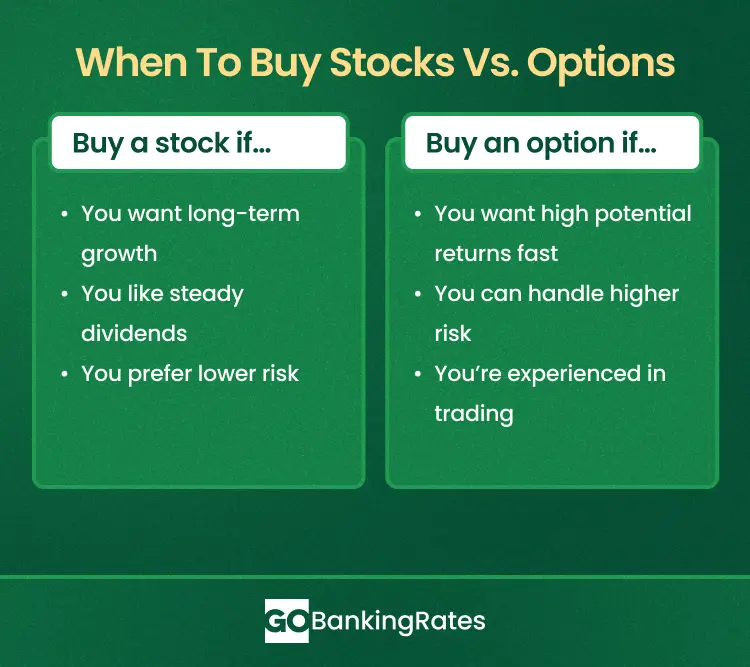
One is not inherently better than the other. When choosing between options and stocks, the best choice is the one that fits your investing goals, your experience as an investor and your tolerance for risk.

Stocks for the Experienced
If you are fairly experienced with the stock market and prefer long-term investments, stocks are the way to go.
Options for Strategic Approaches to Investing
Meanwhile, options are better for investors with a strategic investment approach and a high tolerance for risk. If you want to multiply your investment in a short span and are willing to do the legwork, you might consider options.
Since it requires additional research, investing in options is better for advanced investors who know how to minimize risk and strategically benefit from market trends.
How To Start Investing in Stocks and Options
You can purchase stocks and shares through brokerage accounts. Understand any fees they charge for buying and selling.Before you buy a company’s stock, make sure you do your research into the business and how they’re performing. Read our expert tips for how to invest your money.
FAQ
- Can beginners invest in options?
- Yes, but because of the level of strategy involved, it’s a better option for more experienced investors.
- Are options riskier than stocks?
- Both securities have risk, but options require a little more strategy. This can make them riskier.
- Can you lose more money with options than stocks?
- You can lose money with both types of investments. However, options are a little riskier, so it’s more likely you could lose money.
- How much money do you need to start investing in either?
- You can invest in fractional stocks for less money.
John Csiszar and Daria Uhlig contributed to the reporting for this article.