








An add-on certificate of deposit (CD) is a type of savings product that lets you make additional deposits after you open the account — a feature most traditional CDs don’t allow. While you still lock in a fixed interest rate and term, you can continue adding funds over time to grow your balance.
How Add-On CDs Work
Like a regular CD, you start with an initial deposit that sets your interest rate. From there, you can continue adding money during the CD’s term — as long as you follow the bank’s rules around limits and timing. Your funds remain locked until maturity, and early withdrawals typically result in a penalty.
Add-On CDs vs. Traditional CDs: What’s the Difference?
Here’s how add-on CDs stack up against traditional CDs when it comes to growing your savings.
CD Type Additional Deposits Interest Rate Flexible Growth Add-on CD Allowed Fixed Yes Traditional CD Not allowed Fixed No
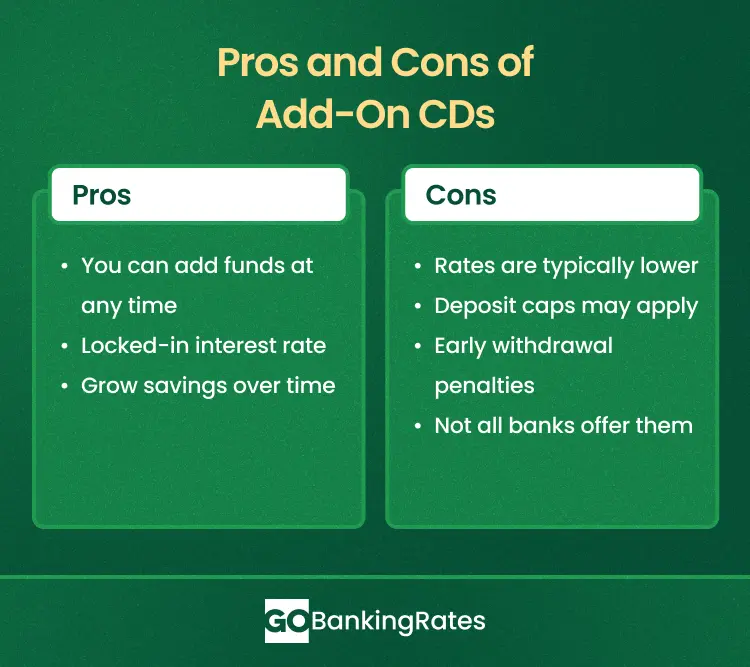
Pros and Cons of Add-On CD Accounts
Before opening a new account, consider the pros and cons of add-on CDs to see if they’re right for you:

Add-On CD Rates in 2025: What To Expect
Add-on CDs aren’t widely available, and rates can vary significantly by institution. In 2025, APYs range from as low as 0.05% to nearly 4%. As the market shifts, many add-on CDs are trending downward.
Here’s a look at current offerings from some top banks:
| Bank | Term | APY | Minimum Deposit |
|---|---|---|---|
| Bank5Connect | 2 years | $500 | |
| Velo Bank | 6 months | $1,000 | |
| TD Bank | 1 year | $250 |
Bank5Connect
Best for: Those who don’t plan to withdraw early and have $500 to initially deposit.
- APY:
- Term: 2 years
- Deposit restrictions: You can make unlimited deposits during the two-year term.
Velo
Best for: Those who can afford the $1,000 minimum deposit and want to capture APY.
- APY:
- Term: 6 months
- Deposit restrictions: You can make additional deposits during the term.
TD Bank
Best for: Those who aren’t looking for a high APY and want the option to invest in an IRA CD account.
- APY:
- Term: 1 year
- Deposit restrictions: You need a minimum of $250 to open the account, and every deposit you make must be $500 or more during the term.
How To Open an Add-On CD Account
Opening an add-on CD is a relatively straightforward process. Here are the steps you can follow:
- Research banks that offer these accounts and compare the CD rates.
- Find out what information and identification the institution requires.
- For online banks, you can upload your materials through the secure portal. If you’re opening an account in person, be sure to bring everything with you.
- Fund the account with the required minimum deposit and add additional funds throughout the term length.
Alternatives to Add-On CDs
Add-on CDs aren’t the right fit for everyone. If you’re unsure whether this savings option aligns with your financial goals, consider exploring other alternatives.
- High-yield savings account: This account gives you access to your money with high interest rates and fewer penalties if you want to withdraw your funds.
- Money market account: Earn interest while maintaining access to your funds. This account typically offers a competitive rate along with check-writing privileges and limited withdrawals.
- Traditional CDs: Typically offer higher interest rates and are widely available, giving you more options to find the best rate and term for your needs.
Here’s a side-by-side look at how these savings vehicles compare to one another:
| Account | Interest Rate | Access To Funds | Minimum Balance | Additional Deposits | Withdrawal Limits | Best For |
|---|---|---|---|---|---|---|
| High-yield savings | Variable, can be higher than most savings options | Withdraw at any time | $0 to $1,000 | Yes | 6 withdrawals per month | Emergency funds, flexibility |
| Money market account | Variable | Limited checks, ATM withdrawal | $500 to $1,000 | Yes | 6 withdrawals per month | Earning interest with some check writing abilities |
| Traditional CD | Fixed for term | Locked until maturity | Varies, but usually low | No, not after original deposit | Penalties for early withdrawals | Lump sum savings with a fixed rate |
| Add-on CD | Fixed for term | Additional deposits allowed, locked until maturity | $0 to $2,500 | Yes | Penalties for early withdrawals | Growing savings with fixed rate |
Who Should Consider an Add-On CD?
- Savers without a large lump sum: Add funds over time instead of making a one-time deposit.
- Planners looking for flexibility: Build your balance gradually while locking in a fixed rate.
- Gig workers or freelancers: Deposit money as it becomes available, no need to open multiple accounts.
- Anyone concerned about future rate drops: Lock in your rate at the time of opening.
Final Thoughts
An add-on CD is a good option for savers who can’t afford a large upfront deposit but still want to grow their savings. You can add funds during the CD’s term and lock in your interest rate from the start. Like a traditional CD, you won’t be able to withdraw funds until maturity — but the ability to build your balance over time adds flexibility. Add-on CDs are rare, but some offer solid APYs worth considering.
Add-On CD FAQ
Here are the answers to some of the most frequently asked questions about add-on CDs.- What banks offer add-on CDs?
- Some banks that currently offer add-on CDs are Bank5Connect, Velo and TD Bank.
- How do add-on CD rates compare to traditional CDs?
- Traditional CDs typically have higher yields than add-on CDs. Unlike a traditional CD, you can add more money to an add-on CD after you open it.
- Are add-on CDs worth it?
- Add-on CDs are a good savings vehicle if you cannot afford the full amount of the CD upfront and want the option of adding money later to secure the APY.
- What does "add-on a CD" mean?
- You can add more money to a CD after opening it. Unlike a regular CD, an add-on CD allows you to deposit more money through regular deposits. The bank may set a limit on how much you can add on.
Andrea Norris, Hiba Boutary and Miriam Caldwell contributed to the reporting for this article.
Rates are subject to change; unless otherwise noted, rates are updated periodically. All other information on accounts is accurate as of July 29, 2025.