Top 6 Things the Upper Class Should Sell Before Retiring — Even If It’s Begrudgingly
 Written by
Angela Mae Watson
Written by
Angela Mae Watson
 Edited by
Zuri Anderson
Edited by
Zuri Anderson
Commitment to Our Readers
GOBankingRates' editorial team is committed to bringing you unbiased reviews and information. We use data-driven methodologies to evaluate financial products and services - our reviews and ratings are not influenced by advertisers. You can read more about our editorial guidelines and our products and services review methodology.

20 Years
Helping You Live Richer

Reviewed
by Experts

Trusted by
Millions of Readers
If you think “wealth” and “prosperity” when you hear the term “upper class,” you wouldn’t be too far off. Upper-class individuals are those who make more than $169,800 a year, according to Pew Research Center (assuming three-person households).
For retirees, it’s less about salary than it is about having a high net worth. GOBankingRates found that upper class retirees have between $714,000 and $2.1 million net worth.
But just because you have a high net worth doesn’t mean you shouldn’t still sell things when you retire — even if you don’t necessarily want to. As for what those things are, here’s what the experts suggest and why.
Antique Cars
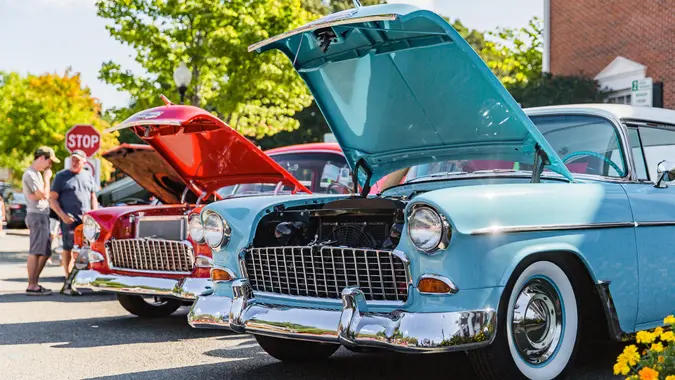
Avid automobile collectors might shy away from the idea of selling their antique cars, but if you’re on the verge of retirement, you might want to bite the bullet now.
“While they may be super cool to look at, and can have tremendous sentimental value, the truth is, [antique cars] are expensive to maintain, can be hard to drive and probably won’t be loved by the next generation as much as they are by you,” said Aaron Ulrich, owner of Integra Financial Planning, LLC in Prospect, Kentucky. “Selling prior to retirement can ensure you get top dollar, and that it goes to someone who knows how to treat it right.”
Rather than leave that antique car to sit in the garage, you can use the funds for something much more meaningful. This could be anything from that vacation you’ve always wanted to take to a large inheritance for your heirs.
Primary or Secondary Home
You might only have the one home, and you might not want to move. But if you’re thinking about retiring, you might benefit from downsizing. Remember, it’s not always about how much money you’re getting. Sometimes, it’s about simplifying your life.
But don’t sell just because you’re retiring, and don’t settle for something you don’t want.
“If you have a multilevel house with so much space you don’t know how you’ll keep up with it, it may be a good idea to sell that house and purchase a house where you can live comfortably on one level,” said Melanie Musson, finance expert with Quote.com. “Look for a house that is handicap-accessible and has space for what you need, but not so much that you feel overwhelmed.”
Life Insurance Policy
You might have needed that life insurance policy earlier on in your life for peace of mind. But now that you’re older and retiring, you might be better off selling any unused policies — key word “might.”
“If someone or a couple have life insurance policies that they no longer need then it may make sense to sell these policies rather than simply dropping them and getting nothing for them, especially if these policies have cash value growth inside them,” said Mike Raines, owner and agent at Raines Insurance Group.
Raines added that every situation is unique, but that couples (and individuals) often no longer need the max life insurance coverage once they retire. This is also the case for when they no longer have a mortgage (common amongst financially savvy upper-class households) and the kids are grown.
It’s not for everyone, so consult a licensed professional before making any major financial moves.
Timeshares
The American Resort Development Association (ARDA) estimates the average timeshare costs around $1,260 in annual maintenance fees. Monthly payments range from $250 to $400.
That might not sound like much for upper-class retirees, but ask yourself: Are you actually using it or are you paying for nothing?
“It might feel like fun when younger or with young kids, [but timeshares] become inflexible liabilities with fees and low resale value,” said Stephen Roth, financial planner at Limestone Financial Group.
Concentrated Stock Positions
No matter your net worth, it’s important to create an investment strategy and portfolio that suits your financial goals and needs. As such, you might want to consider which investments are liquid and which aren’t before you retire.
“Before retiring, you would want to sell or get out of concentrated stock positions or stakes in private equity businesses,” said Roth. “You might not be able to sell shares as easily like publicly-traded stocks, so access to the cash or proceeds is limited when invested.”
With publicly-traded stocks, you have the option of selling them on an exchange for cash. If ever you need the extra funds, you’ve got more flexibility here than you would with more concentrated or private equity options.
Collectibles
Those artworks or baseball cards you’ve spent decades building up? You might want to sell them.
“If you have children and want to check in with them first, do so. But if you have collections you’re not actively building, it’s a good idea to simplify before retirement,” said Musson.
As an added benefit, you might actually feel better once you’ve unloaded some things you no longer actively want or need. Even better is if you sell those collections to someone who appreciates them as much as you once did.
More From GOBankingRates