I’m a Retiree: Here’s How I Spend My $2,785 Monthly Income
 Written by
Daria Uhlig
Written by
Daria Uhlig
 Edited by
Nick Friedman
Edited by
Nick Friedman

Commitment to Our Readers
GOBankingRates' editorial team is committed to bringing you unbiased reviews and information. We use data-driven methodologies to evaluate financial products and services - our reviews and ratings are not influenced by advertisers. You can read more about our editorial guidelines and our products and services review methodology.

20 Years
Helping You Live Richer

Reviewed
by Experts

Trusted by
Millions of Readers
A physically demanding job requiring a long, stressful commute prompted Lucas Smith (pseudonym to protect privacy) to retire at age 62. But it was his sound financial habits — namely, avoiding debt and staying ahead of major expenses — that laid the groundwork for making early retirement possible.
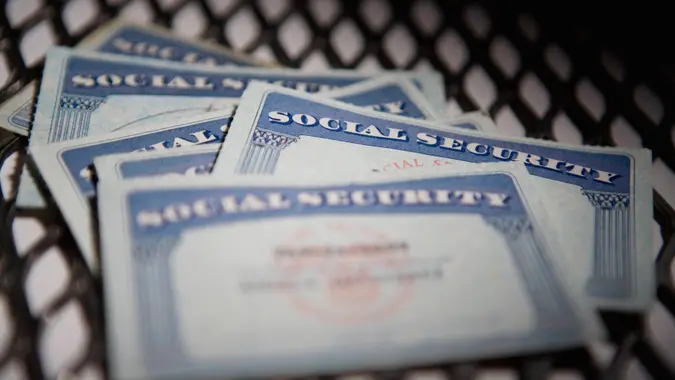
Although Smith has retirement savings in 401(k) and individual retirement accounts, that money is earmarked for future expenses. For now, he’s living solely on his $1,765 monthly Social Security benefit plus $1,020 in rental income from an investment property. Here’s how he spends his $2,785 monthly income.
Housing
Smith has a small mortgage on his primary home. His payment is just $500 per month. In addition, he contributes $200 per month toward the mortgage on a home he co-owns with his siblings.
Utilities
Electric bills are a relatively small expense at $70 to $100 per month. Smith pays an additional $250 per month total for cellphone, internet and TV services.
Transportation
Retirement is saving Smith nearly $40 per week in gas, reducing that expense to a negligible amount. However, he does have a $500-per-month payment on a car loan he’s working on paying off.
Groceries
Smith was accustomed to bringing lunch to work, so his grocery bill is the same now as it was before retirement — about $400 per month.
Investment Property Expenses
Annual property tax and homeowners association fees amount to about $400 per month, prorated. Smith keeps a separate savings account for those payments. He built that savings through his own “savings plan” of sorts.
“Ever since I’ve owned the place, every time I got rental money I used to put that money back into the condo,” Smith said. With no mortgage to worry about, Smith uses the account for other expenses.
Travel and Entertainment
Smith didn’t have much time for entertainment during his working years, so he’s not in the habit of going out just to go out. He’d rather enjoy leisure time at home or spend time with family.
Travel was another thing Smith didn’t have time for when he was working, other than to vacation at his investment property. He’s taking a wait-and-see approach to budgeting future travel.
Healthcare
One risk of a fairly spontaneous early retirement is that some expenses might catch you by surprise. In Smith’s case, that expense is insurance. He had paid coverage through his employer but is currently uninsured and exploring his options.
“I’m looking for a part-time job that offers benefits, something that will take me through the next three years until I get Medicare,” he said.
Tips for Retiring On Less Than $3K per Month
Smith credits his mother — a single mom who raised three children on a teacher’s salary — with teaching him the good financial habits that let him retire early on a modest budget, without tapping into his retirement savings.
The key factors that made it happen are things you can do to retire early on less than $3,000 per month:
- Eliminate credit card debt.
- Anticipate major expenses like home repairs, and do the work or set aside the cash while still working.
- Be willing to adjust expectations about what retirement looks like; it doesn’t have to be all-or-nothing.
More From GoBankingRates