How Trump’s $10B Gaza Aid Could Impact Your Wallet, According to Experts
 Written by
Heather Altamirano
Written by
Heather Altamirano
 Edited by
Angela Corry
Edited by
Angela Corry
Commitment to Our Readers
GOBankingRates' editorial team is committed to bringing you unbiased reviews and information. We use data-driven methodologies to evaluate financial products and services - our reviews and ratings are not influenced by advertisers. You can read more about our editorial guidelines and our products and services review methodology.

20 Years
Helping You Live Richer

Reviewed
by Experts

Trusted by
Millions of Readers
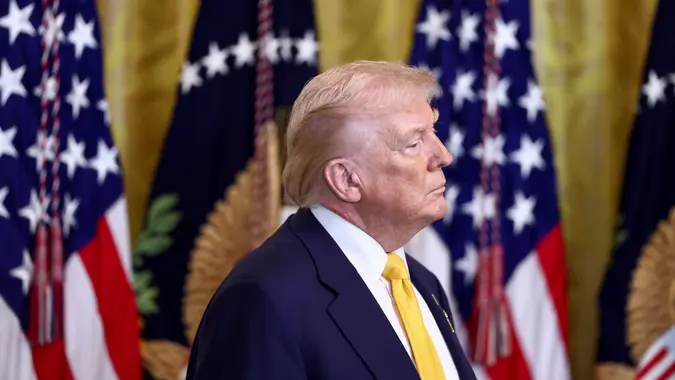
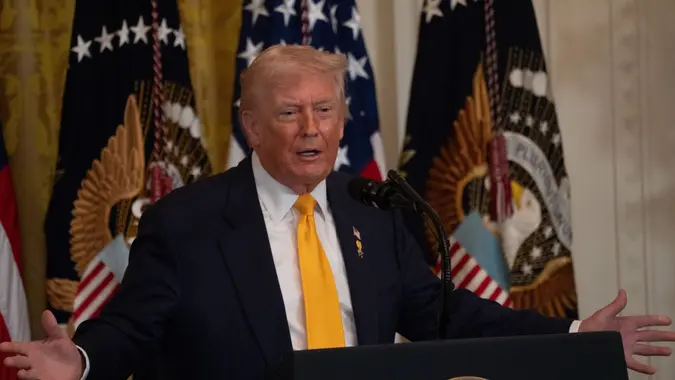
At the inaugural meeting of President Donald Trump’s newly formed Board of Peace, a committee aimed at promoting stability in the Middle East, the president announced that the United States will contribute $10 billion to help rebuild Gaza, NBC News reported. Details of the plan have not been shared and it’s unclear where the money will come from, but Trump compared the figure to the cost of fighting a war.
“It’s two weeks of fighting,” he said. “Sounds like a lot, but it’s a very small number.”
Worried the $10 billion will impact your wallet? Here’s what experts say.
Why It Won’t Raise Inflation
$10 billion seems like a lot of money, but according to Peter C. Earle, Senior Economist at the American Institute for Economic Research, it’s not when you look at the big picture.
“$10 billion outlay is economically negligible relative to a roughly $27 trillion U.S. economy and multi-trillion-dollar annual deficits,” he said. “Inflation pressures are driven far more by aggregate fiscal stance, monetary conditions and supply constraints than by a single, comparatively small appropriation.”
A finance expert also echoed that view, saying the spending is too small to influence prices meaningfully.
“$10 billion or 0.14% of extra spending is a rounding error in terms of aggregate demand and will not measurably affect inflation,” said Nicholas Juhle, Greenleaf Trust’s chief investment officer.
Why It Won’t Affect Mortgage Rates
Another concern is the effect $10 billion will have on mortgage rates, but the figure isn’t large enough to cause a ripple.
“Mortgage rates respond primarily to Federal Reserve policy, inflation expectations and broad borrowing needs, not to incremental spending of this scale,” Earle said.
Why It’s Unlikely to Trigger Tax Increases
In theory, new government spending increases the federal deficit unless it’s offset by higher taxes or spending cuts, but in this case, the $10 billion sum shouldn’t cause a change in tax rates.
“Any future fiscal adjustment would almost certainly be driven by structural imbalances rather than this single project,” Earle said.
What It Means for American Households
Americans have been battling a high cost of living and inflated prices for years, but the $10 billion pledge to Gaza should not have financial consequences for households, experts say.
“The direct financial impact would be imperceptible, as the scale is minuscule compared with a federal budget exceeding $6 trillion and a national public debt approaching $40 trillion,” Earle said.
In short, $10 billion amounts to less than a rounding error for macro-outcomes in the context of a $7 trillion annual federal budget.
“We’re basically talking about spending $100.14 instead of just $100,” Juhle said. He added, “The macroeconomy will not notice an extra $10 billion added to the $7 trillion annual bill, just as you would not notice an extra $0.14 added to your $100 dinner bill.”
While the amount seems extravagant, it’s too small for Americans to feel a difference in the federal budget.
Editor’s note on political coverage: GOBankingRates is nonpartisan and strives to cover all aspects of the economy objectively and present balanced reports on politically focused finance stories. You can find more coverage of this topic on GOBankingRates.com.
More From GOBankingRates