Trump Announces 10% Global Tariff — What Experts Say That Means for Your Wallet
 Written by
Laura Beck
Written by
Laura Beck
 Edited by
Angela Corry
Edited by
Angela Corry
Commitment to Our Readers
GOBankingRates' editorial team is committed to bringing you unbiased reviews and information. We use data-driven methodologies to evaluate financial products and services - our reviews and ratings are not influenced by advertisers. You can read more about our editorial guidelines and our products and services review methodology.

20 Years
Helping You Live Richer

Reviewed
by Experts

Trusted by
Millions of Readers
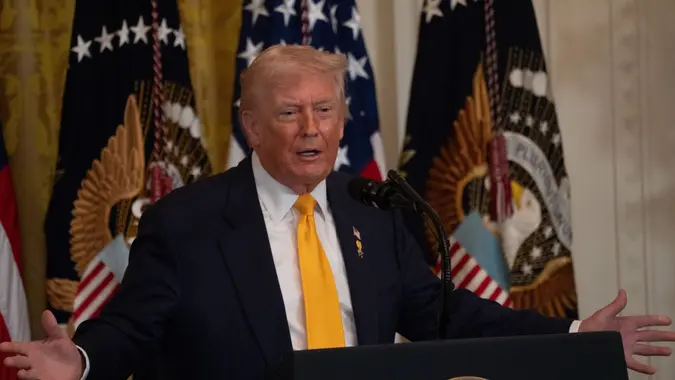
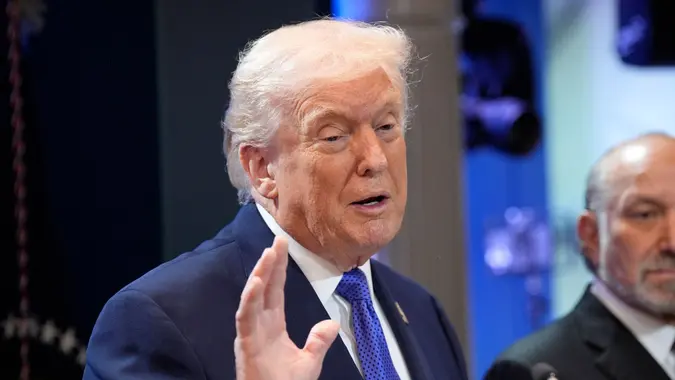
President Donald Trump’s response to the Feb. 20 decision by the Supreme Court to overturn his sweeping tariff program was to impose a temporary 10% global tariff on most imports under Section 122 of the Trade Act of 1974. This is a provision that allows tariffs of up to 15% for 150 days unless Congress extends them.
What Expert Analysis Says About the Impact
While there isn’t economic analysis on Trump’s specific replacement tariff yet, decades of research on how tariffs affect consumer prices shows a clear pattern.
According to the Federal Reserve Bank of Richmond‘s economic study, tariff costs get passed almost entirely to domestic consumers and businesses, not foreign exporters. Many economic studies of recent U.S. tariffs (particularly the 2018-2019 China tariffs) found that most of the cost was borne by U.S. importers and consumers, though the exact pass-through rate varied by product and over time.
Find Out: How Middle-Class Earners Are Quietly Becoming Millionaires — and How You Can, Too
Research from Harvard Business School on prior U.S. tariff rounds suggests that a 10% tariff does not translate into a 10% retail price increase. Instead, the overall inflation impact tends to be smaller though individual goods can see much larger increases.
How This Compares to Before
Before 2025, the U.S. had a weighted average tariff of just 1.5%, according to the Tax Foundation. Most major economies in the World Trade Organization average around 2.5% tariffs.
So, a flat 10% tariff on all imports is obviously higher than modern global norms. For context, in the decades after World War II, average global tariff rates were far higher than today (often above 20% in the late 1940s) before falling steadily through successive trade agreements to low single digits in most advanced economies by the 1990s.
The 150-Day Question
The new 10% tariff expires in five months unless Congress extends it. This creates uncertainty for businesses trying to plan purchasing and pricing decisions months ahead.
Trump also said he’s looking into tariff options through Section 232, which requires a Commerce Department investigation. This process takes longer but gives him another path to impose duties that could last beyond 150 days.
The Bottom Line for Your Wallet
Based on how tariffs have historically worked, a 10% tariff on all imports will likely push some prices higher. How much depends on what you buy and whether businesses absorb costs or pass them on to you.
The short duration creates its own problem. Companies won’t know if the 10% rate will stay or be replaced with something higher — or lower — in five months. That uncertainty can keep prices elevated as businesses hedge against future changes.
One thing is clear: while estimates vary, decades of economic research, including data from Yale’s Budget Lab, generally find that tariffs raise costs inside the importing country more than abroad.
Editor’s note on political coverage: GOBankingRates is nonpartisan and strives to cover all aspects of the economy objectively and present balanced reports on politically focused finance stories. You can find more coverage of this topic on GOBankingRates.com.
More From GOBankingRates