3 Money Experts’ Advice on What To Do With Your Tax Refund This Year
 Written by
Jamela Adam
Written by
Jamela Adam
 Edited by
Amen Oyiboke
Edited by
Amen Oyiboke
Commitment to Our Readers
GOBankingRates' editorial team is committed to bringing you unbiased reviews and information. We use data-driven methodologies to evaluate financial products and services - our reviews and ratings are not influenced by advertisers. You can read more about our editorial guidelines and our products and services review methodology.

20 Years
Helping You Live Richer

Reviewed
by Experts

Trusted by
Millions of Readers
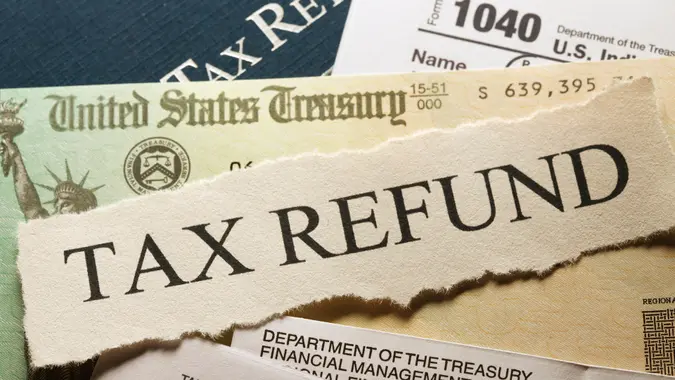
Tax season is here, which means you might be getting a tax refund soon. However, as top names in personal finance are quick to remind us, a refund is simply the government returning a 0% interest loan you gave it over the last year.
The Tax Foundation estimates that the average tax refund will grow from $3,052 in 2024 to $3,800 for tax year 2025, so it’s important to know what to do with that money.
Here is how the top money experts advise you to allocate your refund to maximize your long-term wealth.
Build an Emergency Fund
Certified financial coach Rachel Cruze says that the first thing you should do when you get a tax refund is to build an emergency fund.
“If you haven’t done baby step number one, which is to get a baby emergency fund of $1,000, do that,” she explained in a YouTube video. Once you’ve done that and paid off your debts, you can bump your emergency fund to at least three to six months’ worth of expenses.
Though many experts like Cruze suggest a standard three-month emergency fund, financial expert and television personality Suze Orman recommends saving even more.
“If you don’t have at least eight months of living expenses saved up, this is such a great use of any 2026 tax refund,” she said on her website. “It is always smart to have this cash cushion to deal with life’s curveballs, but I think it may be especially smart this year, as we are beginning to see signs of unemployment inching up.”
Ideally, your refund should be tucked away in a high-yield savings account or a money market account, where it is liquid but earning a competitive rate.
Pay for Insurance Premiums
“I know for many of you, just about every form of protection is costing more: car insurance, home insurance, and for those relying on the ACA marketplace for health insurance, premiums have risen as well,” Orman said.
So if you’re currently paying your insurance premiums on a monthly basis, consider using your refund to pay the entire annual premium upfront. Many insurers offer a “paid-in-full” discount of 5% to 10% for paying the full year at once.
Pay Down Your Debt
According to finance expert Dave Ramsey, tax refunds are a great way to pay off existing debt, such as student loans, credit cards, car loans and mortgages.
For example, if you have a $600 medical bill and a $3,200 credit card balance, a single refund of $3,800 could wipe out both debts in one afternoon. This way, you won’t have to worry about incurring expensive interest charges if you keep dragging out your repayment timeline.
Invest More for Retirement
If you’re debt-free and have already built up a solid emergency fund, Ramsey suggests putting your tax refund toward your retirement account.
He explains on his website that with an initial investment of a $3,200 tax refund followed by monthly contributions of the $266 you gained after adjusting your withholding, you can add almost $831,000 to your nest egg over 30 years. That’s just $95,760 of contributions, but more than $732,000 of growth.
And because your tax refund is money that has already been taxed, contributing it to a Roth allows it to grow and be withdrawn tax-free in retirement. For 2026, the contribution limit for a Roth IRA is $7,500. If you put a $3,000 refund into a Roth at age 30, that could grow to over $50,000 by age 60 (assuming an 8 to 10% return).
Bottom Line
A tax refund can feel like free money, but it’s actually just the government returning a 0% interest loan you provided throughout the year.
So don’t splurge your tax refund like you just won the lottery. Give every dollar a specific job and use your refund to help build a stronger financial future.
More From GoBankingRates