Warren Buffett: ‘People Shouldn’t Worry’ About US Credit Score Downgrade — Do Other Experts Agree?
 Written by
Dawn Allcot
Written by
Dawn Allcot
 Edited by
Daria Uhlig
Edited by
Daria Uhlig
Commitment to Our Readers
GOBankingRates' editorial team is committed to bringing you unbiased reviews and information. We use data-driven methodologies to evaluate financial products and services - our reviews and ratings are not influenced by advertisers. You can read more about our editorial guidelines and our products and services review methodology.

20 Years
Helping You Live Richer

Reviewed
by Experts

Trusted by
Millions of Readers
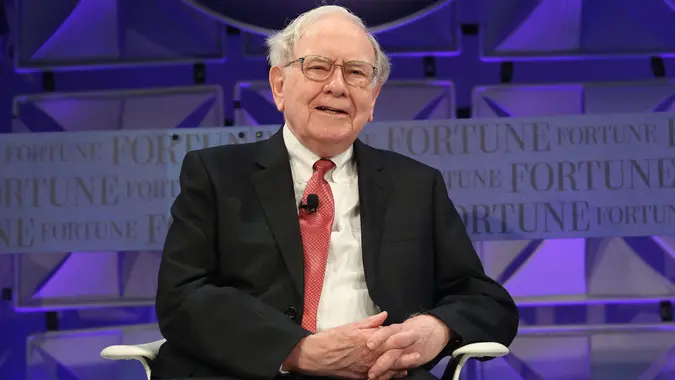
Billionaire investor Warren Buffett, the Oracle of Omaha, still has faith in the U.S. economy and the value of the U.S. dollar — if the recent actions of his company, Berkshire Hathaway, are any indication.
Berkshire Hathaway is a holding company for a diverse range of businesses, including insurance companies, RVs and consumer goods, to name a few. It has purchased $20 billion in U.S. Treasurys over the past two weeks, according to CNBC. More to the point, Buffett seems to be completely unconcerned about the U.S. government’s credit rating dropping from AAA to AA+, based on Fitch Ratings’ long-term-debt rating.
“There are some things people shouldn’t worry about,” Buffett told CNBC. “This is one.”
Experts agree that the credit rating is not cause for concern, in the face of the country’s low unemployment rates and steady growth of the U.S. gross domestic product.
Treasury Secretary Janet Yellen pointed out in a statement on Aug. 1 that the rating is “arbitrary and based on outdated data.” She added, “Fitch’s decision does not change what Americans, investors, and people all around the world already know: that Treasury securities remain the world’s preeminent safe and liquid asset, and that the American economy is fundamentally strong.” Yellen also cited low unemployment figures, inflation slowing and a strong GDP.
Larry Summers, who served as Treasury secretary for President Clinton, said in a post on the social media network X (formerly Twitter) that the downgrade is “bizarre and inept.” Noting in an interview with Bloomberg that the idea of the U.S. defaulting on its debt is “absurd,” he told the news outlet, “I can’t imagine any serious credit analyst is going to give this weight.”
Mohamed A. El-Erian, president, of Queens’ College, Cambridge, called the decision “surprising” in an interview with Yahoo Finance that was also shared on X.
While most economists and investors quoted in various news sources seem largely unconcerned about the credit downgrade, Quincy Krosby, LPL Financial’s chief global strategist, pointed out to Forbes that the downgrade does showcase some concerns in the longer term. “Ultimately, if the deficit isn’t contained taxes will be raised to the point that the engine of the U.S. economy, the all-important consumer, will have considerably less discretionary income.”
And while most economists agreed that the credit rating downgrade won’t have much effect on the stock market in the short term, Krosby told Fortune that if the U.S. takes on more debt, U.S. Treasury yields may rise to the point that they begin competing with the equity market.
Traditionally — and to this day — U.S. Treasurys are a stable and secure asset for risk-averse investors, while other equities provide opportunities for investors with a higher risk tolerance.
More From GOBankingRates