7 Cities Around the World With More Luxury Real Estate Than ‘Regular’ Homes
 Written by
Paige Cerulli
Written by
Paige Cerulli
 Edited by
Levi Leidy
Edited by
Levi Leidy
Commitment to Our Readers
GOBankingRates' editorial team is committed to bringing you unbiased reviews and information. We use data-driven methodologies to evaluate financial products and services - our reviews and ratings are not influenced by advertisers. You can read more about our editorial guidelines and our products and services review methodology.

20 Years
Helping You Live Richer

Reviewed
by Experts

Trusted by
Millions of Readers
Luxury real estate is expanding beyond pockets in popular cities scattered throughout the world. As demand for luxury living increases, luxury real estate has begun to dominate these spaces.
According to Knight Frank’s The Wealth Report 2025, the high-end luxury market has grown so much that some cities now have more luxury real estate than regular homes.
If you’re looking for luxury living, you’ll have plenty of options in these cities, where luxury real estate dominates.
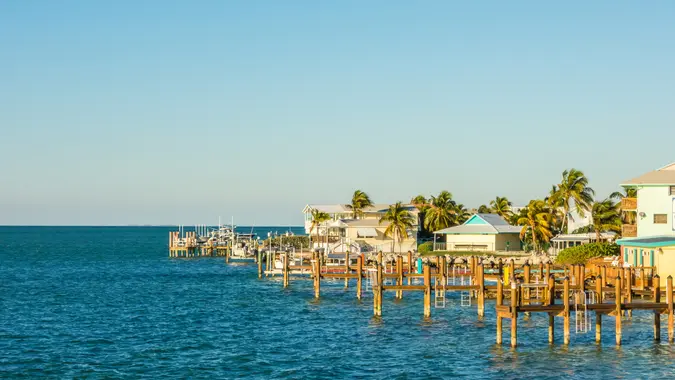
Miami, Florida
According to the report, the inflation and rising interest rates that occurred during and after the COVID-19 pandemic have shifted work, tax and lifestyle patterns in cities like Miami. As a result, luxury living is thriving in Miami, where property values have climbed dramatically from 2020 to 2025.
Dubai, United Arab Emirates
Dubai has experienced the same financial boost from the economic fluctuations that Miami saw. The Wealth Report 2025 identified Dubai as being the top market for five-year growth to Q4 2024; Dubai’s market experienced a 147% increase over the previous five years, meaning prices were 147% higher at the end of 2024 than they were in 2019. That growth has fast-tracked the luxury market.
Seoul, China
Seoul has also undergone significant economic growth which boosted its luxury market. The city ranks eighth among the top 10 markets for five-year growth, experiencing a 60.4% increase. The report also cited significant local wealth creation in the city, as well as the expansion of investable luxury residential developments.
Cities With Growing Luxury Markets
The report cited several other cities that are following the trend of a luxury-driven real estate market. Cities like Christchurch, New Zealand; Shanghai, China; and Los Angeles and San Francisco, California, are all thriving economically. Luxury real estate developers are eyeing these cities as the next hot spots, and as long as those cities continue to thrive, it’s likely that luxury real estate will soon dominate in those locations, too.
What’s Driving the Growth of Luxury Real Estate
Several factors are driving the growth of luxury real estate, resulting in cities where luxury properties outnumber regular homes. Daniel Ickowicz, CEO and broker of Elite International Realty, has 30 years of experience in the real estate market and specializes in luxury real estate, mainly in Florida. He explained that high-net-worth buyers from overseas and from other states want a safe, hard asset that they can trust.
“For instance, a condo in Miami or a house in Texas feels safer than keeping everything in their home country or just in the stock market,” he said.
Ickowicz said that taxes and policy also play a role. Higher-income residents might be attracted to states with no income tax and a business-friendly approach, like Florida and Texas.
Another factor is at work in certain locations, too: the role of media. Alaina McBride, a licensed real estate agent in Wyoming and a broker in California, is a real estate developer and property manager with 20 years of experience. McBride, who lives in Jackson Hole, Wyoming, described the impact of “The Yellowstone Effect.”
“The TV series inspired viewers to live the Western lifestyle and encouraged the rediscovery of the West during COVID,” she explained. “Wyoming was open for business while major cities felt unsafe.”
The income inequality in areas like Teton County, Wyoming, is eye-opening. According to Economic Policy Institute data, the top 1% of the population in Teton County makes 142.2 times more than the bottom 99% of the county’s population. The top earns an average income of $22,508,018, while the average income of the bottom 99% is $158,290 (and even this number is significantly dragged up by the rich portion of that 99%).
Benefits of Luxury City Living
According to Ickowicz, luxury clients look for lifestyle, convenience and privacy when they buy a home. Lifestyle might encompass good restaurants, events and desirable amenities, while convenience often consists of a full-service building including concierge, valet, gym, spa, package handling, in-house housekeeping or wellness. In terms of privacy, clients often look for buildings with security, gated access, private elevators and other features to create a sense of safety in the homes.
Moving to these cities with extensive luxury living options comes with numerous benefits.
“Living in a luxury real estate destination means better services, better infrastructure and a wider range of high-quality options for dining, culture, healthcare and schools surround you,” Ickowicz explained.
Such factors lead to an enhanced quality of life. Luxury real estate settings also offer buyers a resale advantage.
“In luxury markets, there’s always a large pool of buyers who are specifically hunting in those areas,” said Ickowicz. “If you sell, you don’t have to explain why the location is special because the market already knows.”
The Downsides of Luxury Dominance
While the dominance of luxury real estate offers benefits to buyers, it can have negative impacts on others who live in the area. McBride explained that dominance of luxury real estate creates a two-class community consisting of billionaires and the service class. In a location like Teton County, she said that quality healthcare isn’t available and rents are extraordinarily high.
“Seniors are being pushed out due to increasing property tax bills and lack of senior services,” McBride said. “Tradespeople are in high demand and often unreliable since they have too much work.”
“Success at the top can create pressure at every other level,” added Ickowicz. Prices and property taxes in these cities can increase, squeezing local families who have lived in the areas before the dominance of luxury real estate. In fact, workers like teachers, nurses, hospitality workers and others often can’t live near the luxury areas, resulting in longer commutes and frustration.
Ickowicz said that city planning can also result in headaches.
“If the city doesn’t plan appropriately with zoning, transport and schools, it can feel like the luxury developments are outrunning everything else,” he said.
An emphasis on luxury real estate can reshape an area over time, leading to new challenges. It’s a growing trend that more cities are likely to need to navigate in the coming years.
More From GOBankingRates