I Asked ChatGPT To Identify 4 Safe and Beautiful Cities for the Working Class — Here’s What It Said
 Written by
Sean Bryant
Written by
Sean Bryant
 Edited by
Cory Dudak
Edited by
Cory Dudak
Commitment to Our Readers
GOBankingRates' editorial team is committed to bringing you unbiased reviews and information. We use data-driven methodologies to evaluate financial products and services - our reviews and ratings are not influenced by advertisers. You can read more about our editorial guidelines and our products and services review methodology.

20 Years
Helping You Live Richer

Reviewed
by Experts

Trusted by
Millions of Readers
A strange kind of fatigue has settled over working Americans. Wages aren’t keeping pace with housing, and safety concerns are pushing many to reconsider where they live.
Practical, sustainable livability for the working class is getting harder and harder to find in major cities, but there are a few places where housing prices are manageable, crime rates are lower and the surroundings are genuinely pleasant.
To get a clearer picture of where those places might be, we turned to ChatGPT and asked it to sift through recent studies on affordability, safety and overall livability.
What Makes a City ‘Safe and Beautiful’ for Working Class People?
When people talk about an ideal place to live, the conversation often circles back to a few things:
- Affordable housing that fits middle-class budgets
- Low violent and property crime rates
- Local employment to lower commute times
- Reasonable costs of living
- Clean and well-maintained parks, trails, natural scenery and public spaces
4 Cities That Actually Work for the Working Class
After running the criteria through ChatGPT, four cities emerged as strong contenders. Each of them appears repeatedly in studies, confirming they’re not just affordable on paper, but functionally livable for working households.
1. Westminster, Colorado
Westminster, Colorado, which sits adjacent to mountain towns like Denver and Boulder, might grant you scenic Front Range views, lakes and an extensive network of trails amid plenty of nature without the relative high housing costs of surrounding areas, but ChatGPT’s analysis comes with quite a caveat. Despite what the AI claimed, further analysis showed Westminster should hardly be framed as among the safest large cities.
Recent CrimeGrade.org analysis noted an overall crime rate well beyond the U.S. average, ranking in the 6th percentile for safety (meaning 94% of U.S. cities are safer). Yes, safety varies tremendously by neighborhood, but prospective movers would be wise to review block-level crime data before accepting ChatGPT’s take at face value.
2. Rochester, Minnesota
Rochester combines a strong job base — thanks to the Mayo Clinic and related industries — and impressive livability scores. Meanwhile, while estimates on cost of living vary by methodology, several indexes put it near the national average, with some slightly below and others slightly above.
Numerous ranking services such as Niche consider it among the best places in the country to raise a family thanks to affordable housing, parks, job stability, diversity and public schools.
3. Broken Arrow, Oklahoma
If you prefer the South or Midwest and want a safe, affordable living, Broken Arrow might be the place for you. It has a low cost of living (14% to 15% below the national average, per BestPlaces.net) and according to the city’s website, is “among the safest cities in the South, with a low violent crime rate (2.06 incidents per 1,000 people).”
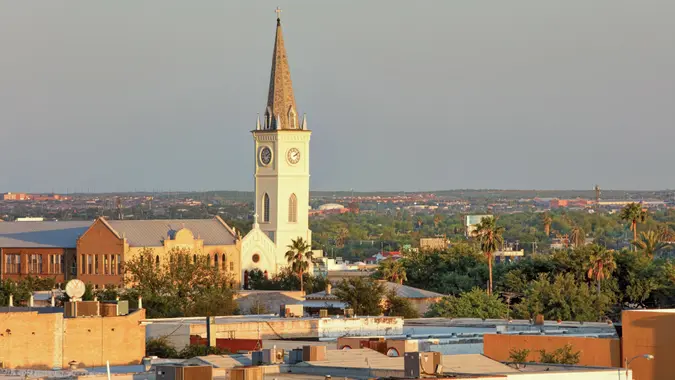
4. Laredo, Texas
Finally, Laredo ticks the affordability box hard. A recent GOBankingRates study placed annual living costs for homeowners at about $36,008 and renters at about $36,888, making it one of the lowest-cost prominent cities in the US.
Not only is it affordable, but Laredo’s livability score is also well above the national averages due to its lower crime rates. Laredo’s population is 250,000, making it one of the biggest border towns in the country — not to mention full of rich culture and friendly people.
Safety and Beauty Still Vary by Neighborhood
As mentioned when referring to Westminster, citywide statistics are helpful, but they can’t tell the full story. A place might look great on a rankings list and still have pockets where crime is higher or areas where housing is cheap, but job opportunities are nonexistent.
But the opposite can be true, too. Cities with bad reputations often have plenty of neighborhoods that are safe, family-oriented and far more affordable than their zip-code averages suggest.
How To Pick a City That’s Right for You
Once a city makes your shortlist, do some research beyond ranking charts. Look at recent crime data at the neighborhood level and not just the city level. Pull up maps showing where schools, parks, shopping malls, entertainment centers and other essential services are actually located. Talk to people who live there and, if you can, walk a few blocks at different times of day.
More From GOBankingRates