We Lost Our Home in a Wildfire: Here’s the Harsh Reality of Mortgage Relief
 Written by
Gabrielle Olya
Written by
Gabrielle Olya
 Edited by
Brendan McGinley
Edited by
Brendan McGinley
Commitment to Our Readers
GOBankingRates' editorial team is committed to bringing you unbiased reviews and information. We use data-driven methodologies to evaluate financial products and services - our reviews and ratings are not influenced by advertisers. You can read more about our editorial guidelines and our products and services review methodology.

20 Years
Helping You Live Richer

Reviewed
by Experts

Trusted by
Millions of Readers
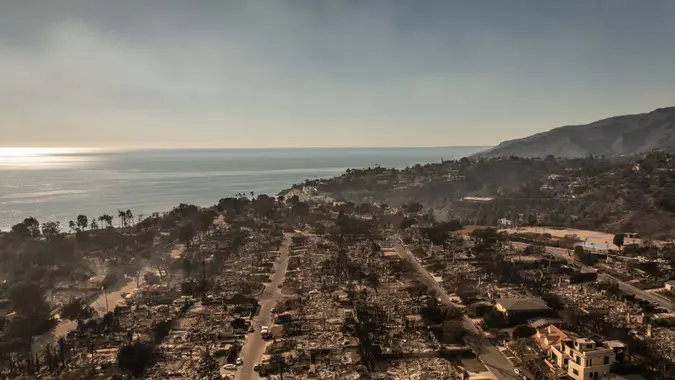
When Rachel Jonas and Rob Fagnani lost their home in California’s Palisades fire in January of 2025, they assumed mortgage relief would help. Instead, they’re facing the possibility of paying a year’s worth of mortgage payments on a home that no longer exists.
That’s because California law mandates only 12 months of mortgage forbearance — even though rebuilding after a wildfire typically takes two to three years.
Jonas and Fagnani are now fighting to change mortgage relief laws on a federal level. GOBankingRates spoke with them about why the current system doesn’t work, and why it matters to homeowners across the U.S.
Why Mortgage Relief Fails Disaster Survivors
The biggest issue, according to Fagnani, is the lack of a universal process for homeowners who lose their homes in federally declared disasters.
“There’s a process called forbearance, which does provide some relief,” he said. “However, relative to the situation, the forbearance relief is not enough.”
Forbearance is an agreement with your lender to temporarily pause or reduce mortgage payments, mainly due to hardship.
Homeowners in This Situation Are Dealing With Multiple Financial Stressors
“We surveyed over 130 homeowners in the Palisades and Altadena,” Jonas said. “These are all people who will likely not be back in their homes for two to three years — or even longer for many.”
Jonas said that most survivors face multiple financial stressors at once:
- Paying mortgages on homes that no longer exist
- Paying rent for temporary housing
- Covering insurance gaps and rebuilding costs

The Hidden Cost: Balloon Payments After Forbearance
When the forbearance period ends, homeowners could face a massive balloon payment for all deferred mortgage payments. In some cases, that could mean $50,000 to $100,000 due at once.
California law protects homeowners from balloon payments for 12 months, but after that, it’s unclear what they could be on the line for. However, it’s likely that options will be limited: pay the lump sum, extend forbearance or defer payments to the end of the loan — and the latter two options can cause a major hit to the borrower’s credit score.
Since many survivors need loans for rebuilding, a credit hit can make borrowing for their new construction more expensive.
“They’re all tough options to swallow,” Fagnani said.
A Federal Fix for Mortgage Relief Gaps
Jonas and Fagnani propose a federal measure that would:
- Extend mortgage forbearance to two to three years to match rebuilding timelines
- Allow deferred payments to be added to the end of the loan without credit impact
“It’s a fair trade,” Fagnani said. “The bank moves money to the end of the loan at current interest rates, and survivors get breathing room to rebuild.”
Most mortgages are backed by federal agencies like Fannie Mae and Freddie Mac, so federal action could standardize relief nationwide.
“This could happen to anyone in any state,” Fagnani said. “And disaster recovery is a long road.”
To learn more and to send a form letter to your senators and representatives supporting these changes, visit DisasterMortgageRelief.com.
More From GOBankingRates