5 Key Signs a Balance Transfer Is a Smart Move for Your Finances
 Written by
Caitlyn Moorhead
Written by
Caitlyn Moorhead
 Edited by
Ashleigh Ray
Edited by
Ashleigh Ray

Commitment to Our Readers
GOBankingRates' editorial team is committed to bringing you unbiased reviews and information. We use data-driven methodologies to evaluate financial products and services - our reviews and ratings are not influenced by advertisers. You can read more about our editorial guidelines and our products and services review methodology.

20 Years
Helping You Live Richer

Reviewed
by Experts

Trusted by
Millions of Readers
If you have credit card debt, improving your financial situation might feel overwhelming. Trying to pay down your balance while facing double-digit interest rates isn’t easy.
However, a balance-transfer credit card can help. Choosing one like the Navy Federal Credit Union Platinum Credit Card allows you to enjoy a low introductory APR — 0.99% for the first 12 months on balances transferred within 60 days of account opening1 (after that, a variable APR between 10.24% and 18% applies) — so you can redirect your hard-earned money toward paying down the balance instead of just the high interest. On average, Navy Federal members save $1,868 over the promotional period by transferring their balance to the Platinum Credit Card.2
Why Credit Card Interest Rates Are So High
If you feel like credit card APRs are steadily increasing, you’re right. In 2013, the average APR was 12.9%, but it nearly doubled to 22.8% in 2023, according to the Consumer Financial Protection Bureau. Rates have continued to climb since: The CFPB’s most recent report* found the average APR reached 25.2% for general-purpose cards in 2024 — the highest level since at least 2015.
Average credit card debt per borrower is also on the rise, according to TransUnion**. As of the third quarter of 2025, the average debt per borrower was $6,523, up from $4,828 in the second quarter of 2021.
If you’re tired of seeing a large portion of your credit card payments go toward interest, opening a balance-transfer card like the Navy Federal Credit Union Platinum Credit Card could be a smart financial move.
Here are some signs it’s a good fit for you:
1. You’re Carrying Balances on Multiple Credit Cards
Having credit card debt can be tough, and it’s even more challenging when you’re carrying a balance on multiple cards. A balance-transfer card allows you to consolidate your debt so you have just one monthly payment.
This means you won’t have to juggle multiple due dates, making it easier to remember to pay your bill on time. Even better, consolidating your credit card payments into one could reduce the total amount of interest you’ll pay.
2. Your High-APR Credit Card Has a Significant Balance
If your current credit card has both a substantial outstanding balance and a high APR, much of your monthly payment goes toward interest. This can make it hard to pay off your debt, but a balance transfer can help.
Moving your balance to a credit card with a lower APR lets you pay down debt faster. For example, the Navy Federal Credit Union Platinum Credit Card offers a 0.99% intro APR for 12 months from account opening on balances transferred within 60 days. After that, a variable APR between 10.24% and 18% applies.
3. You’re Looking to Improve Your Credit Utilization
If your credit utilization isn’t great, a balance transfer may help. Your new balance-transfer credit card may offer a higher credit limit than your existing card(s), increasing your total available credit.
This matters because credit utilization plays a key role in both VantageScore and FICO credit scoring models. Plus, the lower interest rate on your balance-transfer card allows you to pay down the balance faster, boosting your available credit, which can improve your utilization ratio.
4. You Want to Pay Off a Large Purchase Over Time
When you need to make a large purchase, your budget isn’t always equipped to handle the upfront cost. For example, if your washing machine unexpectedly breaks and you need to replace it, you might not have the funds to pay for it in full.
In this case, a balance-transfer card can help you make payments while incurring minimal interest. Simply transfer the balance over to your new card and calculate how much you’ll need to pay each month to settle your debt during the introductory APR period.
5. You’re Not Happy With the Terms and Rewards on Your Current Card(s)
Carrying a balance on a credit card isn’t ideal, but it’s even worse when you’re not happy with the card itself. A balance transfer is your way out of this situation without having to wait years to pay off your debt.
The Navy Federal Credit Union Platinum Credit Card allows you to transfer your balance without a fee. You’ll also pay no annual fee, no foreign-transaction fees and no cash-advance fees1, plus you get perks like collision damage waiver and travel and emergency assistance3.
How to Get Started
Sometimes carrying a credit card balance is unavoidable. If you know you won’t pay off your credit card debt for a while, the Navy Federal Credit Union Platinum Credit Card offers the low rates you need to avoid excessive interest charges.
If you’re a Navy Federal Credit Union member, you can see if you prequalify for this balance-transfer card before submitting an application. You’ll answer three quick questions, and although a credit check will be performed, it won’t impact your credit score.
The Bottom Line
A balance-transfer credit card can be a savvy financial choice. If you have average to excellent credit and plan to carry credit card debt for the foreseeable future, this move could improve your financial situation in more ways than one.
Of course, balance transfers aren’t for everyone. Be sure to consider your unique financial situation before making a decision. This will help you choose the credit card that best fits your needs.
This content is intended to provide general information and should not be considered legal, tax, or financial advice. It is always a good idea to consult a tax or financial advisor for specific information on how certain laws apply to your situation and about your individual financial situation.
1 As of 2/3/2026, rates range from 10.24% APR to 18.00% APR, are based on creditworthiness, and will vary with the market based on the U.S. Prime Rate. ATM cash advance fees: None if performed at a Navy Federal branch or ATM. Otherwise, $0.50 per domestic transaction or $1.00 per foreign transaction. Balance transfer offer: Application must be submitted by 01/03/2027. Offer valid for balances transferred from non-Navy Federal credit cards within 60 days of account opening. Maximum total transfer amount is limited to your available credit line. Balance transfers using convenience checks are excluded from this offer. If you transfer a balance with this offer, interest will be charged on purchases made with your credit card unless your purchases have a 0% APR or you pay the entire balance, including any transferred balances made under this offer, in full each month by the payment due date. Limit of one promotional offer at account opening. Navy Federal reserves the right to change or end this offer at any time without notice.
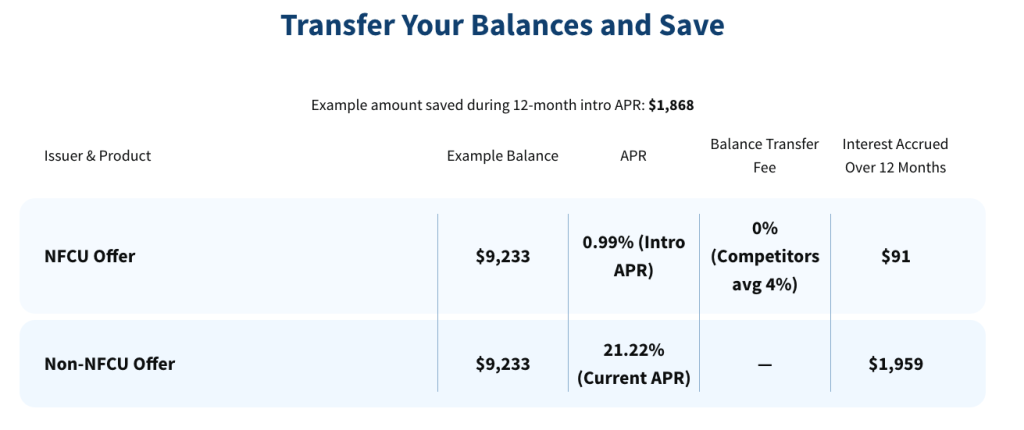
2 This table is for illustrative purposes; your situation may differ. Savings claim uses a $9,233 balance transfer amount, which was the average amount transferred to Navy Federal Platinum Cards within the first 60 days of account opening in 2025. The Interest Accrued amounts and the $1,868 example savings assume no additions to and no payments made toward the transferred balance during the 12-month promo APR period.
3 Certain terms, restrictions, and exclusions apply. Please refer to the card’s Benefits Site or Guide at navyfederal.org for more information.
* https://files.consumerfinance.gov/f/documents/cfpb_consumer-credit-card-market-report_2025.pdf
**https://newsroom.transunion.com/q3-2025-ciir/
More From GoBankingRates