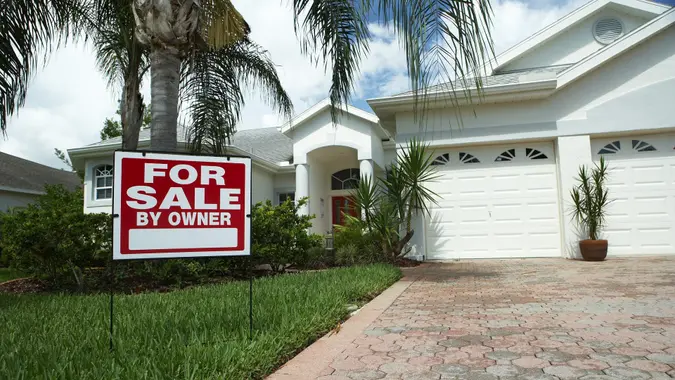
What Downsizing Your Home Too Early Really Costs You in Retirement Flexibility
 Written by
Daria Uhlig
Written by
Daria Uhlig
 Edited by
Angela Corry
Edited by
Angela Corry

Commitment to Our Readers
GOBankingRates' editorial team is committed to bringing you unbiased reviews and information. We use data-driven methodologies to evaluate financial products and services - our reviews and ratings are not influenced by advertisers. You can read more about our editorial guidelines and our products and services review methodology.

20 Years
Helping You Live Richer

Reviewed
by Experts

Trusted by
Millions of Readers
Retirees downsize to free up equity, reduce housing costs and make maintaining a home easier. But downsizing too soon can lead to regret if it limits your financial and lifestyle choices in ways you didn’t anticipate.
Here’s how downsizing early can cost you your hard-earned retirement money.
High Cost of Buying and Selling a Home
Selling your home costs 10% to 15% of the sale price, according to Redfin. On the buying side, expect to pay 2% to 5% in closing costs if you’ll finance the new home, per Fannie Mae. A cash sale has fewer closing costs, but you’ll still pay a transfer tax and title fees.
If this move turns out not to be one you want to make permanent, you’ll have to pay these expenses twice, possibly at the expense of other financial priorities.
A Smaller Home Can Strain Your Budget
Active retirees often move for dual purposes — to scale down, and to live in a community with lots of amenities, per AARP. Such communities often have higher taxes and insurance costs, as well as steep homeowners or condo association fees. Often, those fees support more amenities than you’ll use, which could force you to limit spending on activities you really enjoy.
You Might Lose an Important Safety Net
At first glance, downsizing your home and investing the leftover equity seems like a good idea. After all, stocks usually appreciate faster than real estate, as an Invesco analysis showed. However, home equity serves an important role in your portfolio.
Real estate values move independently of the stock market, so when stocks do poorly, real estate might do well, which mitigates your losses. And while the amount of equity you have changes with market fluctuations, $1 of equity is always worth $1. When the stock market is down, you can spend your equity — accessed through a home equity line of credit, or reverse mortgage, as Fairway recommends — instead of selling securities at a loss.
You Could Lock Into a Lifestyle Before You’re Ready
Retirement is as much of a process as it is an event. Downsizing too soon could prematurely lock you into a particular lifestyle, and force you to give up space and belongings, you might later regret.
In an article for the University of Washington Retirement Association, professor emeritus Terri Mitchell described three phases of retirement.
The early phases are times of transition, which can be rocky, then reinvention as you settle into new relationships and routines. Downsizing at this point, while you’re in the throes of freedom from work, might be tempting. But it’s not until the third and final phase, when health begins changing, and you know which people and activities matter most to you, that most retirees have a clear sense of where they want to live and the kind of house they want or need to live in.
Takeaway
Downsizing makes sense for some retirees, but timing is key. Selling too soon could strain your finances and force you to settle for a home and lifestyle that may not meet your changing needs.
More From GOBankingRates