How Much Does the Average Rich Person Invest In Real Estate?
 Written by
Jordan Rosenfeld
Written by
Jordan Rosenfeld
 Edited by
Molly Sullivan
Edited by
Molly Sullivan

Commitment to Our Readers
GOBankingRates' editorial team is committed to bringing you unbiased reviews and information. We use data-driven methodologies to evaluate financial products and services - our reviews and ratings are not influenced by advertisers. You can read more about our editorial guidelines and our products and services review methodology.

20 Years
Helping You Live Richer

Reviewed
by Experts

Trusted by
Millions of Readers
Financial experts frequently cite the power of real estate investing to truly build wealth. Real estate is one of the most reliable assets to gain in value over time, especially if one is able to buy in at a reasonable mortgage rate. While many people own an individual home, the wealthy tend to hold more real estate.
For those who want to understand how much real estate the wealthy typically hold and what everyday investors can learn from it, we took a look at just how much the average rich person invests in real estate.
There’s Rich and There’s the Top 1%
Clarifying wealth tiers can help to explain how real estate fits into each group’s overall strategy.
For starters, “rich” is a vague term. In some states, a household may only need around $113,000 to reach the top 20%, while in others, it takes close to $700,000 to land in the top 5%. At the very top are the true high-net-worth households, the top 1%, whose wealth ranges from many millions into the billions. For clarity, this article separates “rich” into two groups: the upper class (95th to 99th percentile) and the top 1%.
How the Upper Class Invests In Real Estate
Upper-class households, those in the 95th to 99th percentiles, have a net worth between about $2.5 million and $10 million, according to Redfin’s analysis of the Federal Reserve’s Survey of Consumer Finances. They invest substantially more in real estate than middle-income households in dollar terms, but far less in relative terms.
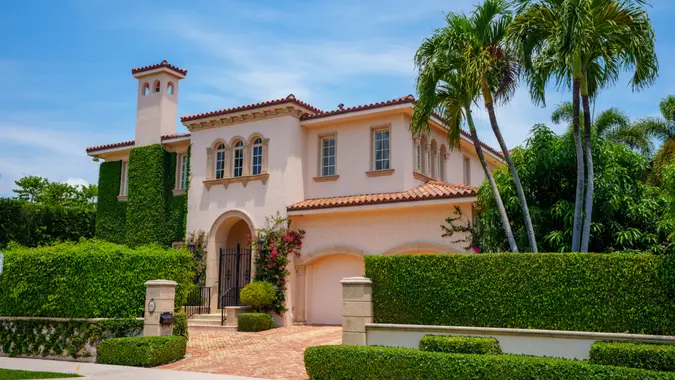
Real estate represents about 19.8% of their total wealth on average. Using those proportions, a household at the lower end of this bracket typically has around $500,000 invested in real estate, while those toward the upper end may hold around $2 million. This often includes a primary residence plus one or more additional properties, such as second homes, vacation homes or rental units that generate passive income.
Why Upper-Class Investors Don’t Rely Solely on Real Estate
For this group, real estate is important but not dominant. Upper-class investors intentionally avoid concentrating too much wealth in property and instead build balanced portfolios that include stocks, bonds, retirement accounts and other financial assets to reduce risk and improve long-term returns.
Because they have greater financial flexibility, these investors also diversify into alternative or higher-growth areas such as REITs, technology sectors and private investments. This helps explain why real estate is a key part of building wealth, but not the primary engine of net-worth growth.
How the Top 1% Invests In Real Estate
The top 1% hold vastly more wealth but real estate represents a surprisingly smaller portion of their portfolios. Federal Reserve data shows that the top 1% hold only about 12.3% of their net worth in real estate. This is not because they own fewer properties; rather, their other assets grow so large that real estate becomes comparatively less significant.
Why the Ultra-Wealthy Rely Less on Real Estate
For the ultra-wealthy, real estate plays a different role. Their portfolios are dominated by business ownership, private equity stakes and substantial stock market holdings, which offer higher long-term growth potential than real estate. These assets scale in ways property generally can’t.
Federal Reserve analysis confirms that among the wealthiest households, financial and business assets expand much faster than property holdings, making real estate a relatively smaller piece of the puzzle even when the dollar amounts remain high.
What the Average Investor Should Do
While everyday investors may not have millions to allocate, they can learn from the patterns of the wealthy:
- Build a balanced portfolio: Real estate can be a strong wealth-building tool, but it shouldn’t be your only one. Complement property ownership with retirement accounts, stock market investing and diversified funds.
- Avoid over-concentration: Many middle-class households have most of their net worth tied up in home equity. As your financial situation improves, gradually shift toward a more diversified asset mix.
- Think in terms of income and appreciation: The wealthy use real estate for rental income and long-term growth. Even one well-chosen rental property can strengthen an average investor’s financial foundation.
- Focus on long-term strategy, not quick wins: Upper-income and ultra-wealthy investors build wealth through decades of steady, diversified growth — not by betting everything on one asset class.
The rich may invest heavily in property, but they also balance it with broader investments. The ultra-rich do the same, relying even more on business and market-based assets to drive their wealth forward. For everyday investors, real estate can be a powerful start, but diversification is what builds long-term financial stability.
More From GOBankingRates