I Asked ChatGPT How Many Americans Qualify for the Trump $2K Dividend — Here’s What It Said
 Written by
Kerra Bolton
Written by
Kerra Bolton
 Edited by
Rebekah Evans
Edited by
Rebekah Evans

Commitment to Our Readers
GOBankingRates' editorial team is committed to bringing you unbiased reviews and information. We use data-driven methodologies to evaluate financial products and services - our reviews and ratings are not influenced by advertisers. You can read more about our editorial guidelines and our products and services review methodology.

20 Years
Helping You Live Richer

Reviewed
by Experts

Trusted by
Millions of Readers
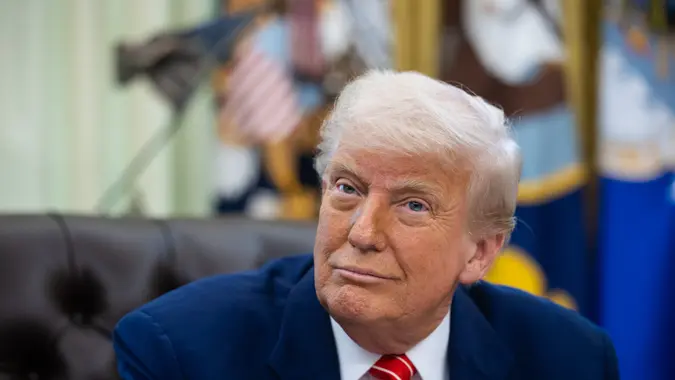
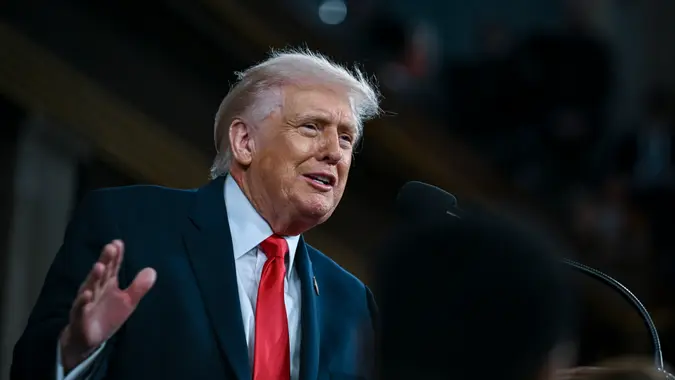
President Donald Trump’s proposed $2,000 “tariff dividend” has Americans wondering who would actually get a check and when.
To find out, I asked ChatGPT to crunch the numbers.
The artificial intelligence’s (AI) estimate was eye-opening: roughly 150 million people could qualify based on income limits now under discussion. That’s nearly half the country, but whether anyone actually sees the money depends on Congress, the courts and the math. Find out more about what ChatGPT shared below.
ChatGPT’s Calculation
ChatGPT based its projection on the income cap floated by Treasury Secretary Scott Bessent — households earning under $100,000 a year, as reported by Reuters. Using Census data, that covers about 150 million Americans.
At $2,000 each, the total cost would reach roughly $300 billion.
That figure tracks with earlier expert estimates and the same problem: tariff revenue likely won’t cover the bill. According to Alex Duarte, senior economist at the Tax Foundation, the plan could fall nearly $90 billion short of what’s needed to fund every qualifying household, per the Los Angeles Daily News.
Why It Matters for Your Wallet
Even if Congress eventually approves the program, the payment might not stretch as far as it sounds.
Inflation is expected to hover near 3% in 2026, per the Information Technology and Innovation Foundation (ITIF) — and tariffs could drive up prices on imported goods that families buy every week, from appliances to groceries.
For households already living paycheck to paycheck, a $2,000 check could help cover overdue bills or chip away at high-interest debt. But financial planners say the better takeaway is to treat the debate as a financial-readiness test.
Use this moment to:
- Build a small emergency fund before you need it.
- Pay down revolving balances so you’re not depending on one-time relief.
- Verify information only through official .gov sources to avoid scams promising “early access” to a dividend.
Whether or not the checks materialize, these are the same moves that keep households steady through any economic uncertainty.
The Roadblocks Ahead
So far, the proposal faces two major hurdles.
Congress: Lawmakers would need to sign off on any nationwide payment program, a tough ask after a year of record federal spending. Policy analysts said that finding room in the budget for hundreds of billions of dollars in new checks would require cutting elsewhere or increasing borrowing.
Supreme Court: The administration’s tariff authority is currently under review. The Court’s decision could determine whether there’s enough legal room or any revenue at all, to fund the checks.
Nevertheless, President Trump promised that the government would start issuing the checks starting in mid-2026, as reported by Axios.
What ChatGPT’s Answer Really Shows
ChatGPT can run the numbers, but it can’t predict politics or household realities. Its 150-million estimate reveals how many Americans fall into the income range that still needs financial breathing room.
That explains why the idea of a “dividend” resonates: it promises quick relief in an economy where wages have struggled to keep up with costs and where nearly half of households say they couldn’t cover a $1,000 emergency without borrowing.
Even if the proposal advances, economists caution it would be a short-term boost at best — helpful for catching up on bills, not for building wealth. The smarter long-term play is steady saving, manageable debt and cautious spending regardless of political promises.
Editor’s note on political coverage: GOBankingRates is nonpartisan and strives to cover all aspects of the economy objectively and present balanced reports on politically focused finance stories. You can find more coverage of this topic on GOBankingRates.com.
More From GOBankingRates