A Government Shutdown Is Imminent – Why This One Could Hit Your Wallet Differently
 Written by
Travis Woods
Written by
Travis Woods
 Edited by
Angela Corry
Edited by
Angela Corry
Commitment to Our Readers
GOBankingRates' editorial team is committed to bringing you unbiased reviews and information. We use data-driven methodologies to evaluate financial products and services - our reviews and ratings are not influenced by advertisers. You can read more about our editorial guidelines and our products and services review methodology.

20 Years
Helping You Live Richer

Reviewed
by Experts

Trusted by
Millions of Readers
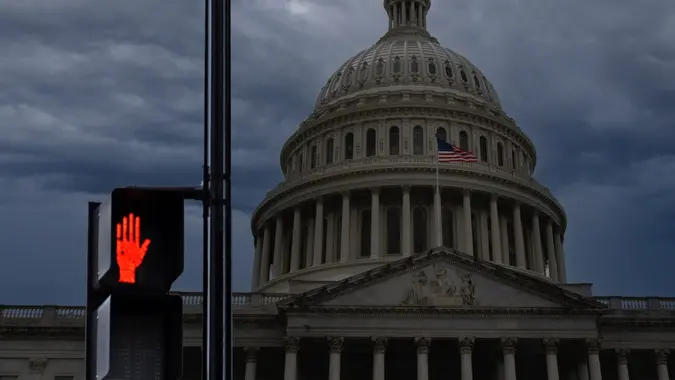
Just a few months after the longest government shutdown in American history, the U.S. government is yet again teetering on the brink of another shutdown. Lawmakers have been unable to agree upon funding for the Department of Homeland Security (DHS) and its controversial office of Immigration and Customs Enforcement (ICE) and must do so before the fiscal year deadline: midnight on Friday, Jan. 30. Should they fail, the government will once again come to a funding standstill.
This time, however, a shutdown will hit households and markets differently.
Unlike prior shutdowns, wherein data-producing agencies maintained funding (or were already funded), this potential shutdown would cut funds to critical economic agencies like the Department of Labor, per Yahoo Finance. As a consequence, key reports like monthly jobs data, inflation numbers and unemployment figures would be delayed at best or skipped at worst, which could devastate everything from the Federal Reserve’s policymaking to the investment decisions made by everyday Americans.
While other parts of the government, such as the Commerce Department, are already funded through a variety of other separate bills, shutting down departments like Labor would create a fragmented, volatile economy, creating uncertainty in household budgets and savings. Additionally, these prolonged and near-continuous shutdowns can handicap overall economic growth, bringing down the GDP with each passing week.
The result of this fragmented economy? Delayed economic data (which could be devastating for investment decisions and the Federal Reserve), extreme market instability and slower government services. In short, this shutdown would be altogether different than what Americans have experienced before, because it would remove the very tools we use to understand what is happening economically.
Editor’s note on political coverage: GOBankingRates is nonpartisan and strives to cover all aspects of the economy objectively and present balanced reports on politically focused finance stories. You can find more coverage of this topic on GOBankingRates.com.
More From GOBankingRates