3 Key Points in Trump’s Davos Speech That Will Impact Your Wallet Right Now
 Written by
Heather Altamirano
Written by
Heather Altamirano
 Edited by
Angela Corry
Edited by
Angela Corry
Commitment to Our Readers
GOBankingRates' editorial team is committed to bringing you unbiased reviews and information. We use data-driven methodologies to evaluate financial products and services - our reviews and ratings are not influenced by advertisers. You can read more about our editorial guidelines and our products and services review methodology.

20 Years
Helping You Live Richer

Reviewed
by Experts

Trusted by
Millions of Readers
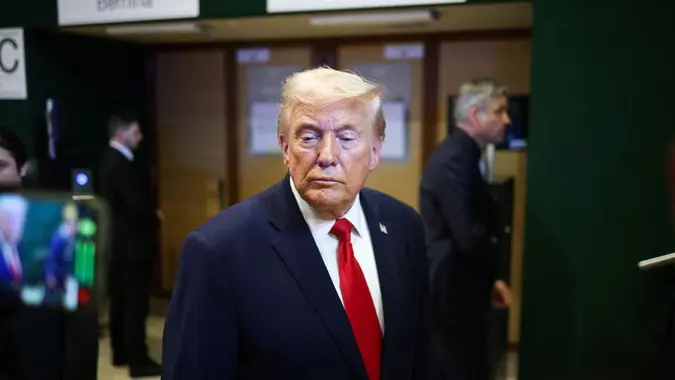
On Wednesday, Jan. 21, President Donald Trump delivered a lengthy, 72-minute speech at the World Economic Forum (WEF) in Davos, Switzerland, covering a wide range of topics with potential implications for Americans’ finances. From Greenland to tariffs, the president touched on three key issues that experts say could directly affect your wallet.
Greenland Tensions Cool, Giving Markets a Breather
Trump’s long-standing interest in acquiring Greenland stems from his view that the island is critical to U.S. national security due to its strategic Arctic location. Positioned between the United States, Russia and Europe, Greenland holds significant economic and defense importance. The president has been aggressively pursuing ownership of Greenland, which has caused instability in markets, but at WEF, he stated he would not use military force and that matters for your wallet.
“Markets hate even the hint of war; they tend to panic fast, so taking military escalation off the table helped ease concerns about defense spending, energy supply, and international trade,” said Danny Ray, founder of PinnacleQuote, “The Life Insurance Experts.”
“That means less market chaos, steadier gas prices and fewer inflation spikes tied to global drama,” he explained.
With Trump backing off his escalating threats against Greenland, geopolitical risk has decreased, helping stabilize markets.
According to Nicholas Juhle, Greenleaf Trust’s chief investment officer, “The easing of tensions between the U.S. and its NATO allies is a welcome reprieve for global markets. After floating the idea of military intervention, investors became skittish — when tariff threats began being made, investors took action and began selling risk assets.”
Tariffs: The Trade Weapon That Still Hits Your Wallet
During his speech, Trump said he would continue to rely heavily on tariffs as his preferred negotiating tool. On Jan. 17, he imposed a 10% tariff on Denmark and seven other European countries until “a deal is reached for the complete and total purchase of Greenland,” NBC News reported.
However, on Jan. 21, the president scrapped that plan after an agreement with the Secretary General of NATO, Mark Rutte.
In a Truth Social post, Trump wrote, “we have formed the framework of a future deal with respect to Greenland and, in fact, the entire Arctic Region. This solution, if consummated, will be a great one for the United States of America, and all NATO Nations.”
While the tariffs on the eight European countries didn’t go through, your bank account is still impacted, according to Ray.
“Instead of hiking domestic taxes, they’ve used tariffs to push for better trade terms,” he said. “But here’s the catch: even though they’re aimed at foreign producers, American consumers often end up footing the bill.”
Ray explained, “When tariffs go into effect, prices on imported goods usually go up. In fact, recent research suggests U.S. households are carrying most of that weight, on average, more than $1,000 a year added to household expenses because of tariff-related costs.”
When prices go up, that leads to less spending.
“A reduction in consumption can lead to slower growth and investment within the U.S. economy, which may put downward pressure on equity prices,” said Juhle.
Why Trump’s Anti-Wind Stance Could Affect Your Energy Bills
Another key point Trump made in his speech that can affect your finances is his disdain for windmills, which he calls “Green New Scam” and said he’s glad the U.S. isn’t part of this program or else the country would have followed Europe into an energy crisis, referring to his administration’s actions to pause offshore wind projects.
“In a time when America is expecting a substantial uptick in energy consumption stemming from AI and their corresponding datacenters, any reduction in energy production can be detrimental,” Juhle said. “Currently, wind power accounts for roughly 10% of total U.S. electricity generation. Energy prices today are based on forward looking estimates on energy production and consumption, so a lowering of expected future production can have the effect of raising prices today.”
Trump wants more home-grown energy from drilling and opening nuclear plants, which “areare more beneficial to energy consumers,” per Juhle.
According to Ray, “when energy policies focus on predictability, that usually means fewer wild swings in fuel and electricity prices.”
He further explained, “Since energy costs trickle into everything from heating bills to food prices, a steady energy supply can help keep household budgets from spinning out.”
That might slow down the renewable rollout a bit, but the immediate benefit could be fewer surprises on your monthly bills.
From geopolitical de-escalation to tariff-driven negotiations, Trump’s Davos speech highlighted how quickly policy direction can influence the market.
“When policies bring more certainty around trade, energy or global conflicts, it tends to keep inflation in check and daily expenses more manageable, at least in the short term,” said Ray.
More From GOBankingRates