Advertiser Disclosure
GOBankingRates works with many financial advertisers to showcase their products and services to our audiences. These brands compensate us to advertise their products in ads across our site. This compensation may impact how and where products appear on this site. We are not a comparison-tool and these offers do not represent all available deposit, investment, loan or credit products.
States Where Workers Will See the Least Benefit From Trump’s New Tax Law
Written by
Heather Taylor
Edited by
Chris Cluff

Commitment to Our Readers
GOBankingRates' editorial team is committed to bringing you unbiased reviews and information. We use data-driven methodologies to evaluate financial products and services - our reviews and ratings are not influenced by advertisers. You can read more about our editorial guidelines and our products and services review methodology.
20 YearsHelping You Live Richer
Reviewed by Experts
Trusted by Millions of Readers
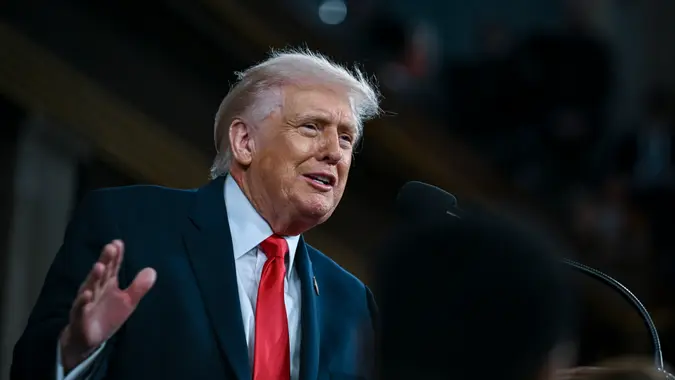
Not all states will be better off under President Trump’s “One Big Beautiful Bill Act,” even though it has been advertised as a win for American workers.
How Paychecks Would Look in Each State If Trump Dropped Federal Income Tax
GOBankingRates spoke with two professionals to learn more about the states and regions that stand to be most negatively impacted by this tax and spending bill. Here’s what positions these states to see the fewest benefits from Trump’s sweeping legislation.
High-Poverty States
George Carrillo is the CEO of the Hispanic Construction Council and former director of social determinants of health for the State of Oregon. Carrillo has seen firsthand the way federal policies shape the lives of working families and told GOBankingRates this bill delivers the fewest benefits to workers and their families in high-poverty states.
Some examples of the nation’s most vulnerable states include Mississippi, Alabama and Louisiana — where low-income Americans are already struggling to get by.
But the reason low-income workers stand to benefit least in these states is not because the states are considered “poor.”
Patrice Williams-Lindo, CEO of Career Nomad and former workforce strategist with Deloitte and KPMG, said low-wage workers lack bargaining power and benefits that are often decoupled from job growth.
States With Strong Clean Energy or Tech Sectors
The clean energy workforce will be heavily impacted in states like Washington and Oregon. According to Carrillo, the bill not only repeals tax credits for electric vehicles and renewable energy but it also threatens the stability of jobs in battery manufacturing, transit electrification and construction.
“Industry estimates point to as many as 100,000 job losses nationally,” Carrillo said. “While these states have higher median incomes and more resources, workers in clean energy sectors will find themselves left out, especially compared to those in traditional fossil fuel industries. Many workers in these fields will see their opportunities shrink just as the industry has started to expand.”
States With High Black and Brown Populations
Another at-risk group are high Black and brown populations in states where there are weak labor protections. According to World Population Review, more than 30% of the population is Black in Maryland, Georgia, Louisiana and Mississippi. Nearly 40% of the population in Texas and California is made up of the Hispanic community, which also accounts for nearly half of New Mexico’s population.
Williams-Lindo said, “Any policy that fails to address wage disparities or the racial wealth gap will compound inequities, particularly in states where workers already face systemic barriers to advancement.”
States Reliant on Federal Aid
A 2025 interactive map from The New York Times revealed where Medicaid enrollment is the highest across America. According to the map, more than 40% of residents in Eastern Kentucky rely on Medicaid. One-third of the population in Eastern Louisiana is enrolled in this program.
If the bill reallocates funds away from social programs in a state reliant on this federal aid, Williams-Lindo said the state will carry a double burden of low wages and reduced safety nets.
“Deep cuts to Medicaid and SNAP force the lowest-income households to pay more out of pocket, while state governments with limited budgets cannot fill the gaps,” Carrillo said. “For a family living on $26,000 a year, losing $1,600 in annual support is significant.”
Why Poorer States Don’t Immediately Benefit
Many Americans may be under the impression that poor states automatically benefit from legislation like the “Big Beautiful Bill.” As Williams-Lindo explained to GOBankingRates, this bill could ultimately leave countless Americans behind.
“Benefits flow along policy design, industry incentives and who holds power locally to secure jobs,” she said. “Without targeted wage support or clean energy transitions, these workers risk being left behind under big promises that don’t translate into household-level impact.”
Share This Article:
You May Also Like
4 in 10 Americans Delayed Moves Due To Inflation -- These Are The Biggest Reasons
January 12, 2026
4 min Read
Two-Thirds of America's Billionaires Are Self-Made -- But What Does That Really Mean?
January 13, 2026
4 min Read
What High-Net-Worth Households Do Differently in the First 60 Days of the Year
January 13, 2026
4 min Read
What Trump's Dispute with the Federal Reserve Means for Interest Rates (and You)
January 13, 2026
4 min Read
How Trump's Push on Venezuela, Cuba and Greenland Could Reshape Everyday American Finances
January 13, 2026
4 min Read
I Asked ChatGPT How To Make My Estate 'Drama-Proof' for My Heirs in 2026 -- Here's Its 12-Month Checklist
January 13, 2026
4 min Read
We Asked Financial Advisors the No. 1 Habit To Improve Your Finances in 2026
January 13, 2026
4 min Read
I Asked ChatGPT Where Gen Z Can Build a Career While Living on $2,000/Month -- Here's What It Said
January 13, 2026
4 min Read
Are Bicentennial Quarters More Valuable as America Approaches 250th Anniversary?
January 12, 2026
4 min Read
Questions Around The Economy
Make your money work for you
Get the latest news on investing, money, and more with our free newsletter.
By subscribing, you agree to our Terms of Use and Privacy Policy. Unsubscribe at any time.

Thanks!
You're now subscribed to our newsletter.
Check your inbox for more details.

Sending you timely financial stories that you can bank on.
Sign up for our daily newsletter for the latest financial news and trending topics.
For our full Privacy Policy, click here.
Looks like you're using an adblocker
Please disable your adblocker to enjoy the optimal web experience and access the quality content you appreciate from GOBankingRates.
- AdBlock / uBlock / Brave
- Click the ad blocker extension icon to the right of the address bar
- Disable on this site
- Refresh the page
- Firefox / Edge / DuckDuckGo
- Click on the icon to the left of the address bar
- Disable Tracking Protection
- Refresh the page
- Ghostery
- Click the blue ghost icon to the right of the address bar
- Disable Ad-Blocking, Anti-Tracking, and Never-Consent
- Refresh the page