Trump Said He’d Lower Grocery Prices on Day 1: See Where They Stand Now
 Written by
Marc Guberti
Written by
Marc Guberti
 Edited by
Ashleigh Ray
Edited by
Ashleigh Ray
Commitment to Our Readers
GOBankingRates' editorial team is committed to bringing you unbiased reviews and information. We use data-driven methodologies to evaluate financial products and services - our reviews and ratings are not influenced by advertisers. You can read more about our editorial guidelines and our products and services review methodology.

20 Years
Helping You Live Richer

Reviewed
by Experts

Trusted by
Millions of Readers
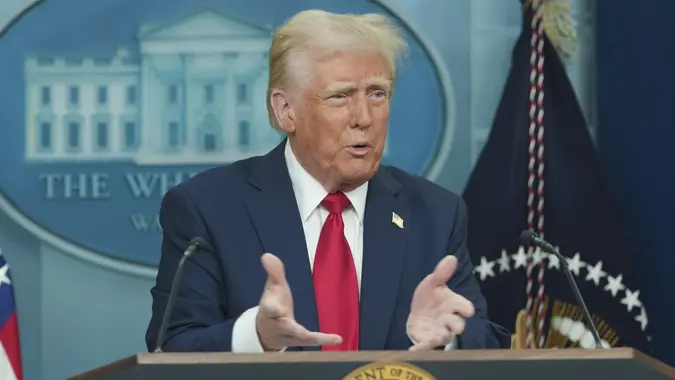
During President Trump’s last campaign before winning the 2024 presidential election, he promised on his first day of office to “immediately bring prices down, starting on Day One” for groceries. But that hasn’t happened so far.
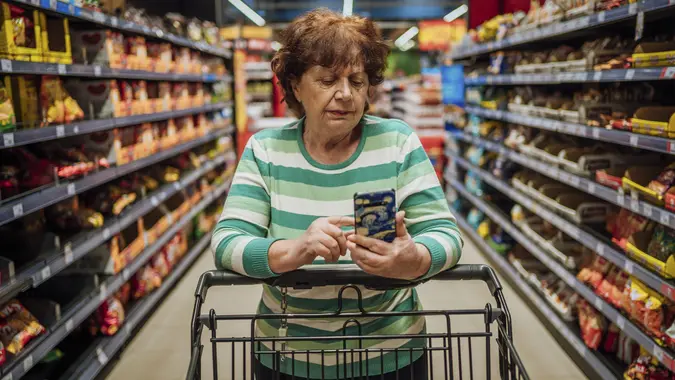
Some prices on your utility bills have gone up and down, but grocery prices remain elevated. There are a few reasons why that’s the case, and some of them are connected to Trump’s policies.
Quick Take: Just How High Are Grocery Prices in 2026?
If you have been feeling the sting when you go to check out your eggs, coffee and a few bananas, you aren’t alone. Here are some key takeaways from how much food costs have increased under President Trump’s second term:
- Average food prices in the United States rose about 2.6% over the 12 months ending November 2025, according to data compiled from the U.S. Bureau of Labor Statistics and the U.S. Inflation Calculator.
- That increase was roughly in line with overall inflation, as the Consumer Price Index across all categories climbed 2.7% year over year during the same period.
- The Federal Reserve’s preferred inflation gauge — core personal consumption expenditures (PCE), which excludes food and energy — has been running near 2.6% to 2.8% year over year, remaining above the Fed’s long-term 2% target but below recent highs.
- Other cost of living increases, such as with energy prices, have moved higher rather than lower, with the energy index up roughly 4.2% year over year as of late 2025, driven by increases in gasoline, natural gas and fuel oil prices.
4 Grocery Items That Have Gotten Much More Expensive Since Trump Took Office
Tariffs Are a Key Component
After some false starts and negotiations with trading partners, tariffs are now in effect, and they have been contributing to higher food prices. Grocery stores like Walmart and Whole Foods have to hike their prices to keep up with the tariffs.
Although critics may question why Walmart, a global retailer that reported more than $7 billion in consolidated net income in Q2 FY26, has to raise prices, it makes sense. Despite Walmart’s vast retail presence and high profits, the company only operates on a 2.5% to 4% net profit margin, depending on the quarter. If prices go up by 10%, Walmart has to respond to the higher prices to preserve a positive profit margin.
The Tax Foundation projects that nearly 75% of all U.S. food imports will be affected by Trump’s tariffs. If tariffs linger or get higher in the future, it can lead to a short-term price hike in food prices. That short-term price hike would only decrease if some tariffs got negotiated away or the U.S. produced enough food to balance the supply-and-demand dynamics.
Beefy Price Hikes
The grocery bill looks different for each person based on what they buy, but if you like to eat beef, grocery inflation will show up more for you.
The U.S. Department of Agriculture (USDA) found that retail beef and veal prices increased substantially. The overall cost has gone up about 15% year-over-year and over 59% from January of 2021 to the end of 2025.
The USDA anticipates beef and veal prices going up by 9.9% in 2025. Tight supplies of beef and veal are playing a role in the elevated prices as steak prices have also risen around 16.6% year-over-year, whereas beef roasts have gone up over 18% and ground beef has gone up 15% as of the beginning of 2026.
Beef and veal are the main headliners, but other food categories are also due for higher prices. Eggs, sugar and sweets, and nonalcoholic beverages are also expected to grow faster than their 20-year historical average rate of growth.
If you’re looking for a deal, you might want to shop around for other meats, fats and oils and fresh vegetables. Those are the food items the USDA expects will see price cuts.
It’s More Expensive To Eat Out
While it’s been known for a while that eating out is more expensive than prepping your own meal, it even applies to inflation rates. The USDA found that grocery store and supermarket food purchases had a 0.1% month-over-month price hike compared to the 0.3% month-over-month price hike for restaurants and other food service providers. Food as a whole is predicted to become 2.2% more expensive in 2026. The rate of inflation is only expected to be 1.2% for groceries, while dining will cost an additional 3.3% in 2026.
These forecasts do not suggest an immediate solution to rising food prices. Trump still has time to reduce food prices, but tariffs and the USDA’s 2026 projections don’t paint a bright picture for lower food costs.
Caitlyn Moorhead contributed to the reporting for this article.
Editor’s note on political coverage: GOBankingRates is nonpartisan and strives to cover all aspects of the economy objectively and present balanced reports on politically focused finance stories. You can find more coverage of this topic on GOBankingRates.com.
More From GOBankingRates