3 Ways Trump’s Affordability Campaign Could Hurt Your Finances in 2026
 Written by
Heather Altamirano
Written by
Heather Altamirano
 Edited by
Jenna Klaverweiden
Edited by
Jenna Klaverweiden
Commitment to Our Readers
GOBankingRates' editorial team is committed to bringing you unbiased reviews and information. We use data-driven methodologies to evaluate financial products and services - our reviews and ratings are not influenced by advertisers. You can read more about our editorial guidelines and our products and services review methodology.

20 Years
Helping You Live Richer

Reviewed
by Experts

Trusted by
Millions of Readers
Americans have been hit hard by the high cost of living. From unattainable housing to pricey borrowing costs and skyrocketing essential expenses, it’s been a challenge for many to keep up with prices that rose much faster than wages and deal with those higher prices that have stuck even as inflation cooled.
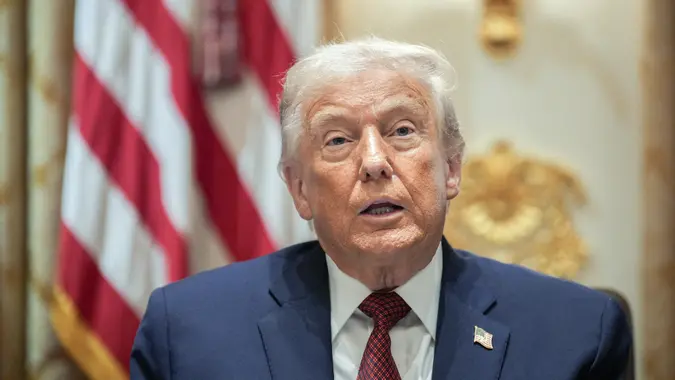
President Donald Trump has outlined plans to help reduce costs and make everyday life more affordable, though whether his proposals will happen likely depends on several factors. Here are three ways Trump’s affordability plans could impact your wallet.
A 10% Credit Card Interest Cap Could Backfire for Millions
Trump is calling on Congress to approve a one-year cap on credit card interest rates at 10%. While the move is appealing, personal finance experts point out the flaws.
“Banks won’t just accept lower profits — they’ll tighten credit standards dramatically,” said finance expert Andrew Lokenauth with Fluent in Finance. “When profitability drops, lenders reduce risk by cutting off access to the riskiest borrowers.”
According to Lokenauth, there are several issues with this plan.
- Americans with credit scores below 700 could struggle to qualify for new cards, eliminating an emergency lifeline many rely on for unexpected expenses like medical bills or car repairs.
- Existing cardholders could also face higher annual fees as banks shift from interest income to fee-based revenue.
- A card that currently charges high interest with no annual fee could flip to a lower rate with a costly annual charge — changing how consumers pay, not necessarily saving them money.
- Rewards programs could also disappear. “Cash-back and airline miles are funded by interest paid by people who carry balances,” Lokenauth said. “Cap that interest, and the profit pool vanishes.”
Ultimately, the proposal fails to address why Americans rely on credit cards in the first place. “Capping interest rates doesn’t fix stagnant wages or rising health care and child care costs — it’s a Band-Aid on a broken system,” Lokenauth said.
Banning Institutional Investors Could Lower Home Prices — and Raise Rents
Housing affordability remains one of the biggest financial hurdles for American families, especially first-time buyers competing with all-cash offers. Trump has proposed limiting or banning large institutional investors from buying single-family homes, a move that could free up inventory.
“If institutional buyers disappear from a market where they own 15% of homes, you’ve suddenly increased available inventory by 15%,” Lokenauth said. “Basic supply and demand suggest prices could fall 5% to 10% within 12 to 18 months.”
He explained that, in some cases, it could be enough to make homeownership attainable for some families.
But the policy could also create ripple effects and potentially raise rent prices, per Lokenauth. He pointed to several potential drawbacks.
- Institutional investors provide rental housing in markets where people can’t buy. Not everyone qualifies for a mortgage.
- Institutional landlords are often better than individual landlords. They maintain properties consistently, comply with fair housing laws and have professional management systems.
- If institutions can’t buy existing homes, they’ll pivot to building new rental communities. That doesn’t help aspiring homeowners. It just shifts institutional capital from purchases to development. You haven’t solved the problem; you’ve redirected it.
- Rental prices will likely increase in markets where institutional investors currently provide significant rental stock.
- Enforcement will be messy. What counts as an institutional investor?
- The policy could also freeze the market temporarily. Institutional investors might stop buying immediately while waiting for clarity, but individual buyers won’t instantly fill that gap.
Using 401(k) Funds as a Down Payment for a House
This is a plan that Trump hasn’t said too much about, but he has floated the idea of allowing people to take money out of their 401(k) and use that for a down payment for a home. That could sound alluring to many people, but it’s a “dangerous move,” according to finance expert Mary Clements Evans, author of “Emotionally Invested: Outsmart Your Anxiety for Fearless Retirement Planning” and founder and president of Evans Wealth Strategies.
Evans also questioned whether households struggling to afford a down payment are prepared for the full costs of homeownership. “If your finances are so tight that you have to dip into retirement savings to buy a home, will you realistically be able to cover repairs, maintenance and insurance — while resuming 401(k) contributions and making up lost ground?” she said.
Some of Trump’s affordability ideas could help lower certain costs — but others risk driving prices higher or creating new financial headaches.
Editor’s note on political coverage: GOBankingRates is nonpartisan and strives to cover all aspects of the economy objectively and present balanced reports on politically focused finance stories. You can find more coverage of this topic on GOBankingRates.com.
More From GOBankingRates