What a $50 Grocery Budget Bought in 1980 vs. Today
 Written by
Crystal Mayer
Written by
Crystal Mayer
 Edited by
Zuri Anderson
Edited by
Zuri Anderson

Commitment to Our Readers
GOBankingRates' editorial team is committed to bringing you unbiased reviews and information. We use data-driven methodologies to evaluate financial products and services - our reviews and ratings are not influenced by advertisers. You can read more about our editorial guidelines and our products and services review methodology.

20 Years
Helping You Live Richer

Reviewed
by Experts

Trusted by
Millions of Readers
The 1980s was a decade marked by iconic fashion, unforgettable music and movies that defined a generation. Today, people are not only nostalgic for totally tubular times but also more financially friendly foods at the store.
Undoubtedly things have changed at the checkout aisle in the past forty years, but here’s exactly what a $50 grocery budget bought in 1980 versus today.
$50 Grocery Budget in 1980
It goes without saying that a $50 grocery budget would go much further in 1980 compared to today, but just what would half a hundred buy? According to Delish, milk cost $2.18 a gallon, bread cost $0.50 per loaf and one dozen eggs cost a mere $0.83. At these prices, $50 could not only cover a Sunday brunch for a family of four but also lunches and dinner for the week.
How Much Would $50 in 1980 Be Worth Today?
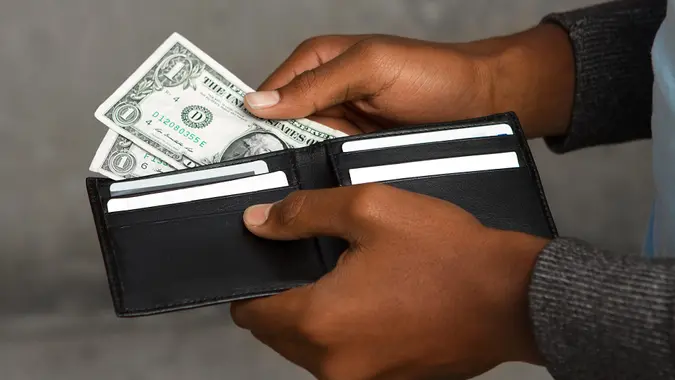
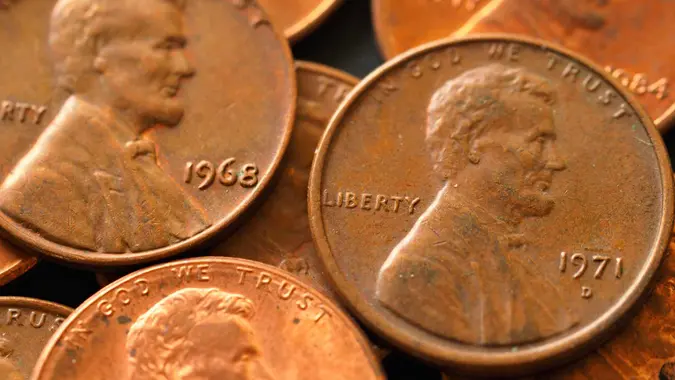
Utilizing the Consumer Price Index’s Inflation Calculator provided by the U.S. Bureau of Labor Statistics, $50 in 1980 had the same buying power as $208.30 in November 2025. Over the past forty years, food prices rose significantly in most categories. These price hikes were caused by several factors, including disruptions to supply chains, increased labor and transportation costs, as well as drought and other climate disruptions.
$50 Grocery Budget Today
As most shoppers know, $50 would not go far at the grocery store. A loaf of bread, for instance, costs $1.79 per loaf. Eggs, which skyrocketed to over $6 a dozen earlier in the year, are currently $2.86 using BLS data.
Additionally, a gallon of milk increased to $4 per gallon. Meat, like ground chuck, continues to rise in price recently reaching $6.50 per pound. These few basics can easily add up to $20 or more, nearly half of the initial $50 budget. Add in other staples like produce and a few snacks and there is nothing left to complete a full meal.
Given the increases in costs, feeding a family of four on a $50 grocery budget today is much more challenging. With proper planning and budget-saving tips, however, it can be done.
How To Stretch a Grocery Budget Today
According to the experts at Ramsey Solutions, food prices increased 21% over the past four years alone. Luckily, there are ways to save.
The money-saving team suggested meal planning, freezing and storing made ahead meals, sticking to a list and taking advantage of curbside pickup. Just staying out of the physical grocery store can lead to surprising savings since shoppers aren’t as inclined to indulge in impulse buys.
The article also mentioned avoiding eye-level products, since they are strategically placed to encourage a purchase. Less expensive alternatives may be on higher or lower shelves. Shoppers also should eat before they grab a cart. Shopping hungry can lead to overspending. The experts also suggested shopping a farmers’ market at the end of the day and buying generic instead of name brand.
Utilizing these tips, a $50 budget can stretch much further. While it may not fill a cart the same way it did in 1980 it can at least partially fill a refrigerator and at least one shelf in the pantry.
More From GOBankingRates