What Trump’s Fed Chair Nominee Kevin Warsh Could Mean for Your Wallet
 Written by
Vance Cariaga
Written by
Vance Cariaga
 Edited by
Angela Corry
Edited by
Angela Corry
Commitment to Our Readers
GOBankingRates' editorial team is committed to bringing you unbiased reviews and information. We use data-driven methodologies to evaluate financial products and services - our reviews and ratings are not influenced by advertisers. You can read more about our editorial guidelines and our products and services review methodology.

20 Years
Helping You Live Richer

Reviewed
by Experts

Trusted by
Millions of Readers
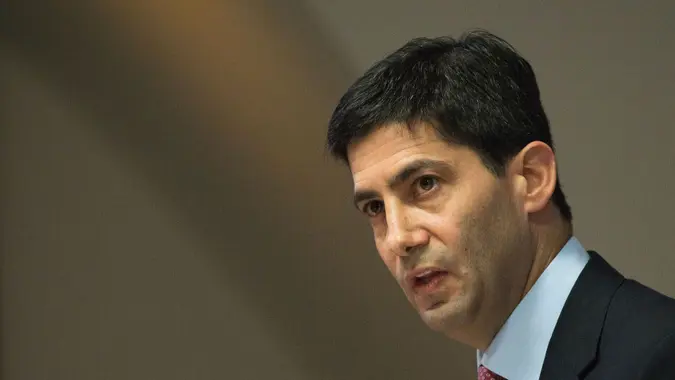
After months of battling Federal Reserve chairman Jerome Powell over the central bank’s interest rate policy, President Donald Trump has revealed his pick to replace Powell: Kevin Warsh, a former Fed governor, White House advisor and Wall Street banker.
The announcement was made in a Truth Social post early Friday, Jan. 30, with Trump proclaiming that Warsh will “go down as one of the GREAT Fed Chairmen, maybe the best.”
Warsh will first need to be confirmed by the U.S. Senate to become Fed chair. That’s likely to happen because of a “friendly Republican Senate,” NPR reported.
The immediate reaction on Wall Street was mixed, with the stock markets trending lower early Friday but mainly trading in a narrow range.
Warsh’s selection eased some concerns about the Fed’s independence due to his experience as a Fed governor and “strong stance at times against inflation,” CNBC reported.
But there are still worries that Warsh might push more aggressively for rate cuts to appease Trump.
That’s an important point in terms of what it could mean for your wallet, given how Trump’s rocky relationship with the Fed has impacted both interest rates and the stock market.
Rate Cut Disagreements
Since taking office for a second time, Trump has been at loggerheads with Powell over the Fed’s pace of interest rate cuts. Powell hesitated to lower rates because of high inflation but finally approved a series of three rate cuts in the latter half of 2025, which bolstered the stock markets.
The prospect of a less independent Fed has rattled stock markets both in the U.S. and abroad. For now, however, the general consensus (or at least hope) is that Warsh will maintain the central bank’s independence.
How Would Warsh Govern?
One important thing to know about Warsh is that he’s a pretty conventional candidate for Fed chair.
A Stanford University graduate who earned a law degree from Harvard, Warsh spent many years as an investment banker with Morgan Stanley. From 2006 to 2011 he served on the Fed’s governing board. Prior to that he worked as an economic adviser under President George W. Bush administration, NPR reported.
Scott Helfstein, head of Investment Strategy at Global X ETFs, called Warsh a “good pick” in an email note shared with GOBankingRates.
In his previous roles with both the Fed and the Bush administration, Warsh sometimes opposed aggressive interest rate cuts because of concerns about inflation. That remains a concern in 2026.
“There is more wood to chop on inflation,” Helfstein wrote. “The question now is whether inflation is being driven by tariffs or expectations that are above the Fed target.”
What It Could Mean for Your Wallet
If your finances are heavily tied to the Fed’s interest rate policy, you might not see a huge change under Warsh, according to Lauren Goodwin, Economist and Chief Market Strategist at New York Life Investments
“A new chair alone is unlikely to drive a materially faster pace of rate cuts in 2026,” she wrote in a December note shared with GOBankingRates. “While the chair plays a critical role in shaping the Federal Open Market Committee’s (FOMC) discussions and communication, interest rate decisions ultimately rest with the majority of the FOMC’s 12 voting members, not just the chair.”
For investors, the Warsh nomination “should be good for markets in general,” according to Helfstein.
But there is one area to keep an eye on.
“Warsh has expressed interest in shrinking the Fed balance sheet as a means to ensure the bank’s independence from policymakers,” Heffstein wrote.
“That could drive some volatility in the rates market that spills into equities and credit spreads.”
Editor’s note on political coverage: GOBankingRates is nonpartisan and strives to cover all aspects of the economy objectively and present balanced reports on politically focused finance stories. You can find more coverage of this topic on GOBankingRates.com.
More From GOBankingRates