Humphrey Yang: 6 Reasons Why Wealth Accelerates After $20,000
 Written by
Ashley Donohoe
Written by
Ashley Donohoe
 Edited by
Zuri Anderson
Edited by
Zuri Anderson

Commitment to Our Readers
GOBankingRates' editorial team is committed to bringing you unbiased reviews and information. We use data-driven methodologies to evaluate financial products and services - our reviews and ratings are not influenced by advertisers. You can read more about our editorial guidelines and our products and services review methodology.

20 Years
Helping You Live Richer

Reviewed
by Experts

Trusted by
Millions of Readers
Whether you’d like to become a multi-millionaire or build up a modest cushion for retirement, having $20,000 in your investment and bank accounts might not seem too impressive. After all, you might dwell on how you still have several years or decades before reaching your target number.
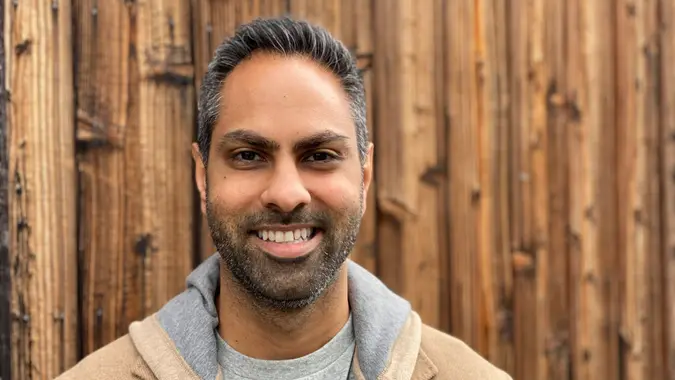
However, money expert Humphrey Yang believes that reaching this money milestone gives you the flexibility to make better decisions and sets you on a path toward accelerated wealth. In a recent YouTube video, he discussed six reasons that reaching $20,000 is a game-changer for your money.
Your Wealth Starts Accelerating
Thanks to compound interest, having $20,000 means that your money can start multiplying more quickly and provide a cushion for your budget.
Yang demonstrated using an example of someone who got an 8% return. If they only have $10,000 in their account, they’d get around $66 per month or $800 per year in interest. But once they reach $20,000, the interest rises to about $132 per month or $1,600 per year.
As you continue to invest, accumulating the next $20,000 happens more quickly. According to Yang, someone contributing $500 per month at an 8% return would need 35 months to reach their first $20,000 and 26 months to reach their next $20,000. By the time they hit $500,000, they would have another $20,000 in only six months.
Your Mindset Shifts Toward Abundance
Only 48% of Americans had enough savings to cover a $2,000 emergency expense in 2024, according to a Federal Reserve report. Such financial insecurity can leave you focused on scarcity.
Yang explained that reaching $20,000 offers psychological benefits since you’ll have sufficient reserves to handle financial setbacks and likely still maintain a five-figure balance. You’ll also gain some confidence regarding money, which changes your way of thinking.
“Now you can start to shift your mindset to more of an abundance mindset at the [$20,000] level because each dollar is making you more independent than before,” the former financial advisor said.
You’ll Enjoy Freedom of Career Options
Many people feel stuck in bad jobs since they don’t have a decent safety net to leave. Yang explained that $20,000 could cover you for several months if you keep your expenses low, so you will have more freedom to escape a job that harms you mentally or physically.
At the same time, your $20,000 cushion removes the need to take another poor-fit job to survive. You can even pay for training for a different role or pursue entrepreneurship.
Yang added, “I think that that freedom is worth it because you could parlay that into a better job that pays you more of an income, and therefore your net worth can grow even faster at this point, too.”
Certain Things Don’t Cost As Much
When you don’t have much money, you can face higher costs than financially secure people.
For example, a low account balance puts you at risk of overdraft or non-sufficient funds fees, which cost Americans $12.1 billion in 2024, according to the Financial Health Network. Plus, you might owe monthly account service fees if you can’t meet the minimum requirements.
Yang said these bank fees may not be an issue if you have $20,000. He also explained you may be able to afford certain things that save you more money, such as bulk groceries, higher-quality clothes and annual insurance policies with discounts.
You’ll Join the Investor Class
While you can invest with less than $20,000, Yang explained that this amount pushes you to a new level. For example, you can maximize your annual Roth IRA contributions without compromising your emergency fund or overall financial security and try different types of investments, including index funds with minimum purchase requirements.
Yang also highlighted an example allocation for diversifying your money at this stage. This includes a $7,000 Roth IRA balance, an $8,000 emergency fund, a $2,000 checking balance and a $3,000 taxable brokerage account balance.
Additionally, you’ll be able to manage market swings better so that you can avoid panic selling and instead take advantage of the dips.
You Can Think Long Term
Yang discussed how delayed gratification is important for your long-term success. While reaching $20,000 shows that you have the discipline to get what you want, some other people chase dopamine and make poor financial decisions with just the short term in mind.
“Perhaps they might forego investing in retirement, or they might prematurely hop jobs, or perhaps they just want to go for the YOLO stock that tries them a 50x but then they end up losing everything instead,” he explained.
With a foundation of $20,000, you’re in a better place to make smart long-term decisions and hopefully avoid taking dangerous risks in hopes of quick wins.
More From GOBankingRates