Warren Buffett’s Top 5 Tips That Will Save Retirees From Financial Disaster
 Written by
Ellie Diamond
Written by
Ellie Diamond
 Edited by
Molly Sullivan
Edited by
Molly Sullivan
Commitment to Our Readers
GOBankingRates' editorial team is committed to bringing you unbiased reviews and information. We use data-driven methodologies to evaluate financial products and services - our reviews and ratings are not influenced by advertisers. You can read more about our editorial guidelines and our products and services review methodology.

20 Years
Helping You Live Richer

Reviewed
by Experts

Trusted by
Millions of Readers
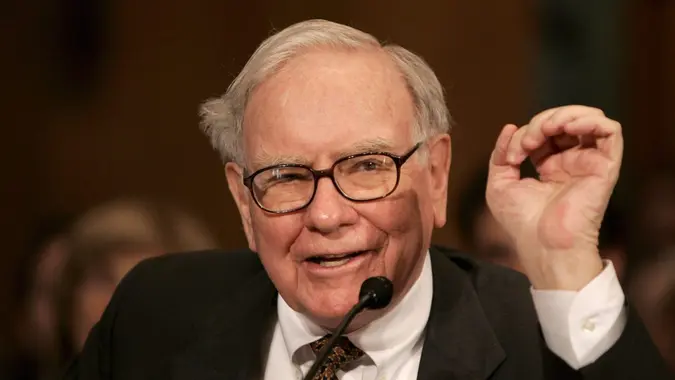
Warren Buffett, 95, might be one of the most-quoted money experts in history. He’s an inspiration to retirees in many ways, and his advice is especially relevant to those seeking to protect their retirement funds. After all, he’s protected his wealth so effectively that he’s now worth $142 billion — a figure that increased by $15.4 billion in 2025 alone.
Here are his top five tips that can help you protect your retirement.
1. Don’t Lose Money
“The first rule of investment is, don’t lose. The second is, don’t forget the first rule. And that’s all the rules there are.”
This is probably Buffett’s most widely shared quote, first recorded in a 1985 television interview. It applies to all investors but is especially critical for retirees, 64% of whom worry more about running out of money than about dying.
The takeaway from this advice is simple: Watch your investments and protect your capital. If you don’t feel equipped to avoid a loss, seek professional advice.
2. Avoid High-Interest Debt
A friend once asked Buffett what to do with a recent influx of money. Buffett immediately suggested that she pay off her credit cards, which had an interest rate of around 18%.
“If I owed any money at 18%,” he said, “the first thing I’d do with any money I’d had would be to pay it off. It’s going to be way better than any investment idea I’ve got.”
Rates are even higher today, averaging above 20% since early 2023. That kind of debt can feel like a necessity, but it can tap your financial reserves fast, especially if the balance accumulates.
“You can’t go through life borrowing money at those rates,” Buffett said.
One alternative is to use your credit card only if you can afford to pay for the item in cash or with a debit card. Then, pay your balance by the end of the month.
3. Only Spend on What Matters
Warren Buffett is famously frugal. He lives in the Nebraska home he purchased for $31,500 in 1958 and starts every day with a biscuit sandwich from McDonald’s — or just two sausage patties, if the market is down.
“Why am I frugal?” one participant recorded Buffett as saying in a student Q&A in 2009. “You can’t buy health, and you can’t buy love. Don’t confuse the cost of living with the standard of living.”
In other words, don’t focus on keeping up with friends or neighbors. Spend your hard-earned retirement income on choices that significantly improve your quality of life and only do so when you can afford it.
4. Hold Your Investments as Long as Possible
In his annual letter to Berkshire Hathaway shareholders in 1988, Buffett wrote:
“Our favorite holding period is forever. We are just the opposite of those who hurry to sell and book profits when companies perform well, but who tenaciously hang on to businesses that disappoint.”
Holding onto a high-valued stock feels like a big ask when you’re living on retirement income, especially in volatile markets. This past year was one for the books, with sell and buy trends following one another at impressive speeds. Dips like these can be scary, particularly if you depend on investments for your retirement income. But, as Buffett and other money experts have said, the courage to ride it out can pay off.
In September, Fidelity reminded wary investors that portfolios tend to suffer when people are reactive rather than confident and steady. One portfolio manager told Fidelity, “I have found that investors who keep waiting for the perfect time to invest often miss out on gains over time.”
5. Act on Opportunities
Avoiding loss and reactivity doesn’t mean holding back when opportunities present themselves. As Buffett said in his 2016 letter to shareholders:
“Every decade or so, dark clouds will fill the economic skies, and they will briefly rain gold. When downpours of that sort occur, it’s imperative that we rush outdoors carrying washtubs, not teaspoons.”
The average retiree may not have Buffett’s impressively sized financial washtubs, but the spirit of this advice applies. For example, if you come into a lump sum, you might decide to pursue a high-potential growth stock — assuming you’ve done your homework.
If Buffett believes in one thing, it’s always doing your homework and understanding your investments. Always remember rule No. 1 — don’t lose money — and protect your capital by making wise spending decisions.
More From GOBankingRates