4 Ways the Trump Administration Can Decrease the Retirement Costs in the Next 3 Years
 Written by
Vance Cariaga
Written by
Vance Cariaga
 Edited by
Zuri Anderson
Edited by
Zuri Anderson
Commitment to Our Readers
GOBankingRates' editorial team is committed to bringing you unbiased reviews and information. We use data-driven methodologies to evaluate financial products and services - our reviews and ratings are not influenced by advertisers. You can read more about our editorial guidelines and our products and services review methodology.

20 Years
Helping You Live Richer

Reviewed
by Experts

Trusted by
Millions of Readers
Retirement has never been cheap, but lately it has gotten even more expensive.
A 65-year-old who retired in 2025 could expect to spend an average of $172,500 in health care and medical expenses throughout retirement, according to a report from Fidelity. That’s up 4% from the prior year and continues a “general upward trajectory” of projected health-related expenses.
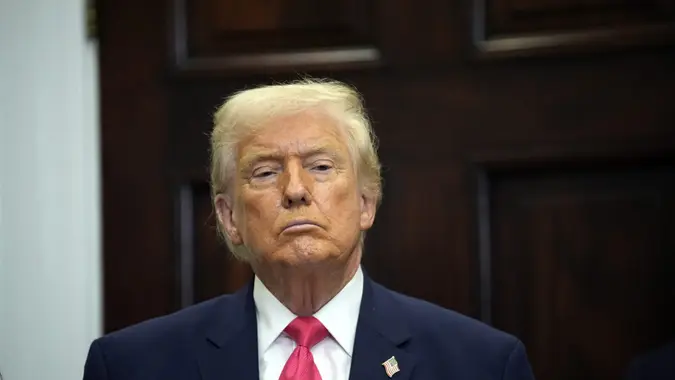
What can President Donald Trump do about it? Here are four ways his administration can work to lower the cost of retirement over the next three years, according to experts.
Make Medicare More Affordable
This is one of the biggest ways the Trump administration can lower overall costs for seniors, according to Jay Zigmont, PhD, certified financial planner (CFP), founder of Childfree Trust, which provides estate services to people without children.
“Long-term care is the largest single cost in retirement, and Medicare should pay for it,” Zigmont told GOBankingRates. “Currently, Medicare only pays for a limited number of days of rehab. Medicaid pays for long-term care, but only after you have spent through all of your assets.”
One thing the administration can do is back legislation that would strengthen Medicare.
“Ultimately, Medicare will need more funding and a shift of priorities,” Zigmont said. “Congress would have to pass a law to increase funding for Medicare and include long-term care as a benefit.”
But so far, neither Trump nor Congress have done much to bolster Medicare funding. In fact, they’ve gone in the opposite direction, according to a July report from the Center for Medicare Advocacy (CMA).
The CMA pointed to Trump’s One Big Beautiful Bill Act (OBBBA), which accelerated the timeline for when Medicare’s trust fund (which pays for hospital care) will become insolvent.
“If Congress takes no additional action, automatic spending cuts will be triggered, reducing Medicare funding by approximately $500 billion between 2026 and 2034,” the CMA noted.
Bring Down Consumer Prices
Inflation continues to be a thorn in the side of retirees (and everyone else), though it has been slowing.
The overall U.S. inflation rate in November rose 2.7% from the previous year, according to the Bureau of Labor Statistics. That was below most forecasts, CNBC reported, but still above the Federal Reserve’s long-term target rate of 2%.
Meanwhile, prices of certain items that especially impact retirees continue to rise at a rapid clip — including electricity (up 6.9%), utility gas services (9.1%) and medical care services (3.3%).
One thing the administration can do is help influence policies that lower prices, said Tyler Meyer, CFP, founder of RetireToAbundance.com and owner of QED Wealth Solutions.
“Policies that eliminate sales tax on groceries and basic necessities — which several states have already done — directly reduce cost of living for seniors on fixed incomes,” Meyer told GBR. “Food, prescriptions and household staples are recurring expenses, and lowering those costs quietly but consistently improves retirement security.”
Support Health Savings Accounts
Health savings accounts, or HSAs, are tax-free accounts that help eligible individuals pay for qualified medical care. Because you put pre-tax money into an HSA, you can also make tax-free withdrawals as long as you use the funds for qualified healthcare expenses.
Opening an HSA is “one of the best ways” to save for healthcare costs during retirement, said Whitney Stidom, vice president of consumer enablement at eHealth, a leading private online health insurance marketplace.
Encouraging the adoption of more HSAs could help lower the cost of retirement in the next three years.
“With these accounts gaining more support under the Trump administration, and with new rules taking effect in 2026 [that would expand eligibility], it is key to review how HSAs work and fully fund one (if possible) to lower healthcare costs now and in the future,” Stidom told GBR.
Lower Taxes
The administration include a new seniors tax deduction in its OBBBA spending bill that lowers taxable income for people 65 and older and should help them save money.
“In practical terms, that boosts after-tax cash flow,” Meyer said. “For many retirees, it means their Social Security ends up being effectively tax-free once all the deductions are applied. This effectively gets more money back in retirees’ pockets every year.”
Editor’s note on political coverage: GOBankingRates is nonpartisan and strives to cover all aspects of the economy objectively and present balanced reports on politically focused finance stories. You can find more coverage of this topic on GOBankingRates.com.
More From GOBankingRates