5 Ways Your Retirement Could Be Impacted by the End of Trump’s Second Term
 Written by
Caitlyn Moorhead
Written by
Caitlyn Moorhead
 Edited by
Molly Sullivan
Edited by
Molly Sullivan
Commitment to Our Readers
GOBankingRates' editorial team is committed to bringing you unbiased reviews and information. We use data-driven methodologies to evaluate financial products and services - our reviews and ratings are not influenced by advertisers. You can read more about our editorial guidelines and our products and services review methodology.

20 Years
Helping You Live Richer

Reviewed
by Experts

Trusted by
Millions of Readers
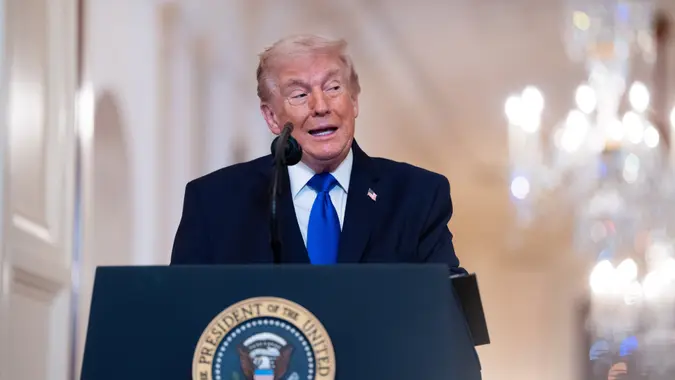
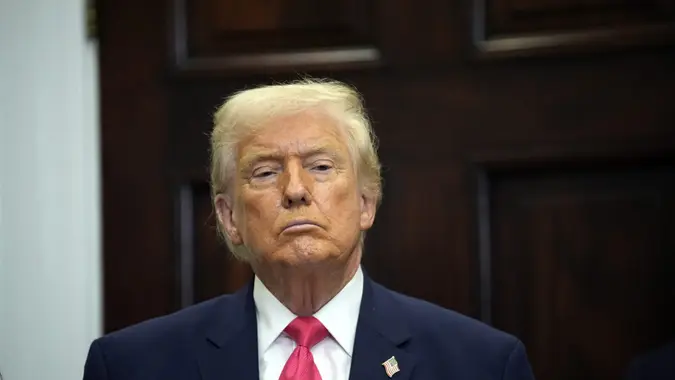
In times of political unrest and economic volatility, it’s best to remember to remain calm and keep planning for retirement the best way you can. However, it is natural to wonder how future policies could affect your financial security. President Donald Trump’s second term has retirees and pre-retirees shaking a Magic 8-Ball to better understand any possible policy directions that can help better prepare and protect their retirement incomes.
In this case, the proverbial 8-Ball has responded with the dreaded, “Ask again later,” but that doesn’t mean you can’t be proactive, no matter what happens in Washington. Take a deep breath and remember your retirement security hopefully doesn’t depend on any single presidency, it depends on proactive planning, strategic adjustments and staying informed.
From investment returns to Social Security and 401(k) plans, here are five ways Trump could change your retirement before he leaves office for the second time.
1. Social Security Benefits Could Change
Though a crystal ball would be nice when it comes to predicting the future of Social Security, short of being a psychic economist, many outcomes of this retirement staple remain murky less than 10 years from now. While Social Security continues to pay as scheduled unless Congress formally changes the law (or there is a government shutdown), discussions about long-term solvency have been a recurring theme in nearly every administration.
Yes, Trump has consistently repeated that he “will not cut Social Security” but is focused on eliminating “waste and fraud” to help keep it solvent. What does this mean in the short term?
The good news is that there shouldn’t be any immediate change to your benefits, and you’ll receive 100% of them estimated through at least 2033. The bad news is that, with the White House administration laying off employees and closing field offices, you could face added delays and longer waits when dealing with a representative to solve any Social Security issues you have. Plus, after 2033, the trust fund will be all but wiped out, and the government will only be able to pay 77% of earned benefits thanks to ongoing Social Security payroll deductions from working Americans.
At the end of Trump’s second term, there may be a few tweaks, so watch for proposals involving changes to the full retirement age, stay informed about any plans to adjust cost-of-living increases (COLAs) and also consider how potential payroll tax policy shifts could impact long-term Social Security health.
2. The Ripple Effect of Trump’s Taxes for Retirees
Between the One Big Beautiful Bill Act (OBBBA) and extensions of the Tax Cuts and Jobs Act that was originally supposed to expire at the end of last year, there lies the question of just how Trump’s tax policies are affecting your retirement accounts. Keep in mind, shifts in taxes or rates can directly shape your retirement withdrawals, investment decisions and estate planning.
In fact, Trump’s new law marks a meaningful step toward easing the tax burden for millions of retirees, but this relief is income-limited and doesn’t apply to everyone and seniors with higher earnings may see little to no change.
Lower tax rates can mean keeping more from IRA and 401(k) withdrawals, while estate tax changes might affect long-term legacy planning. Staying alert to tax law updates can help maximize your retirement savings.
There are a few key takeaways to consider under the OBBBA and Trump’s administration for the next few years if you are planning to retire during his second term. For example, if you were born between 1950 and 1959, you must begin taking required minimum distributions (RMDs) at age 73, but if you are still working past that age, you can delay taking RMDs from the 401(k) sponsored by your employer. Additionally, if you have multiple IRAs, you may combine them to simplify RMDs.
3. Changes to Healthcare and Medicare
Healthcare remains one of the largest expenses for retirees, so cuts to programs and funding aren’t exactly the news you want to hear for your golden years. However, Trump legislation from 2025 triggered potential deep cuts to Medicare through the PAYGO (Pay-As-You-Go) Act, with estimates suggesting over $500 billion in cuts are estimated by 2034, affecting payments to providers, Medicare Advantage plans and potentially limiting benefits for low-income enrollees.
This, in addition to ongoing Medicare payment cuts for physicians that have persisted for years, is compounding practice costs and threatening patient access. In general, policy shifts could influence the cost and coverage options for Medicare, supplemental insurance and prescription medications. Simply put, it looks likely that your healthcare costs will rise during Trump’s second term.
4. Inflation and Market Volatility
To say the least, political transitions or bold swings can sometimes introduce periods of uncertainty in financial markets. Because Trump’s tax cuts rely on revenue from his administration’s controversial tariffs, it is simultaneously causing inflation and increasing consumer prices and the cost of living.
The resulting tariffs from what can be boiled down to a trade war have only shown a slight uptick in inflation so far in 2026 during the first year of Trump’s second term, but many economists believe higher prices are basically inevitable. The current inflation rate is 2.7%, which is above the Fed’s preferred 2% target, but some economists are predicting that to decrease to 2.4% by the end of 2026. This is potentially good news for those living on a fixed income.
5. Alternative Assets in Your 401(k)
Being able to add alternative assets to your employer-sponsored retirement accounts may be a gamechanger for your nest egg by the end of Trump’s second term. In August of 2025, Trump signed an executive order to allow assets such as private equity, private credit and cryptocurrencies to 401(k) plans.
What could this mean for your retirement savings and investment strategy? Well, because these types of alternative assets have traditionally only been available to high-net-worth investors and large institutions such as pension funds, you could now have much broader access to them.
For example, allowing private equity investments, which tend to be less liquid and hard to sell, in employer-sponsored retirement accounts via target-date funds, means it could add more diversification and upside potential. Allowing digital alternative assets, it legitimizes crypto as part of a well-rounded investment portfolio. However, keep in mind that these assets can be both complex and volatile, so prepare for a steep learning curve if you feel like this could be a good fit.
Editor’s note on political coverage: GOBankingRates is nonpartisan and strives to cover all aspects of the economy objectively and present balanced reports on politically focused finance stories. You can find more coverage of this topic on GOBankingRates.com.
More From GOBankingRates