The IRS Won’t Do This by Text or Email — but Scammers Will
 Written by
Josephine Nesbit
Written by
Josephine Nesbit
 Edited by
Jenna Klaverweiden
Edited by
Jenna Klaverweiden
Commitment to Our Readers
GOBankingRates' editorial team is committed to bringing you unbiased reviews and information. We use data-driven methodologies to evaluate financial products and services - our reviews and ratings are not influenced by advertisers. You can read more about our editorial guidelines and our products and services review methodology.

20 Years
Helping You Live Richer

Reviewed
by Experts

Trusted by
Millions of Readers
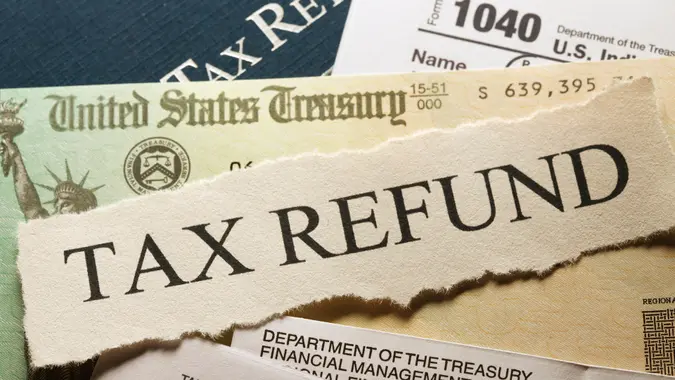
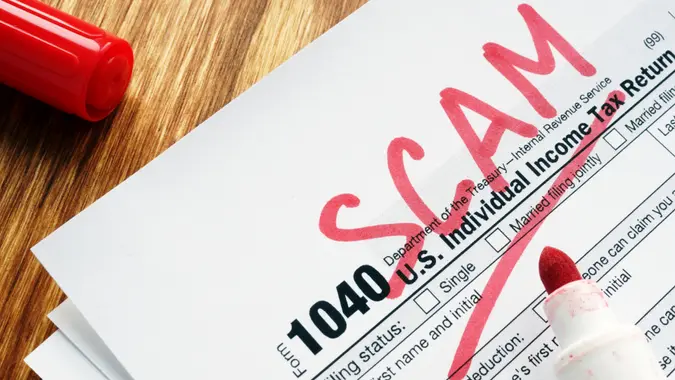
Tax season is always a busy time of the year, especially for scammers. According to the Federal Trade Commission (FTC), a text or email about your “tax refund” is always a scam. These messages are phishing scams designed to steal your personal information or your identity.
Here’s what you need to know about these tax scammers, what to look out for and how to protect yourself.
Tax Refund Scam
A Jan. 22 notice released by the FTC noted that the scams typically start with a text or email that looks like it’s from the IRS or state tax office, saying it has “processed” or “approved” your tax refund claim. To verify and send payment, it asks you to click a link and enter your Social Security number and bank account information.
If you click the link and share your personal details, the scammer could steal this information to claim your tax refund or use it to open other accounts.
What To Look Out For
The most important thing to understand about the IRS is that it doesn’t do urgency, said Chris Simpson, director of National University’s Center of Cybersecurity.
“If you owe money or there’s an issue with your return, you will receive a letter in the mail and you’ll have reasonable time to respond,” Simpson wrote in an email.
This is what makes these scams easy to spot, he explained. “Any unsolicited contact that creates pressure, whether an email, a text, a social media message or a phone call warning of immediate penalties, is almost certainly not the IRS,” he said.
Simpson added that you should also be on the lookout for the following:
- Promises of huge refunds or special credits
- Unsolicited notices about unclaimed refunds
- A request for a gift card payment
- A message pushing you to act immediately.
How To Protect Yourself
Tax season gives cybercriminals the perfect opportunity to target taxpayers. But there are ways to protect yourself, Simpson explained. For one, consider getting an IRS identity protection pin (IP PIN), which is a six-digit number that prevents fraudulent filing available to all taxpayers through the IRS website.
Simpson also recommended verifying communication through official channels. Additionally, before you click a link, hover over it to check the destination, and always make sure it leads to a legitimate government site with a .gov domain.
More From GOBankingRates