From Groceries to Gas: Where People Feel Inflation the Most (and Least)
 Written by
Sean Bryant
Written by
Sean Bryant
 Edited by
Zuri Anderson
Edited by
Zuri Anderson

Commitment to Our Readers
GOBankingRates' editorial team is committed to bringing you unbiased reviews and information. We use data-driven methodologies to evaluate financial products and services - our reviews and ratings are not influenced by advertisers. You can read more about our editorial guidelines and our products and services review methodology.

20 Years
Helping You Live Richer

Reviewed
by Experts

Trusted by
Millions of Readers
GDP growth looks healthy. The Wall Street Journal reports the stock market keeps hitting records, as are gold prices, and unemployment remains relatively low, per Trading Economics. And yet, shop at a grocery store long enough and you’ll start to believe the economy is collapsing.
You’re not necessarily wrong for thinking that either, but you’re not tracking what economists track. Does that really matter, though? Because at the end of the day, where we feel inflation the strongest is in those must-buy situations, where we’re forced to watch our money evaporate.
Where Inflation Feels the Worst
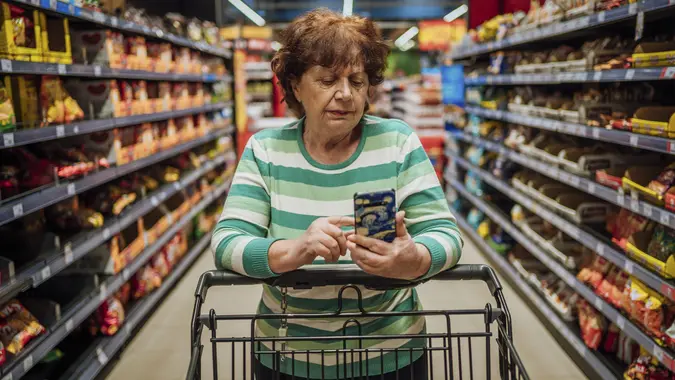
Groceries are the classic example of something you must purchase, no matter what. You can postpone buying a new laptop, but you can’t postpone dinner.
Food-at-home prices are up 1.9% over the 12 months ending in November 2025, according to the Consumer Price Index (CPI). While 1.9% doesn’t seem like a lot, it adds up fast when encountered weekly, sometimes daily, with no ability to opt out, especially considering that within that statistic, essentials like meats, poultry, fish, and eggs went up 4.7%.
Every trip you make shows that your dollar buys less than it used it. Of course it’ll feel significant.
What is Destroying Most People’s Budgets
Food is essential, everyone can agree on that, but it only takes up around 13% of household spending, on average. Housing takes up 44% of household spending, which is more than three times what is spent on groceries and going out to eat.
Because shelter is the dominant force in everyone’s financial life, even modest increases to the cost of living and maintaining it can compound to insanely high levels.
November 2025 data shows shelter costs up 3.0% year-over-year. That’s lower than grocery inflation, and dramatically lower than the 6.9% spike in electricity costs, but because housing occupies such enormous real estate in your budget, a 3% increase on your biggest expense hurts more than a 7% increase on a small one.
How Significant is Gas Inflation?
Gasoline dominates inflation discourse, despite representing less than 3% of household budgets and actually showing a decrease in price over the past three years.
Regular gas averaged $3.10 per gallon in 2025, down $0.21 from 2024. By any rational measure, gas prices haven’t been hit too hard by inflation. So why does it seem like it has?
One reason is that the price of gas changes constantly, and seeing a 20- or 40-cent jump feels like a big deal, even if it reverses later on.
Additionally, regional differences mean that millions of Americans will never experience the “average” price that makes it into headlines. If you live where gas costs $4.50, the fact that someone in Texas pays $2.80 probably provides zero comfort to you.
Where People Feel Inflation the Least
Apparel prices rose 0.2% and new vehicles rose 0.6%. You buy clothes sporadically and a car every several years, if that. Which means you won’t be confronting these rising prices every week.
Not to mention that the infrequency with which these items are purchased might give you price amnesia. If you remember what you paid for your jeans three years ago, kudos to you, but for most people, the difference between $20 and $21 over a 3-year period might not be recognizable.
However, most people will absolutely remember what eggs cost last month.
More From GOBankingRates