Trump’s Plan for Greenland: The Expected Economic Impact on the American Middle Class in the Coming Months
 Written by
Chris Adam
Written by
Chris Adam
 Edited by
Angela Corry
Edited by
Angela Corry
Commitment to Our Readers
GOBankingRates' editorial team is committed to bringing you unbiased reviews and information. We use data-driven methodologies to evaluate financial products and services - our reviews and ratings are not influenced by advertisers. You can read more about our editorial guidelines and our products and services review methodology.

20 Years
Helping You Live Richer

Reviewed
by Experts

Trusted by
Millions of Readers
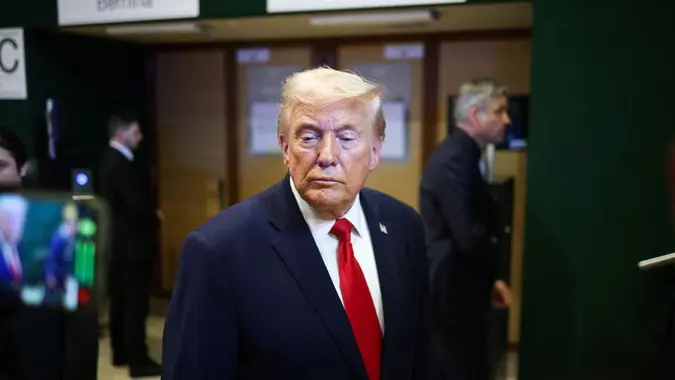
Greenland has been on the minds of many consumers in the United States over the past couple of weeks, particularly as President Donald Trump issued threats to use force to obtain Greenland and potentially impose tariffs on European countries who tried to stand in the way.
Such bold moves have led to concerns about the economic impacts on the middle class depending on what happens with Greenland.
Here’s a look at what a few money experts told GOBankingRates may happen within the coming months.
Waiting for Impacts
“When I look at this, I don’t see something that’s likely to change day-to-day life for middle-class families in the near term,” said Taylor Kovar, certified financial planner (CFP), co-founder of BudgetGPT. “It’s largely a geopolitical discussion, and those usually take time before they have any real economic effect at the household level.”
Melanie Musson, a finance expert with Quote.com, said, “Things could be better for the middle class. The U.S. gaining access to or control of Greenland’s minerals would boost the economy and be an economic win, resulting in greater prosperity. There would also be less dependence on China, which would strengthen the U.S. in general.”
Watching the Markets
For middle-class investors who watch the stock market daily, they may have felt big emotional ups and downs in recent days.
“As we’ve seen over the past week, the political atmosphere, especially news around Greenland, has had a huge effect on the market,” noted Brandon Gregg, CFP, advisor with BBK Wealth Management. “Large moves in either direction will have a major impact on the middle class as their investment assets are directly impacted.”
Looking at Inflation and Prices
“Price fluctuation continues, with the tariffs and economic pressure as the means to the end of acquiring Greenland,” said Marcus Sturdivant Sr., managing member of The ABC Squared. “We could see some items experience inflation. Greenland’s largest export to the U.S. is seafood, not a huge part of our imports.”
According to Sturdivant, Greenland has a lot of untapped natural resources and minerals that would benefit the U.S. He added that heightened trade tension and tariff threats could raise prices for other countries not involved, as Greenland is used as a chess piece to pressure other sovereign nations.
Tracking Three Factors
Andrew Lokenauth, from Fluent in Finance, said that while a lot of attention may be focused on tariffs, the real middle-class “squeeze” is from three compounding factors.
“First, developing Greenland’s mining infrastructure could cost over $1 trillion across two decades,” he noted. “That’s taxpayer money. Even if Congress approves it gradually, you’re looking at roughly $150 to $300 per household annually in either direct taxes or reduced government services.”
Second, per Lokenauth, alienating European allies increases U.S. borrowing costs.
“When Denmark, France and Germany reduce their purchases of U.S. Treasury bonds, which they’re already doing, interest rates climb,” Lokenauth added. “Your mortgage rate, car loan and credit card APR all move in lockstep. A 0.25% increase in baseline rates costs the average family about $75 monthly on a $300K mortgage.”
The third factor Lokenauth pointed to is dollar weakness.
“The reserve currency status America enjoys exists because allies accept dollars and buy our debt,” he said. “Threatening NATO members undermines that foundation. I’ve seen this pattern before in emerging markets during my years in banking.”
Further, Lokenauth noted that when trust erodes, currency follows. He said a 5%-dollar decline means your $4,500 annual spending on imports such as clothes, electronics and furniture costs you an extra $225.
More From GOBankingRates