How Rich Has Warren Buffett Been During Every Decade of His Life?
 Written by
Joel Anderson
Written by
Joel Anderson
 Edited by
Chris Cluff
Edited by
Chris Cluff
Commitment to Our Readers
GOBankingRates' editorial team is committed to bringing you unbiased reviews and information. We use data-driven methodologies to evaluate financial products and services - our reviews and ratings are not influenced by advertisers. You can read more about our editorial guidelines and our products and services review methodology.

20 Years
Helping You Live Richer

Reviewed
by Experts

Trusted by
Millions of Readers
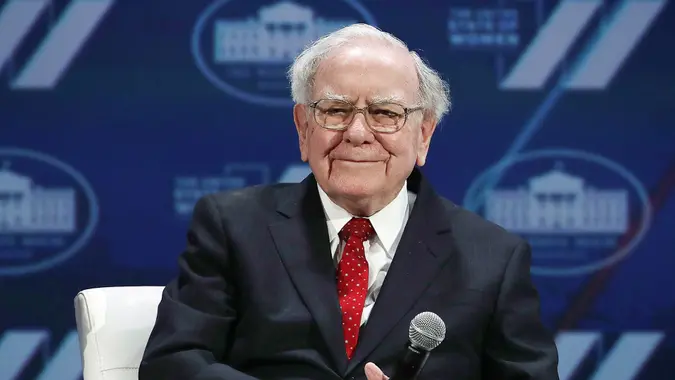
If you’ve ever shown any interest in the uber-wealthy or just Googled the word “investor”, you may have run across the name Warren Buffett. He is widely regarded as one of the greatest investors of all time, but his rise to extraordinary wealth didn’t happen overnight. In fact, nearly 99% of Warren Buffett’s net worth was accumulated after age 50, which is a pretty good omen from the Oracle of Omaha for those who have gotten off to a late start financially.
Here is just how rich Warren Buffett was during every decade of his life, so you can track how and when he became one of the richest men in the world.
Warren Buffett’s 20s: The First $100,000
Born in 1930 during the Great Depression, Buffett showed an early knack for business and money management, launching small ventures as a child and investing well before most people opened their first savings account. After graduating from college, Buffett tried repeatedly to land a job with his mentor Benjamin Graham — even offering to work for free — but had to return to Omaha to work for his father as a stockbroker after Graham’s repeated rejections. At age 21, his net worth was just $20,000.
However, after he kept sending investment ideas to Graham, the legendary investor relented and hired Buffett a couple of years later for an annual salary of $12,000 — almost three times the annual median income for the average family in 1954. When Graham retired just two years later, Buffett took what he had learned and started applying it to an investment partnership he formed with friends and relatives. By the time Buffett reached 26, his net worth was $140,000.
Warren Buffett’s 30s: Millionaire Status
In 1960, the median family income in the U.S. was $5,620 per year, but Buffett was doing much better than that. In early 1962, Buffett plowed almost all of his net worth — $450,000 at the time — into his investment partnership. That proved a smart move, as the partnership had grown to $17 million in value by early 1964, of which his stake was $1.8 million.
Buffett bought a controlling share of stock in Berkshire Hathaway in 1965, obtaining the company that he would become synonymous with. It also marked the end of the investment partnership that launched Buffett’s career. He closed the partnership to new investors in 1966 and then retired from managing it entirely by 1969.
Warren Buffett’s 40s: Bounces Back From Financial Troubles
By age 43, Buffett’s personal net worth was at a high of $34 million. In 1972, he purchased See’s Candies for $25 million, and the company would haul in about $2 billion in profits over the next 50 years.
Buffett’s 40s also marked the period during which he first reached the milestone of a personal net worth of $100 million, which he achieved in 1978 at the age of 48 as Berkshire Hathaway continued to grow. By the end of the decade, the median U.S. household income was about $21,000 — around 4,500 times less than Buffett’s holdings.
Warren Buffett’s 50s: Becoming a Billionaire
In 1982, when Forbes first printed its list of the 400 richest Americans — a list Buffett has been on every single year of its existence — he was listed with a net worth of $250 million, a quarter of the way to billionaire status. And by 1985, just three short years later, the 55-year-old Buffett had managed the astonishing feat of quadrupling the value of his holdings to get that magical third comma.
Meanwhile, the median household income in 1985 was $27,735. Buffett wasn’t done with the 1980s, though. He would keep building his wealth at an incredible rate and by 1989 at age 59, Buffett was worth $3.6 billion — more than tripling $1 billion in just four years.
Warren Buffett’s 60s: Buffett’s Net Worth Triples
The continued success of Berkshire meant Buffett’s wealth kept growing — from $3.3 billion in 1990 to $10.7 billion in 1995 and closing out the decade at $36 billion in 1999. And although ending the decade with ten times as much money as you started is jaw-dropping, it’s worth noting that he had actually slowed his pace, as his 1989 net worth was 14.4 times what he had in 1982.
The average American family began to creep up in earning power during the 1990s, even if they still fell far short of Buffett. The median household income by the end of the decade was about $42,000, according to Census data.
Warren Buffett’s 70s: Philanthropy and Growth
The early aughts saw Buffett continue to make impressive sums of money, but the extreme pace at which he was multiplying his value started to slow considerably. He hit $32.3 billion in 2001 and climbed to $62 billion by 2008. However, the financial crisis meant Buffett took a big hit, just like everyone else, with his net worth falling to $37 billion in 2009.
In 2006, Buffett ramped up his philanthropic efforts, releasing pledge letters that stated he would donate 85% of his wealth to five charitable organizations over time, most of it to the Bill and Melinda Gates Foundation.
Warren Buffett’s 80s: The Sky’s the Limit
As of early 2018, Buffett’s net worth was $84 billion per Forbes, making him the third richest person in the world behind Bill Gates and Jeff Bezos. By 2020, he had already donated around $37 billion to charity.
Of course, the master investor was still making much more than the average American. The median household income in the U.S. was $55,322, according to the most recent Census Bureau data.
Warren Buffett’s 90s: Still Going Strong
Despite having an eye-popping net worth of $147.3 billion as of Feb. 18, 2026, Buffett has fallen a few rungs and is now just the 10th wealthiest person on the planet at age 95, but he should still be OK financially. Though he has yet to show signs of slowing down, with his total charitable giving topping $50 billion, he officially retired as CEO of Berkshire Hathaway on Dec. 31, 2025, after 60 years in the role, with his successor Greg Abel taking over daily operations.
Caitlyn Moorhead contributed to the reporting for this article.
More From GOBankingRates