Billionaire Investor Battle: Comparing How Warren Buffett and Bill Ackman Invest
 Written by
John Csiszar
Written by
John Csiszar
 Edited by
Angela Corry
Edited by
Angela Corry

Commitment to Our Readers
GOBankingRates' editorial team is committed to bringing you unbiased reviews and information. We use data-driven methodologies to evaluate financial products and services - our reviews and ratings are not influenced by advertisers. You can read more about our editorial guidelines and our products and services review methodology.

20 Years
Helping You Live Richer

Reviewed
by Experts

Trusted by
Millions of Readers
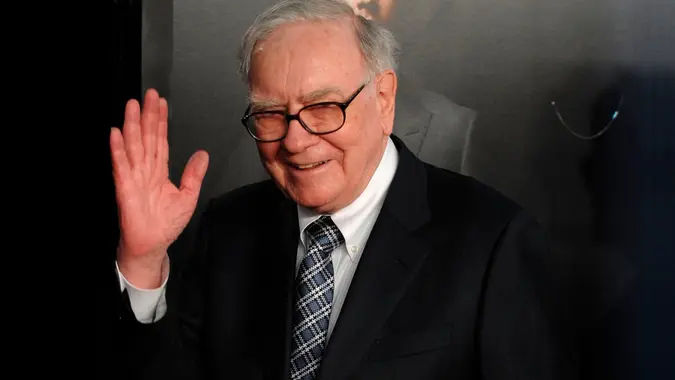
Bill Ackman, the CEO of Pershing Square Capital Management, has historically invested in a very different manner than Warren Buffett, the legendary investor dubbed the “Oracle of Omaha.” The activist investor makes splashy, aggressive bets and touting them in the financial media. But recent reports have quoted Ackman as saying he wants to build a “modern-day Berkshire Hathaway,” suggesting a potential shift in his strategy.
Though there are many differences between Warren Buffett and Bill Ackman, there are a lot of similarities as well. Here are three of the biggest.
Similarities
Concentrated Portfolios
As an investor, you’ve likely heard the advice that you should “diversify your holdings.” And for most casual investors, that’s good advice. But if you’re a professional money manager with access to insights not available to the average investor, you can afford to make bigger bets – and that’s one of the hallmarks of both Buffett and Ackman.
Buffett has long advocated for a concentrated portfolio with large positions in hand-selected names. While he warns that this is a bad strategy for the “know-nothing” investor, if you have the time and ability to pick apart the financials of businesses, it only makes sense to bet big on companies that are unequivocally undervalued. Buffett certainly lives up to this mantra. According to CNBC’s Berkshire Hathaway Portfolio Tracker, just three stocks – Apple (AAPL), American Express (AXP) and Bank of America (BAC) – comprise nearly half of the company’s $311 billion portfolio.
Ackman invests in a similar manner. According to the company’s latest 13F filing, Pershing Square only owns 11 stocks, with its top three positions – Uber Technologies (UBER), Brookfield Corp. (BN) and Howard Hughes Holdings (HHH) making up more than half of the roughly $14.6 billion portfolio.
Buy-and-Hold Philosophy
Warren Buffett is famous for saying that his favorite holding period is “forever,” indicating a strong preference to ride out short-term swings in the market in favor of long-term outperformance.
Ackman’s investment style historically ran against this principle, as he would take large, activist positions in controversial companies and attempt to control them before selling out at a big profit. His recent shift towards wanting to create “the next Berkshire Hathaway,” however, has changed things. Now, Ackman’s Pershing Square portfolio is built around long-term positions in durable companies positioned for the long run.
Performance
Buffett’s track record with Berkshire Hathaway has been nothing short of amazing, especially considering its long-term consistency. Over the past 60 years, Buffett has posted average annual returns of 19.9%, a stunning record over six decades of ups and downs.
But Ackman’s performance isn’t that far behind. Since its founding in 2004, more than 20 years ago, Ackman’s Pershing Square fund returns have compounded at a 19.8% annual rate.
Certainly, that’s not an apples-to-apples comparison, as Buffett’s record stretches three times as long and Ackman’s does not account for the deduction of fees. But nonetheless, there’s no denying that these two investment managers have consistently posted elite returns.
How They Differ
Active vs. Passive Investment
Buffett’s whole career has been built around building sizable, long-term stakes in quality businesses. This applies to the private sector as well, with Berkshire Hathaway outright owning non-public companies like See’s Candies, NetJets and Geico.
Ackman’s Pershing Square, on the other hand, currently invests only in publicly traded companies.
Structure and Fees
Berkshire itself is merely a holding company that trades on the public stock exchange, accessible to all investors without paying management fees.
Ackman’s Pershing Square, on the other hand, is a publicly traded fund that owns publicly traded equities and charges high management fees. According to Barron’s, Ackman charges a 1.5% annual management fee and an incentive fee equal to 16% of the fund’s annual performance — essentially making it a hedge fund, not a holding company.
Risk Profiles and Scale
Due to his activist nature, Ackman’s gains and losses tend to be more volatile than the historically steady, diversified cash flow from Berkshire’s blend of fairly conservative businesses. Ackman has historically swung for the fences and made big, oftentimes controversial bets, including Canadian Pacific and Herbalife.
Buffett also controls an immense portfolio that includes a cash position of over $300 billion. This gives Berkshire Hathaway immense leverage and the ability to completely purchase private companies, something that Ackman cannot yet do.
The Bottom Line
Both Warren Buffett and Bill Ackman have long track records of investment success, but they’ve taken different tracks to get there. Buffett famously buys dominant companies with predictable cash flow that trade at a discount, while Ackman has been more of a “run-and-gun” type of investment manager, investing in companies he can take an activist position in.
But things may be changing. Buffett has announced his intention to retire at the end of 2025, and Ackman has made claims that he wants to build a new-era Berkshire Hathaway. Regardless of what happens, both managers have shown a knack for maximizing shareholder returns and building long-term wealth.
More From GOBankingRates