Jim Cramer Says Not To Invest in SPACS, Should You Listen?
 Written by
Yaël Bizouati-Kennedy
Written by
Yaël Bizouati-Kennedy
 Edited by
Daria Uhlig
Edited by
Daria Uhlig
Commitment to Our Readers
GOBankingRates' editorial team is committed to bringing you unbiased reviews and information. We use data-driven methodologies to evaluate financial products and services - our reviews and ratings are not influenced by advertisers. You can read more about our editorial guidelines and our products and services review methodology.

20 Years
Helping You Live Richer

Reviewed
by Experts

Trusted by
Millions of Readers
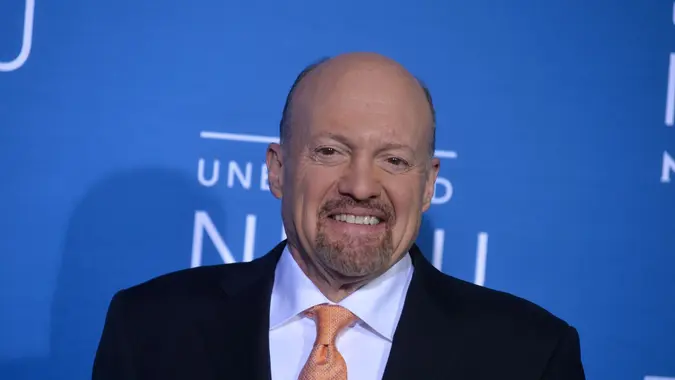
Jim Cramer is warning consumers to not invest in SPACs — special purpose acquisition companies — which were in a frenzy during the pandemic.
“I see more SPACs showing up again and I am urging everyone to stay away from these legal cons,” Cramer tweeted on Aug. 15.
A SPAC is a publicly traded company specifically created to acquire or merge with private companies. As such, SPACs are often viewed as “blank check” companies. Acquisition by a SPAC can be a fast track to the public market as opposed to enduring the standard initial public offering process, which takes 12 to 18 months compared to three to four months for a SPAC, as SoFi explained.
“The explosion of SPACs since the pandemic began has been incredible. Hundreds of billions of dollars have been raised in support of what are fundamentally blank check companies,” said Peter C. Earle, economist, American Institute for Economic Research.
As Earle noted, SPACs are subject to certain risks that aren’t present in IPOs and established companies, or at least not nearly as frequently. Those risks include deals collapsing, inexperienced management and poor returns on average, he added.
“In 2022, in fact, according to one index, SPAC values fell by 73%. That’s almost four times as bad at the S&P 500’s 2022 return (-19.6%) last year,” he said.
According to Earle, one of the biggest problems with SPACs is that their managers — usually called sponsors — have two years to find a company to purchase. If they don’t find a target to acquire and fold into the SPAC shell, they have to give investors their money back.
“What that means is that there is pressure to find an acquisition target, which may result in either a rush to purchase a subpar company, overpaying for the target company, or both. It’s a suboptimal arrangement for investors,” he said.
Another issue, he noted, is that the way many SPACs are structured disproportionately benefits sponsors. In turn, when the share price of the SPAC rises, the sponsor often makes several times what the later investors make. So when the price falls, investors have the overwhelming majority of downside risk.
“A traditional IPO might generate fees of 7% or so for an investment bank, while SPACs can generate much higher fees for the sponsors. It’s a very expensive way to make what have often been atrocious returns,” Earle said, adding that there are always exceptions to a rule, but generally, the warnings about SPAC performance have proven valid.
Other experts echoed the sentiment, saying that these blank check companies have no commercial operations and are formed strictly to raise capital.
“I often disagree with Cramer, but he is correct here,” said Robert R. Johnson, PhD, CFA, CAIA, professor, Heider College of Business, Creighton University.
“In layman’s terms, the investors in a SPAC have no idea what company they ultimately will be invested in. Essentially, these companies choose to go public via a SPAC to avoid those pesky disclosures required in an IPO,” he said.
As Johnson noted, many celebrities have gotten into the lucrative SPAC game. Former basketball player Shaquille O’Neil, former baseball player Alex Rodriquez, tennis superstar Serena Williams and former speaker of the House Paul Ryan all issued SPACs.
It’s worth noting that in 2021, the Securities and Exchange Commission had to issue a notice warning against the dangers of SPACs and their sponsors.
“The SEC’s Office of Investor Education and Advocacy (OIEA) cautions investors not to make investment decisions related to SPACs based solely on celebrity involvement … It is never a good idea to invest in a SPAC just because someone famous sponsors or invests in it or says it is a good investment,” the SEC said in the notice.
More From GOBankingRates