Average Unsecured Debt Skyrockets from $20K to $30K in 18 Months — Are Americans Running Out of Money and Credit?
 Written by
Dawn Allcot
Written by
Dawn Allcot
 Edited by
Nicholas Morine
Edited by
Nicholas Morine
Commitment to Our Readers
GOBankingRates' editorial team is committed to bringing you unbiased reviews and information. We use data-driven methodologies to evaluate financial products and services - our reviews and ratings are not influenced by advertisers. You can read more about our editorial guidelines and our products and services review methodology.

20 Years
Helping You Live Richer

Reviewed
by Experts

Trusted by
Millions of Readers
In a video from earlier this year, YouTube star and finance expert Jaspreet Singh predicted that “Americans are running out of money.” As previously reported by GOBankingRates, despite the repercussions, “The reason the economy is staying hot is because people are still spending money,” Singh stated.
However, that scenario may be shifting, as observed by Thomas Nitzsche, senior director of media and brand at Money Management International (MMI).
In an email interview, Nitzsche told GOBankingRates that MMI recorded a 44% year-over-year increase in consumers seeking credit counseling services during Thanksgiving week, and an 80% increase on Cyber Monday, typically one of the biggest shopping days of the holiday season.
“I am very concerned with the fact that we have not seen the usual holiday decrease in new clients. Typically, November and December are slower months for us, but November counseling volume was down just 7% from October and up 51% year-over-year,” he said.
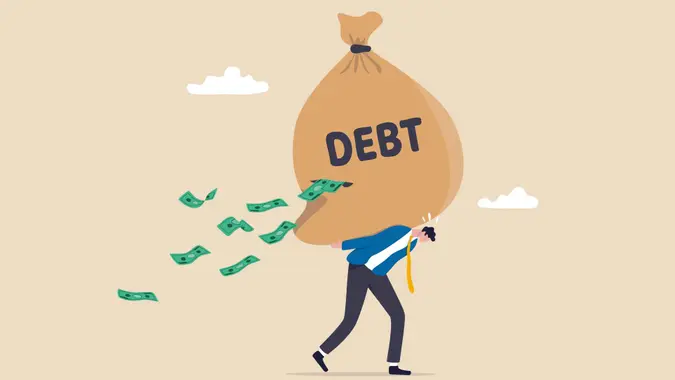
Meanwhile, the average unsecured debt of new MMI clients rose from $20,000 to $30,000 in the past 18 months across all age groups.
Holiday Spending Growth Slows, According to National Retail Federation
Meanwhile, the National Retail Federation reported that, although a record number of shoppers made purchases during Thanksgiving weekend, spending during November and December is projected to see its slowest growth rate in five years.
In 2022, sales grew by 5.4% and, in 2021, sales grew by 12.7%. In 2023, sales are projected to increase by just 3% to 4%, the NRF reported in a press release.
A growth rate of 3% to 4% aligns with spending patterns from 2010 to 2019, which could indicate that the era of post-pandemic “revenge spending” might be over. And, as Singh predicted, this may not be good for the economy.
Nitzsche said he would “defer to an economist to speculate on the possibility of a recession.”
However, he added, “If the trend continues and impacts more over-extended middle-class Americans, it will certainly have a negative impact on the economy.”
Revenge Spending, Student Loan Payments and Other Financial Stressors
“Post-pandemic spending is likely one of several factors catching up with Americans and driving some of the increases [in credit counseling requests] we are seeing,” Nitzsche noted.
Other factors driving requests for credit counseling, according to Nitzsche, include:
- Record-high credit card interest rates.
- Student loan payments resuming.
- Wages not keeping up with the cost of living.
- Inflation.
- The expiration of COVID relief efforts.
“We don’t typically meet with clients until they have exhausted other options (like a consolidation loan) and maxed out their credit,” Nitzsche said. “Clients are also often referred to us by their creditors when they notice that the consumer is struggling with multiple debts across several lenders.”
Nitzsche pointed out that the resumption of student loan payments, in particular, is affecting members of Gen Z and young millennials. People ages 18 up to 39 showed sharp increases in requests for credit counseling over the past 18 months. In fact, the number of new MMI clients who are 18 to 29 years surpassed the number of new clients ages 50 to 59.
“We are particularly concerned about the unusual increases in clients who are young adults as student loan payments come back online,” Nitzsche told GOBankingRates. “For many of these clients, it’s their first time experiencing high credit card interest rates and student loan payments while juggling elevated housing costs and high cost of living.”
Can Credit Counseling Help You?
If you’re struggling with student loan debt on top of high credit card interest rates and balances, credit counseling may offer a solution.
A credit counselor may recommend using the debt snowball or debt avalanche method to pay down your debt, particularly if your credit score is too low to qualify for a credit consolidation loan or a 0% interest credit card.
If that seems impossible, Nitzsche said, a credit counselor can help find alternatives. These solutions could include settlements for lump sum payments of less than you owe or a debt management plan.
“If the client is struggling to afford high-interest credit card debt, the counselor may suggest a debt management plan (DMP) which, on average, reduces interest rates to around 7% and creates a path to be debt-free within 5 years,” Nitzsche explained.
“There are no credit score requirements and terms are competitive with a consolidation loan, although included accounts are closed upon enrollment.”
Credit Counseling and Unpayable Debt
There may be additional solutions for seniors or those who do not have the income to repay their debt, Nitzsche indicated.
“If the client is elderly or disabled with no assets and receiving social security or other protected income, they may be “judgment proof” and not have to repay the debt if they cannot afford their basic living expenses,” he said.
Likewise, if a client cannot afford to repay their debt while also covering their housing and other living expenses, the credit counseling agency may recommend speaking to a lawyer about bankruptcy.
Whatever your circumstances, if you are struggling with debt, the first step is to create a written budget, Nitzsche pointed out. “It’s important to understand how much you can afford to devote towards debt without straining other areas of spending. For many of our clients, working with us on a written budget is the first time they have done so,” he said.
It seems that 2024 might be the year in which Americans need to get their financial houses in order as debt rises to staggering levels and interest rates remain elevated. “If rates do not decrease, I expect to see more widespread impact,” Nitzsche said.
“January and February are typically higher-volume months for us, as holiday bills roll in and people set new year’s financial resolutions,” Nitzsche said. “The strong demand for counseling through the holidays indicates to me that unless economic factors change significantly, we will continue to see increases in both counseling volume and debt loads into next year.
More From GOBankingRates