5 Biggest Benefits of Trump’s Tariffs in 2025
 Written by
Dawn Allcot
Written by
Dawn Allcot
 Edited by
Angela Corry
Edited by
Angela Corry
Commitment to Our Readers
GOBankingRates' editorial team is committed to bringing you unbiased reviews and information. We use data-driven methodologies to evaluate financial products and services - our reviews and ratings are not influenced by advertisers. You can read more about our editorial guidelines and our products and services review methodology.

20 Years
Helping You Live Richer

Reviewed
by Experts

Trusted by
Millions of Readers
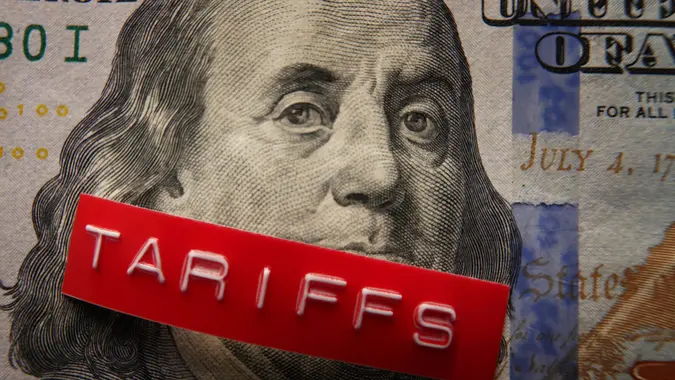
Businesses and consumers began feeling the effects of President Donald Trump’s tariffs in mid-2025. The year was marked by economic uncertainty and inflation, but some experts asserted that as things stabilize, the U.S. may see some advantages from the tariffs.
“This year has been very chaotic with the import of raw materials, refined materials and components,” said Matthew Chang, Chang Robotics founder and principal engineer. “It’s required a major reorientation of distributors and resellers … But we now have a sense of stability in terms of what the tariff environment is, and [what] it’s going to continue to be for the next year and the remainder of this presidential administration.”
Increased Pricing Power, Especially for Smaller Local Businesses
Sectors like electronics, beauty products, home goods, toys and clothing are already seeing an impact. The “de minimis” tariff rule that allowed offshore retailers to sell cheap goods online impacted companies like Shein and Temu but didn’t stop them from doing business in the U.S. While this opened doors for American manufacturers, it also introduced new challenges.
Read More: Trump’s $2,000 Tariff Dividend: 6 Mistakes To Avoid If You Receive This Payment
“Shipping and logistics companies will now have to handle increased processing workloads which adds cost and slows delivery times,” Ben Johnston, COO of Kapitus, a small business lender and marketplace, said. “On the flip side, domestic manufacturers should benefit from less competition and the ability to achieve pricing power in a market that, for many de minimis impacted products, had become uneconomic to produce in the United States.”
“We can count on the competitive advantage we have versus foreign firms and the tariffs foreign firms encounter,” Chang added.
Less Consumption and Localized Production
Babak Hafezi, adjunct professor of international business at American University and CEO of Hafezi Capital, shared that tariffs could reduce consumption in the U.S. which, ultimately, will be better for the environment and sustainability efforts.
“I’m talking about everything, from raw materials all the way to packaging and shipping, gasoline consumption, warehousing and climate control,” he said. “We’re going to see shrinkage in the number of units Americans consume, and we’re going to have less diversity in options, as well.”
Although this may be a net-positive for the environment, some experts view it as a step backward in other ways.
“Trade itself was the means by which to create more opportunities for commerce,” said Freight Right founder and CEO Robert Khachatryan. “Reducing goods, reducing merchants, reducing consumable opportunities is the opposite of free trade. Throwing consumers back to a time of limited choice and limited opportunities simply to try to meet aspirations of a foregone time is unspeakably challenging.”
Increased Economic Resilience
In spite of the challenges ahead, a reduced reliance on foreign goods can help the US increase resilience.
“We don’t want to be dependent on countries like China for critical goods,” Hafezi said. “We want to be self-sufficient.”
Investment in Infrastructure
Self-sufficiency may not happen in every industry, but tariffs allow us to choose our trade partners more carefully. Then, the US can carefully choose industries we can competitively and affordably reshore.
“We have to find segments we believe we can compete in,” Hafezi said. “The infrastructure, meaning roads, electricity, internet, docking ports — those all have to be upgraded.”
Khachatryan conceded that tariffs could reduce US dependence on foreign supply chains if domestic markets can continue innovating and investing in the people and technology necessary to make it happen.
“[If] the U.S. is going to continue down this road of intentional isolationism, it will need to incentivize those that remain in this country to develop the means by which to achieve as close to true independence from the rest of the world as possible,” he said.
Focus on Automation and Workforce Upskilling
Hafezi views automation as a big part of the solution. “Automation will become a critical factor in reshoring, meaning that we’re not going to restore [jobs] one-to-one,” he said.
“If there are 100 employees manufacturing in China, we may bring 10 to 15 jobs to the U.S., and the remainder is going to be automated.”
Chang agreed, “We can’t create two times the current number of factory workers … The opportunity we see is that manufacturing is coming back, and existing factory workforces are getting upskilled and trained in software automation, technician work and maintenance work.”
He said he’s already seeing requests for automation.
“Our phone is ringing off the hook for engineering services right now. This means companies are putting plans in place to expand next year,” he said. “They want to understand what it’s going to take to increase their production domestically. We’re seeing it in a variety of sectors, in everything from consumer-packaged goods to aerospace.”
More From GOBankingRates