2 Economic Scenarios That Could Trigger Another Wave of Stimulus Checks, According to Economists
 Written by
Martin Dasko
Written by
Martin Dasko
 Edited by
Amen Oyiboke
Edited by
Amen Oyiboke
Commitment to Our Readers
GOBankingRates' editorial team is committed to bringing you unbiased reviews and information. We use data-driven methodologies to evaluate financial products and services - our reviews and ratings are not influenced by advertisers. You can read more about our editorial guidelines and our products and services review methodology.

20 Years
Helping You Live Richer

Reviewed
by Experts

Trusted by
Millions of Readers
An article published earlier this year by USA Today explored the idea of Americans receiving a “tariff dividend” refund check, as President Trump mentioned at different points in 2025.
While the piece noted that such stimulus checks would likely require legislation passed by Congress, as happened in 2020 and 2021, it’s important to note that there hasn’t been an official announcement as of January. However, it’s worth exploring what could trigger another wave of relief checks for Americans.
GOBankingRates consulted experts to determine scenarios that could trigger another wave of stimulus checks and to share insights into what caused these checks in the past.
What Would Trigger Another Wave of Stimulus Checks?
“Another round of stimulus checks would almost certainly require a sharp, economy-wide shock rather than a period of slower growth or isolated weakness,” said Lisa Simon, the chief economist at Revelio Labs.
She emphasized that in the past, direct checks have been sent out when households suddenly lost their incomes and policymakers needed to boost demand quickly. When the economy stalls due to an unforeseen event, the government may intervene by distributing cash to Americans to rebalance supply and demand.
Why Were Stimulus Checks Distributed In the Past?
The most common examples of stimulus checks being distributed occurred during the COVID-19 pandemic.
“In 2020 and 2021, multiple rounds of stimulus checks were sent as unemployment spiked abruptly, large parts of the economy were shut down, and millions of workers lost income at the same time,” Simon said. “Lawmakers viewed direct cash payments as the fastest way to stabilize household finances and prevent a deeper recession.”
The economy was in a unique situation because Americans were urged to stay home in many cases. Some businesses had to shut down, many jobs went remote, and consumers were cautious about travel.
Melanie Musson, a finance expert with Quote.com, said, “COVID stimulus checks helped boost an economy that was absolutely halted by shutdowns, job losses, and supply shortages.”
The money provided relief at a time when Americans were stressed about their finances and the future.
Before the pandemic, stimulus checks were distributed in a few other scenarios. “Earlier episodes followed a similar logic, including the 2001 tax rebate checks after the dot-com downturn and the 2008 rebates during the Global Financial Crisis, both aimed at cushioning consumer spending during periods of economic stress,” said Simon.
As a quick recap, here are notable stimulus checks:
- Economic Growth and Tax Relief Reconciliation Act in 2021.
- Economic Stimulus Act in 2008.
- CARES Act in 2020.
- Coronavirus Relief Act in 2020.
- Rescue Plan Act in 2021.
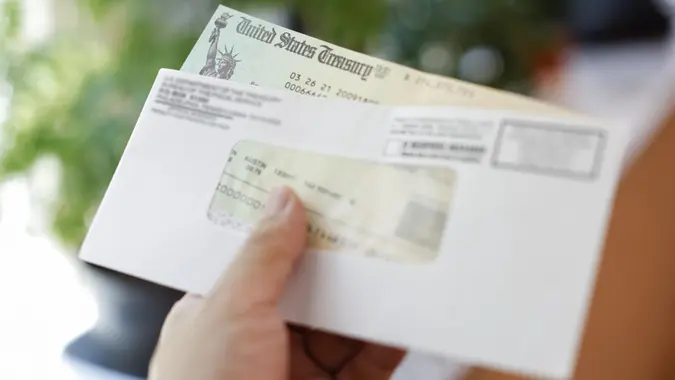
It’s worth noting that the pandemic era included three rounds of stimulus checks. The first round offered individuals $1,200, the second round was $600, and the final round was $1,400. CNBC shared that 90% of taxpayers received some form of financial relief during this period.
What Scenarios Could Lead To Stimulus Checks in 2026?
“We as economists tend to be very bad at predicting Black Swan events, which would sort of be the requirement for a stimulus check scenario,” said Simon. She said that if 2026 did come with stimulus checks and she had to guess what led to them, it would be one of the following two specific scenarios:
A rapid deterioration in hiring, a sharp rise in mass layoffs and unemployment, and a near stop in consumer spending — likely caused by a severe outside event such as a war that led to a halt in spending and subsequent halt in hiring, combined with mass layoffs.
A stock market crash, with AI companies losing their high valuations and a complete sell-off to follow. This may, in turn, trigger a 2008-style financial crisis and subsequent stimulus checks.
She noted that these scenarios are very unlikely but would be her best guesses, since such events are difficult to predict in advance. Simon concluded, “Stimulus checks are typically a crisis response, not a tool used during a normal slowdown in an otherwise functioning economy.”
Are Stimulus Checks Likely for 2026?
Simon said today’s environment looks very different. “Unemployment remains low by historical standards, consumer spending has held up, and inflation remains an important constraint on fiscal policy,” she said.
She did share a few warning signs that could trigger stimulus checks:
- Policymakers would likely need to see a rapid rise in job losses, with unemployment skyrocketing.
- A clear pullback in consumer spending because consumers either don’t have the money or are worried about the future.
- Broader signs of systemic stress, combined with enough disinflation to make large cash transfers politically and economically viable.
- A significant portion of Americans in a worsening financial position, with a large number of foreclosures.
Musson said the economy would have to experience a downturn. While people may point to economic uncertainty in the current climate, uncertainty alone won’t trigger stimulus checks. Musson concluded, “While a stimulus check would be welcome, the hardships required to trigger one are not worth it.”
Time will tell whether stimulus checks will arrive in 2026 in some form, but it’s too soon to know what will happen.
More From GOBankingRates