Here’s How Trump’s $2K Dividend Will Impact the Cost of Groceries
 Written by
Heather Altamirano
Written by
Heather Altamirano
 Edited by
Amen Oyiboke
Edited by
Amen Oyiboke
Commitment to Our Readers
GOBankingRates' editorial team is committed to bringing you unbiased reviews and information. We use data-driven methodologies to evaluate financial products and services - our reviews and ratings are not influenced by advertisers. You can read more about our editorial guidelines and our products and services review methodology.

20 Years
Helping You Live Richer

Reviewed
by Experts

Trusted by
Millions of Readers
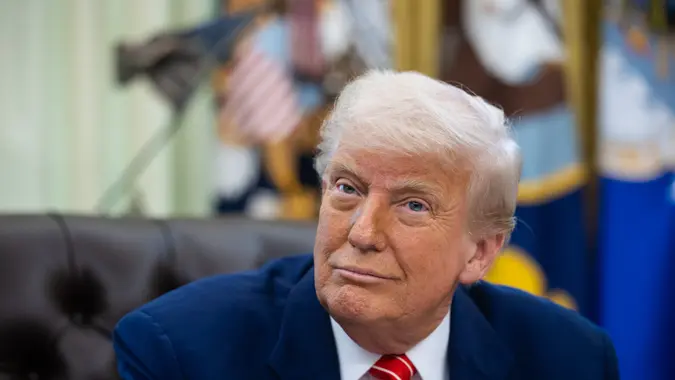
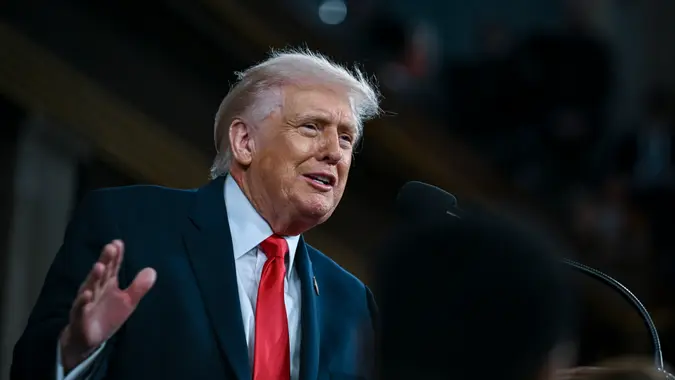
President Trump has vowed to give qualifying Americans a $2,000 tariff dividend. There are no details or a plan, but White House press secretary Karoline Leavitt confirmed that Trump is “committed” and told reporters on Nov. 12, “We are currently exploring all legal options to get that done.”
While many Americans could use an extra boost, experts worry that the $2,000 dividend could raise prices, including grocery costs. Here’s how.
How the Dividend Can Affect the Price of Groceries
Trump’s proposal is a nice idea on the surface, but it could lead to higher prices because many items, like fresh produce and coffee, contain imported components.
“As input costs rise due to tariffs, the final prices of grocery items at the store increase,” said Jesse Singh, CEO and founder of Maadho.
But there’s another reason for grocery prices to rise if a payout is approved. Millions of people will buy essentials like food, which creates a bigger demand than there is supply.
“When you inject artificial money into the economy without any corresponding increase in production or output, you inevitably increase demand,” said Peter Diamond, a federally licensed and certified bankability expert.
When demand outpaces supply, costs go up. It’s the fundamental law of supply and demand.
There Is a Risk of the Dividend Complicating Inflation and Cost Pressures
Trump wrote on Truth Social that $2,000 will come from money generated by his tariffs, but many argue that there isn’t enough money to do so and that it will complicate inflation and add to cost pressures.
“If the dividend costs more than the tariffs bring in, the gap is covered by more government borrowing, which is another form of stimulus layered on top,” said Danny Ray, founder of PinnacleQuote. “Analyses so far suggest that a nationwide $2,000 payment would likely exceed tariff revenue by a wide margin, so it would behave more like a deficit-financed rebate than a true dividend.”
Injecting such a large amount of borrowed money into an economy that is already struggling with rising costs is inherently inflationary.
“This action not only fails to offset the full economic damage inflicted by the tariffs but also adds extra money to a relatively fixed supply of goods, which increases economy-wide inflation,” said Singh.
How a One-Time Cash Payment Can Lead to Economy-Wide Inflation and Impact Groceries
When previous stimulus checks have been issued, lower-income households typically spend the money immediately on basics like food. As a result, demand increases significantly.
“Groceries are a non-discretionary purchase, so consumers have to pay the higher price, which causes this sudden spike in demand to translate directly into higher consumer prices in the food sector and contributes significantly to the overall rate of inflation,” said Singh.
Short-Term Relief Will Cause Long-Term Problems at the Cash Register
Receiving an extra $2,000 will help many Americans in the short term cover essential expenses such as food, rent, and other monthly bills. However, it will ultimately cost them more, according to Ray.
“Once a supermarket raises the price of milk, bread, or meat to cover higher costs, it rarely rushes to cut those prices back down,” he said. “The cash hits bank accounts once, but the grocery bill can stay higher month after month.”
When the dividend is gone, the high prices remain.
“The combination of tariffs and extra demand can leave them paying more for food long after the money is spent,” Ray said.
The bottom line is that the $2,000 checks will create more financial problems and long-term instability.
“Very few people are disciplined enough to save or invest that money, even though that’s the smartest thing to do with funds you didn’t plan on having,” Diamond said. “Unfortunately, this type of payout risks making the inflation problem worse, not better.”
More From GOBankingRates