4 Themes of Trump’s First Year of His Second Term — And What They Meant for Your Money
 Written by
John Schmoll
Written by
John Schmoll
 Edited by
Molly Sullivan
Edited by
Molly Sullivan
Commitment to Our Readers
GOBankingRates' editorial team is committed to bringing you unbiased reviews and information. We use data-driven methodologies to evaluate financial products and services - our reviews and ratings are not influenced by advertisers. You can read more about our editorial guidelines and our products and services review methodology.

20 Years
Helping You Live Richer

Reviewed
by Experts

Trusted by
Millions of Readers
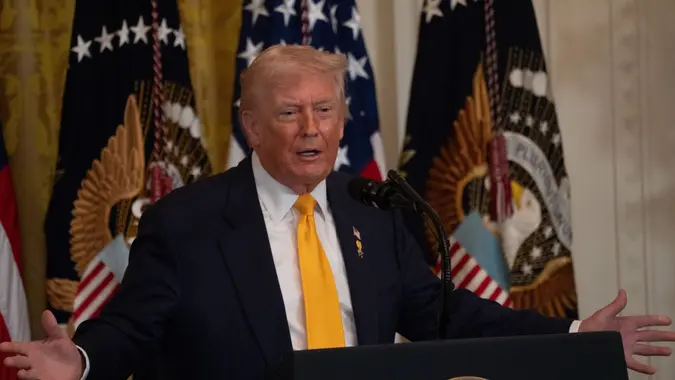
President Donald Trump recently celebrated his first year in office for his second term. In that time, Trump has dominated the headlines with many of his actions. While many of those measures have had political ramifications, a fair number have had economic impacts on Americans.
How such steps will affect Americans’ pocketbooks depends on factors like income, homeowner status, state of residence and more. Here are four overriding financial themes from Trump’s first year back in office and what they meant for many Americans.
Significant Tax Changes
Trump campaigned on the idea of making significant changes to the tax law. The signing of the One Big, Beautiful Bill Act (OBBBA) on July 4, 2025, saw many of those changes come to light. The OBBBA effectively extended or restored much of Trump’s tax agenda from his first term in the Tax Cuts and Jobs Act (TCJA).
According to the Tax Policy Center, tax changes include:
- Nearly doubling the standard deduction
- Increasing the child tax credit
- Possible auto loan tax interest deductions
- Increase in the state and local tax (SALT) deduction cap
- Tax deductions for seniors 65 and over
- Tip income tax deduction
Lower-income Americans will receive the greatest relief from tax changes, according to the Ways and Means Committee. However, analysis by the Tax Policy Center (TPC) shows differently. Nearly 60% of the benefits will go to the top quintile of earners (those with incomes over $217,000), per the TPC. Time will tell who will benefit most from the tax changes.
Tariffs Used as a Bargaining Tool
Tariffs were something Trump had long mentioned on the campaign trail. He has lived up to that promise, introducing tariffs on numerous imports. Despite Trump’s claims that tariffs are bringing in billions of dollars, studies show they are driving up prices for Americans.
Tariffs have led to prices increasing by 4.8% on domestic goods compared to pre-tariff levels, according to the Tax Foundation. Americans are noticing increased prices at stores, too. Roughly 75% of Americans believe Trump isn’t doing enough to lower prices, according to CBS News.
With the legality of Trump’s ability to levy tariffs before the Supreme Court still in question, it remains to be seen whether tariffs will continue to impact Americans’ wallets.
Attacking Housing Affordability
Finding affordable housing remains a challenge for Americans. Tight inventory and higher mortgage interest rates are key drivers intensifying the headwinds for most.
Trump has taken some actions to increase options for would-be buyers. Seeking to limit how many single-family homes large institutional investors can purchase is one step, according to Reuters. Additionally, Trump recently directed Fannie Mae and Freddie Mac to purchase $200 billion in mortgage bonds on Truth Social.
There’s no clarity yet on how these actions will improve housing affordability. Worse yet, housing inventory continues to lag, according to the National Association of Realtors. For interested buyers, it’s wise to improve your credit score to put you in a good position to buy when the timing is right.
Unleashing American Energy
One of Trump’s first acts upon returning to office was his effort to unleash American energy. It’s understandable as electricity bill increased 13% alone from January to October 2025, according to Time.
Trump’s goal is to reduce regulation around energy and boost domestic energy production, per to the White House, with the effect of introducing more supply and, thus, lower costs for Americans. Unfortunately, Trump significantly curtailed tax credits for Americans buying solar panels and electric vehicles. Reduced energy prices are still possible, but given the current market, achieving them will be difficult, per Time.
Policy shifts are ongoing, but it’s clear that Trump is impacting many Americans’ budgets. Staying abreast of changes and how they impact your wallet, while continuing to identify ways to save, is the best course of action for concerned Americans.
Editor’s note on political coverage: GOBankingRates is nonpartisan and strives to cover all aspects of the economy objectively and present balanced reports on politically focused finance stories. You can find more coverage of this topic on GOBankingRates.com.
More From GOBankingRates