Bigger Refund, Bigger Risk: The Tax Refund Advance Ads Are Coming Back
 Written by
John Csiszar
Written by
John Csiszar
 Edited by
Zuri Anderson
Edited by
Zuri Anderson
Commitment to Our Readers
GOBankingRates' editorial team is committed to bringing you unbiased reviews and information. We use data-driven methodologies to evaluate financial products and services - our reviews and ratings are not influenced by advertisers. You can read more about our editorial guidelines and our products and services review methodology.

20 Years
Helping You Live Richer

Reviewed
by Experts

Trusted by
Millions of Readers
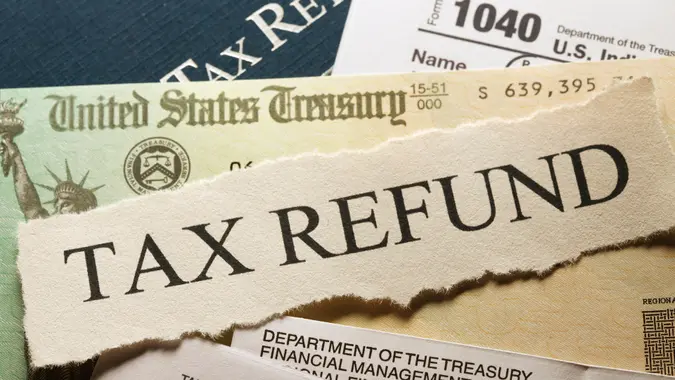
With average IRS refunds running higher this season, tax refund advance ads are making a strong comeback.
The marketing promises “cash today” or “refund in minutes,” but consumers should understand what they’re actually signing up for before clicking apply.
Also find out what tax breaks many middle-class families miss when they file too fast.
How Tax Refund Advances Are Structured
According to the Consumer Financial Protection Bureau, tax refund advances are really short-term loans, often dubbed refund advance loans (RALs). Here’s how they work.
An RAL is not technically your tax refund. Rather, firms that offer RALs must front the money out of their own pockets. In exchange for this service, they charge fees and interest, often at very high rates.
Some firms do advertise “no-fee” advances, but those are usually for smaller amounts. If your tax refund exceeds $1,000, you should read the fine print to see how much you’ll be paying in fees and interest for the convenience.
Is a Tax Refund Advance Worth It?
Before agreeing to an RAL, be sure to understand exactly what it will cost you. Then, ask yourself these questions:
- Can I wait the 21 days that the IRS usually takes to process a refund for e-filers?
- Are there cheaper borrowing alternatives if I truly need emergency cash?
Remember that over a one-month period, even a very high interest rate might not seem like a burden. For example, if you pay a 36% interest rate on a $3,000 RAL for one month, your interest charge will only amount to $90. That makes these loans much easier to market. While a $90 outlay may not sting that much in the face of a $3,000 refund, it’s still an extremely costly expense.
How To Tell if You’re Being Offered an RAL
As refund anticipation loans sometimes carry a negative connotation, markets have come up with a wide variety of descriptions of tax refund advance loans. Here’s an example of the types of marketing copy often associated with these loans:
- Offers of upfront cash “in minutes” or “same day” after filing your taxes.
- Marketing that emphasizes getting money fast without credit checks but that doesn’t highlight the cost.
- Suggestions that these advances can help with bills, emergencies or living expenses before your refund arrives.
Things To Remember
Before you accept any type of RAL, remember these facts:
- These “advances” have nothing to do with the IRS. A refund anticipation loan doesn’t push the IRS to deliver your refund faster. You’re simply taking out a short-term loan from a financial company.
- You’ll usually have to pay your fees and interest from your refund. This lowers the amount that you’ll actually receive. While you may be able to get a “no-fee” advance, you’ll usually have to pay a firm to process your return in order to be eligible.
- RALs can be expensive. Consumer watchdog groups like the California Department of Financial Protection and Innovation advise against using refund advances unless you truly need emergency funds and have no cheaper alternative.
More From GoBankingRates