Advertiser Disclosure
GOBankingRates works with many financial advertisers to showcase their products and services to our audiences. These brands compensate us to advertise their products in ads across our site. This compensation may impact how and where products appear on this site. We are not a comparison-tool and these offers do not represent all available deposit, investment, loan or credit products.
Don’t Hide Your Emergency Cash in These Spots
Written by
Cynthia Measom
Edited by
Chris Cluff

Commitment to Our Readers
GOBankingRates' editorial team is committed to bringing you unbiased reviews and information. We use data-driven methodologies to evaluate financial products and services - our reviews and ratings are not influenced by advertisers. You can read more about our editorial guidelines and our products and services review methodology.
20 YearsHelping You Live Richer
Reviewed by Experts
Trusted by Millions of Readers
To keep from having to go into debt when the unexpected happens, financial experts recommend that you open a savings account and build an emergency fund that can cover three to six months’ worth of expenses. While that’s all well and good, sometimes you need to have cash within arm’s reach.
“It is smart to have a stash of money on hand in case of natural disasters or major power outages when electronic money transfers may not be possible,” said Andrew Latham, certified financial planner and content director for SuperMoney. “However, the lion’s share of your emergency savings should be in an FDIC-insured savings account earning interest.”
If you’re hiding emergency cash at home, here are some spots you should avoid.
Buried in Your Yard
“If you want to keep your cash accessible but not in a bank account, you might get tempted to put it in a coffee can or plastic bag and bury it in your yard,” said Laura Adams, MBA and personal finance expert with Finder. “That might be the worst place for cash because it could get destroyed, forgotten or stolen. Even if you have home or renters insurance, it never covers lost, damaged or stolen cash.”
In a Safe That Isn’t Waterproof or Fireproof
“If you want cash on hand, ensure it’s in a waterproof and fireproof safe or locked cabinet,” Adams said. “Make sure you don’t keep all your emergency money at home because a natural disaster such as a fire, flood or windstorm could put you at risk of losing all of it.”
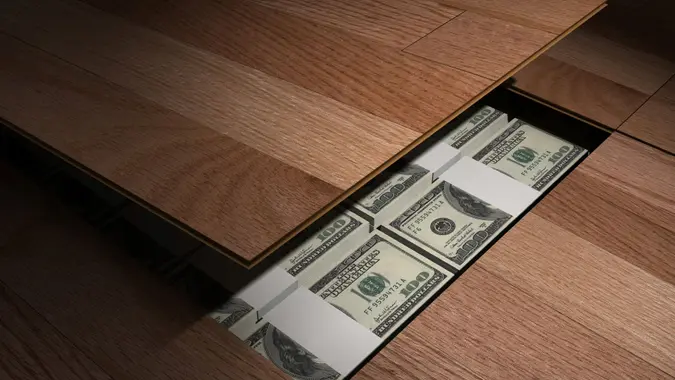
Under a Loose Floorboard or Behind a Loose Brick
That loose floorboard in the hallway or that loose brick in the fireplace might seem like the perfect hiding spot, but, unfortunately, they are not.
“These places are often the first that a thief will check — and are also vulnerable to water damage or other environmental factors,” said Nate Nead, CEO and principal investment banker at Invest.
In a Sock or Underwear Drawer
Burying your emergency cash in the depths of your sock or underwear drawer seems like the perfect place to keep it safe, but thieves are likely to toss it if they enter your home.
“These are also common places that thieves will check,” Nead said.
In a Plant Pot
“While it might seem like a good idea to hide cash among the soil and leaves, it’s not a great idea because it can be damaged by water, humidity or pests,” said Nead.
In Your Bedroom
“Do not hide money in your bedroom,” said Doug Carey, chartered financial analyst and owner of WealthTrace. “This is the first place most burglars will go to search for cash, jewelry and other valuables.”
If you’re thinking about putting the cash under your mattress, think again.
“Hiding money under the mattress is the very worst place because burglars will no doubt flip the mattress over when looking for valuables,” Carey said.
In Your Child’s Bedroom
“You should also never hide valuable items in your children’s bedrooms,” Carey said. “Burglars will spend a lot of time in children’s bedrooms looking for expensive toys, game consoles and electronics. You can bet they would also find any valuables you hide there.”
In a Hidden or False Wall Comparment
Going to the trouble of installing a hidden space for your money might work. But then again, it might not.
“These types of compartments can be easy to install,” Nead said, “but they can also be easy to spot and break into if someone knows what they’re looking for.”
In the Fridge or Freezer
“This might sound like a place where no burglar will look, but don’t fool yourself,” Carey said. “Burglars know this trick, and they will quickly throw everything out of the refrigerator and freezer as they look for hidden valuables.”
In Other Household Items
“Don’t hide your emergency cash stash … in a cookie jar, a jewelry box or a shoebox,” Latham said. “These are the first places burglars will look. You also want to avoid places where your money could get damaged, such as the toilet tank, a mayonnaise jar or a bucket with paint.”
Hard-To-Remember Spots
And finally, don’t hide your emergency cash so well that you won’t remember where you hid it.
“Some people think they’re being prudent by hiding money in a place that nobody will think of, ” Carey said. “But sometimes they can’t think of it themselves when they’re looking for the money! An example is hiding money in an old jacket pocket that is stuffed way back in the closet. Months or even years can go by before you go looking for that money. Will you really remember where you put it?”
More From GOBankingRates
Share This Article:
You May Also Like
Here's Why Inflation Feels Worse Than the Numbers Look, According to an Expert
December 24, 2025
5 min Read
Elon Musk Predicts 'Universal High Income' Will Pay For Everything -- How Much Would You Get?
December 23, 2025
5 min Read
I Asked ChatGPT What the Richest Americans Invest In -- Here's the Surprising List
December 24, 2025
5 min Read
3 Tools the Wealthiest Americans Use To Safeguard Their Generational Wealth
December 23, 2025
5 min Read
Only 50% of Salary Raise Requests Succeed -- 6 Proven Strategies To Boost Your Chances
December 22, 2025
5 min Read
10 Tips To Start a Business With Very Little Money, According to Entrepreneurs
December 23, 2025
5 min Read
Make your money work for you
Get the latest news on investing, money, and more with our free newsletter.
By subscribing, you agree to our Terms of Use and Privacy Policy. Unsubscribe at any time.

Thanks!
You're now subscribed to our newsletter.
Check your inbox for more details.

Sending you timely financial stories that you can bank on.
Sign up for our daily newsletter for the latest financial news and trending topics.
For our full Privacy Policy, click here.
Looks like you're using an adblocker
Please disable your adblocker to enjoy the optimal web experience and access the quality content you appreciate from GOBankingRates.
- AdBlock / uBlock / Brave
- Click the ad blocker extension icon to the right of the address bar
- Disable on this site
- Refresh the page
- Firefox / Edge / DuckDuckGo
- Click on the icon to the left of the address bar
- Disable Tracking Protection
- Refresh the page
- Ghostery
- Click the blue ghost icon to the right of the address bar
- Disable Ad-Blocking, Anti-Tracking, and Never-Consent
- Refresh the page