Dave Ramsey: The Key Indicator That You’re Going To Stay in the Middle Class
 Written by
Ashleigh Ray, AI Editor
Written by
Ashleigh Ray, AI Editor
 Edited by
Ashleigh Ray
Edited by
Ashleigh Ray
Commitment to Our Readers
GOBankingRates' editorial team is committed to bringing you unbiased reviews and information. We use data-driven methodologies to evaluate financial products and services - our reviews and ratings are not influenced by advertisers. You can read more about our editorial guidelines and our products and services review methodology.

20 Years
Helping You Live Richer

Reviewed
by Experts

Trusted by
Millions of Readers
In the world of personal finance, few voices are as recognizable and authoritative as Dave Ramsey’s. With a career spanning decades, Ramsey has shared countless pearls of wisdom, aiming to shift the average American from a cycle of debt into a future of wealth.
Among his insights, one stands out as particularly eye-opening — a key indicator of whether you’re likely to break free from the middle class or stay within its confines.
Middle Class Indicator
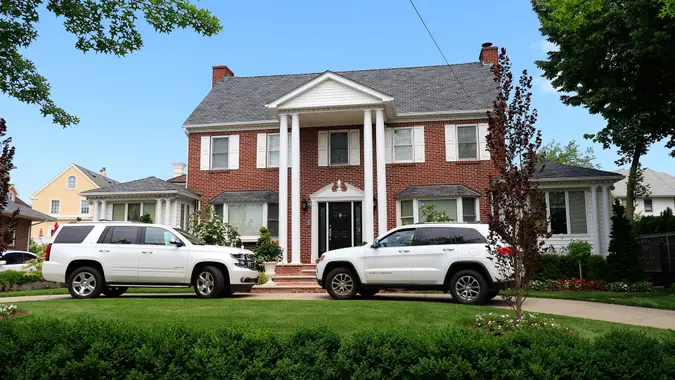
Let’s cut to the chase. According to Ramsey, the dead giveaway that you’re set to remain in the middle class is this: owning two expensive cars that scream $500 to $700 monthly payments, parked in front of a middle-class home.
This, Ramsey asserts, is a surefire sign that upward mobility is off the table. Why? Because it reflects a preference for immediate gratification and status symbols over strategic wealth accumulation.
America’s love affair with shiny new cars is nothing short of legendary, but Ramsey suggests it might be a romance best avoided. At the end of 2023, U.S. households had racked up a staggering $1.61 trillion in auto loan debt–a figure that mirrors the country’s student loan debt.
This comparison is particularly stark when considering the return on investment: unlike education or real estate, cars depreciate at an astonishing rate, with new vehicles losing 60% of their value within just five years.
Ramsey’s Wealth-Building Guidelines
So, how does one navigate away from the siren call of immediate gratification and toward the serene waters of wealth?
Ramsey lays it out simply: Minimize expenditure on depreciating assets. Ideally, no more than 50% of your annual income should be tied up in things like cars, which plummet in value.
Take Micah from Washington D.C. for example. He recently called into “The Ramsey Show” looking for advice — he was contemplating buying a $30,000 sports car in addition to a $13,000 vehicle he already owned while on an $80,000 salary.
Opting for this purchase would put 53.8% of his income into rapidly depreciating assets — clearly over Ramsey’s recommended threshold.
The alternative? Invest in assets that appreciate or at least hold their value, according to Ramsey.
Had Micah considered placing his $30,000 into a low-cost index fund mirroring the S&P 500, for instance, he could have seen significant growth in his net worth over time, potentially reaching $98,027.5 over a decade, considering a 12.57% compounded annual growth rate.
The Takeaway
The path to wealth is often marked by restraint and calculated decisions. This is often the case with many of the world’s richest individuals like Warren Buffett, a billionaire known for choosing used vehicles over new ones.
This approach starkly contrasts with the conventional pursuit of new cars as status symbols, underscoring a broader principle: real wealth often resides in the unseen, in the quiet accumulation and prudent investment of resources.
Ramsey’s advice, distilled through years of observing financial success and failure, offers a clear directive: focus on building your wealth over displaying it prematurely.
The allure of a new car, with its sleek design and the promise of envy from peers, is undeniable. But the cost, Ramsey warns, extends beyond the sticker price — it’s a missed opportunity to invest in your future.
In the end, the choice between remaining in the middle class or ascending towards wealth may just boil down to what sits in your driveway. Choose wisely.
Editor's note: This article was produced via automated technology and then fine-tuned and verified for accuracy by a member of GOBankingRates' editorial team.
More From GOBankingRates