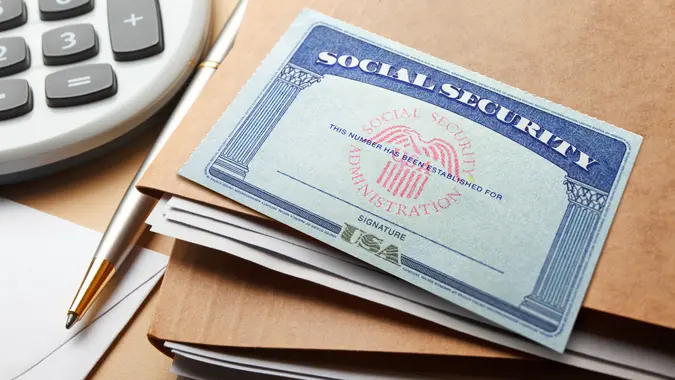
4 Social Security Strategies Middle-Class Retirees Can’t Afford
 Written by
Sarah Sharkey
Written by
Sarah Sharkey
 Edited by
Cory Dudak
Edited by
Cory Dudak

Commitment to Our Readers
GOBankingRates' editorial team is committed to bringing you unbiased reviews and information. We use data-driven methodologies to evaluate financial products and services - our reviews and ratings are not influenced by advertisers. You can read more about our editorial guidelines and our products and services review methodology.

20 Years
Helping You Live Richer

Reviewed
by Experts

Trusted by
Millions of Readers
When it comes to making the most of your Social Security in retirement, there is no shortage of tips designed to help you maximize this retirement income stream. While some tips are useful, many can seem out of reach for the middle class.
Explore which Social Security tips might not make sense for middle-class Americans below.
Wait Until Age 70 to Claim Benefits
If you wait until age 70 to claim your Social Security benefits, you’ll see a larger monthly check. In fact, each month you wait to claim benefits after your full retirement age (FRA) comes with an increased monthly benefit. If you wait until you are 70 to claim your benefits, you’ll receive a monthly check equal to 124% of your standard benefits that you would have received if you filed for Social Security at exactly your FRA, according to the Social Security Administration (SSA).
While the idea of getting a bigger monthly check is enticing, in reality, many Americans simply cannot afford to wait until their 70th birthday to claim their Social Security benefits. Instead, many plan to claim benefits before that milestone.
A recent survey of Americans by Schroders found that just 10% of pre-retirees plan to wait until age 70 to claim their Social Security benefits.
Wait Until Your Full Retirement Age to Claim Benefits
Social Security sets a FRA based on your birthday. As of this writing, your FRA falls somewhere in between age 66 and 67. For example, if you were born on January 1, 1970, your FRA would be 67, per the SSA.
Many experts advise waiting until you reach your FRA to claim your Social Security benefits to tap into a full benefit check. If you claim early, as early as 62, you’ll face a reduced monthly Social Security payment.
However, many Americans don’t wait until their FRA to claim benefits. Instead, many retirees opt to claim their benefits as early as age 62 in order to bolster their income.
Supplement Your Social Security Income with Separate Retirement Savings
Most experts advise against relying entirely on Social Security in retirement. But with budgets stretched, saving for a future retirement often gets put by the wayside.
In retirement, as much as 39% of Americans are currently exclusively on their Social Security income, according to 401k Specialist. In addition, two-thirds of seniors rely on Social Security for more than half of their income, according to a recent survey from the Senior Citizens League.
With millions potentially falling behind on their retirement savings goals, according to the Pew Research Center, building a separate nest egg to lean on in retirement can be difficult.
Work Part-Time in Retirement
Working part-time in retirement is often lauded as a solution for seniors on a tight budget. While picking up a part-time job might be a solution for some, it’s not a practical option for many. Between potential medical constraints and the difficulty of finding a high-paying part-time job as a senior, this common tip might not offer real relief for seniors who rely heavily on Social Security in retirement.
More From GOBankingRates