Why Warren Buffett Avoids Tech Stocks — And When He Makes Exceptions
 Written by
Jacob Wade
Written by
Jacob Wade
 Edited by
Angela Corry
Edited by
Angela Corry
Commitment to Our Readers
GOBankingRates' editorial team is committed to bringing you unbiased reviews and information. We use data-driven methodologies to evaluate financial products and services - our reviews and ratings are not influenced by advertisers. You can read more about our editorial guidelines and our products and services review methodology.

20 Years
Helping You Live Richer

Reviewed
by Experts

Trusted by
Millions of Readers
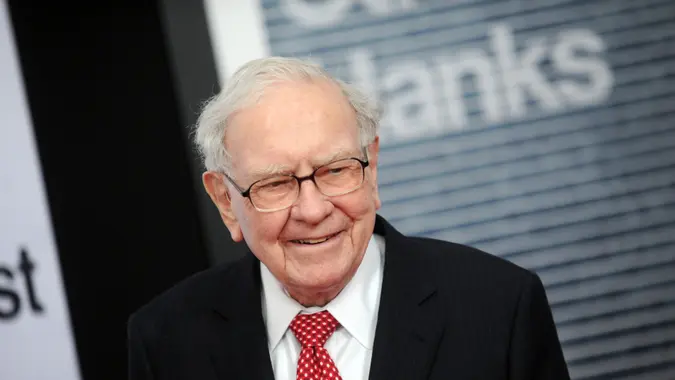
For decades, Warren Buffett had a simple rule that shaped his entire investment philosophy:
“Buy what you know.”
And if there was one thing Buffett made crystal clear, it’s that he didn’t know tech.
He joked that smartphones were “too smart” for him. He didn’t keep a computer on his desk. He tweeted only nine times in four years, because — in his words — the alternative was “going to a monastery.”
So when people asked why the Oracle of Omaha wasn’t buying flashy tech stocks during some of the biggest tech booms in history, his answer was basically:
“Because I don’t understand them.”
But that wasn’t Buffett being humble. That was Buffett being Buffett.
Why Buffett Historically Avoided Tech
Buffett’s avoidance of tech wasn’t about fear; it was about predictability.
What he’s always looked for is a business whose future economics he can reasonably understand. Not the technology. Not the hype. Not the product specs. But the business.
And early tech didn’t have the two things Buffett loves most:
1. Durable Competitive Advantages
Tech moved too fast. Competitors leapfrogged each other every few years. Buffett likes slow-moving moats such as railroads, insurers and consumer goods. Tech companies didn’t stay dominant long enough for him to trust them.
2. Predictable Cash Flows
If the business model changes every 18 months, there’s no way to reliably project long-term earnings. For Buffett, that’s like investing blindfolded.
So for decades, “no tech” wasn’t just a preference, but a filtering system. Buffett famously said he only invests in businesses he can’t imagine being disrupted. And in tech? Disruption is the business model.
IBM: Buffett’s First Major Misstep in Tech
When Buffett finally ventured into technology in 2011 with a large investment in IBM, he did so cautiously. He believed IBM’s enterprise relationships and service contracts created the kind of sticky, predictable business he could understand.
In hindsight, Buffett acknowledged that the thesis didn’t play out as he hoped. IBM wasn’t a catastrophe, but it significantly underperformed during a bull market.
As he put it, “We haven’t lost money, but it’s been a significant underperformer.”
IBM was Buffett’s reminder that even mature tech companies can face unpredictable competitive pressures.
Apple: The Company That Changed Everything
Buffett’s investment in Apple marked a turning point. And not just for Berkshire, but for how Buffett viewed technology altogether.
Buffett has repeatedly said he doesn’t consider Apple a “tech company” in the traditional sense. Instead, he sees it as a consumer goods company with extraordinary brand loyalty, supported by a tech ecosystem.
Apple’s predictability doesn’t come from processors or operating systems, it comes from human behavior. iPhones have become central to modern life, and Apple’s ecosystem creates switching costs that resemble Buffett’s classic consumer staples.
The breakthrough was that Buffett didn’t start understanding tech, but the tech sector started producing companies with economic characteristics he’d always understood.
The result? Apple became one of Berkshire’s most successful investments ever.
What This Means for Your Portfolio
Buffett’s tech evolution provides a practical framework for how individual investors should think about their own portfolios.
1. Know Your Investments
Buffett didn’t avoid tech because it was new, he avoided it because he couldn’t predict it. The same principle applies to any investor; Invest only in businesses or sectors you can explain and evaluate.
2. Expand Your Knowledge Gradually
Buffett didn’t rush into tech despite decades of hype. He waited until he could clearly understand the long-term economics of a company before making a major allocation. Investors don’t need to buy every emerging trend, they just need to wait for opportunities where clarity aligns with conviction.
3. Tech’s Role in a Modern Portfolio
Today, tech includes cloud infrastructure, enterprise software, digital payments, AI-driven services and consumer platforms with strong recurring revenue. These are areas with far more predictable earnings than early-stage Silicon Valley startups.
That means tech doesn’t have to be avoided. Instead, position size should reflect how well you understand the business. For some investors, that may justify a 20% weight in tech. For others, 40%.
For Buffett, it was essentially zero, until he started to consider Apple a long-term anchor, not a speculative play.
More From GOBankingRates