Rachel Cruze Warns of 7 Money Mistakes Costing You Thousands
 Written by
Nicholas Morine
Written by
Nicholas Morine
 Edited by
Cory Dudak
Edited by
Cory Dudak

Commitment to Our Readers
GOBankingRates' editorial team is committed to bringing you unbiased reviews and information. We use data-driven methodologies to evaluate financial products and services - our reviews and ratings are not influenced by advertisers. You can read more about our editorial guidelines and our products and services review methodology.

20 Years
Helping You Live Richer

Reviewed
by Experts

Trusted by
Millions of Readers
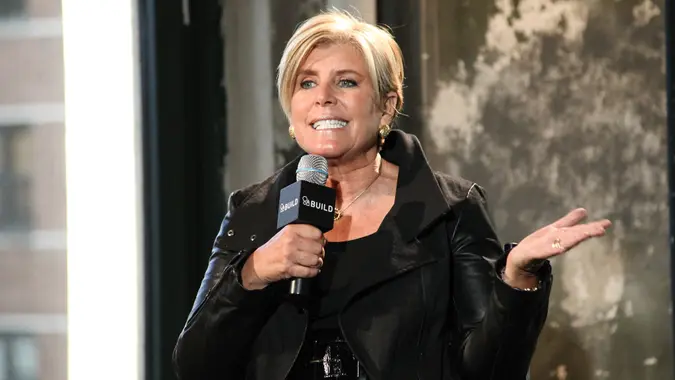
When it comes to dispensing relevant and easily digestible financial advice, Rachel Cruze — daughter to Dave Ramsey and an integral part of the Ramsey Solutions team as co-host of “The Ramsey Show” — is one of the top voices in the space.
In a video shared to YouTube via her own channel, Cruze outlined seven substantial money mistakes that commonly end up costing people thousands of dollars. Which errors should you watch out for when handling your hard-earned cash?
1. Juggling Minimum Payments
Describing an all-too-common scenario in which you might be racking up your credit cards or lines of credit with purchases, then remaining satisfied with making the minimum payments on debt owed, Cruze listed this as the No. 1 habit to avoid.
“You’re not getting ahead, you’re paying interest — sometimes even fees if you’re late,” Cruze said. “Getting out of debt and freeing up those minimum payments, then having no debt in your life… is going to make your income go so much further.”
Cruze then pivoted to endorse the snowball method of debt reduction: Listing your debts in order of smallest to largest, regardless of rate of interest, and paying off the smallest principal first while maintaining minimum payments on the rest, as the best way to start digging out.
2. Having Substantial Savings, But Also Significant Debt
Cruze then detailed a situation in which you might be holding a large amount of debt, but also enjoying a significant amount of assets in savings.
“Throw that savings and get rid of your debt. Because your debt, you’re paying interest on,” she began.
“Could you be making interest on the money that’s saved, maybe in a HYSA (high-yield savings account)? Yes. But it’s usually way lower of an interest [rate] that you’re gaining in that way, versus what you’re paying out. And the level of risk [in keeping large debts on the ledger] is huge,” Cruze concluded.
3. Taking on a Mortgage Before You’re Completely Ready
While homeownership is extremely desirable, being a milestone achievement for most people, Cruze noted that people often hastily rush into this situation.
Before doing so, she advised: “I want you to be debt-free. I want you to have a fully funded emergency fund. And then I want you to have a good down payment. If you’re a first-time homebuyer, 5% is fine. But if you get up to 20%, which would be amazing, you can avoid PMI (private mortgage insurance), which means you aren’t paying out as much in insurance.”
“All of these things are really crucial to have a solid foundation for you as you become a homeowner, otherwise it just becomes a barrel of fish hooks where you are just leaking money everywhere,” she added.
4. Failing To Keep on Top of Your Insurance Plan
Suggesting that while it was a tricky business to perfectly balance the level of coverage one might need across a variety of insurance types, Cruze stated that, in her experience, many people were overpaying for insurance coverage — to the tune of hundreds of dollars per month.
Cruze pitched the idea of turning to RamseyTrust agents as a solution for those looking to re-evaluate their level, and cost, of coverage.
5. Lacking a Will
“Regardless of your net worth, whether you own a home or not, everyone needs a will,” Cruze stated. Death is inevitable, and without clear direction on where your assets should be placed, this money could be tied up indefinitely.
6. Insisting on a Car Payment in Your Budget
“The average new car payment is over $700 a month,” Cruze noted. “If there’s two new cars, that’s $1,400 going to [vehicles] that are going down in value. It’s one of the worst financial moves people can make.”
While most people might need a car, she conceded, considering the purchase of a car that suitably matches your financial state is most important.
7. Sitting Out of the Stock Market
“Don’t just have your money sitting in a HYSA doing nothing. Have money in the market,” Cruze advised, particularly after paying off debt and creating a proper emergency fund. Then comes retirement investment via 401(k) and Roth IRA, in well-vetted mutual funds or index funds.
More From GOBankingRates