Trump’s ‘Great Healthcare Plan’ Promises Lower Drug Costs — Will Your Pharmacy Bill Really Drop?
 Written by
Heather Altamirano
Written by
Heather Altamirano
 Edited by
Angela Corry
Edited by
Angela Corry
Commitment to Our Readers
GOBankingRates' editorial team is committed to bringing you unbiased reviews and information. We use data-driven methodologies to evaluate financial products and services - our reviews and ratings are not influenced by advertisers. You can read more about our editorial guidelines and our products and services review methodology.

20 Years
Helping You Live Richer

Reviewed
by Experts

Trusted by
Millions of Readers
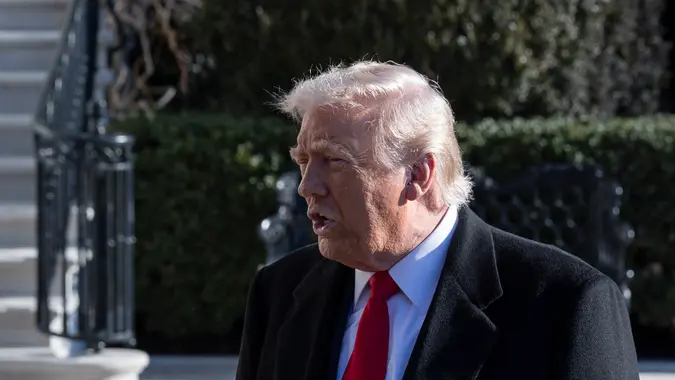
President Donald Trump announced a new healthcare proposal he’s urging Congress to pass, dubbed ‘The Great Healthcare Plan,’ which aims to lower drug prescription costs and “puts more money in your pocket,” he said in a video released by the White House.
Part of the plan is to secure significant savings on prescription medications through the “most favored nation drug pricing policy.” While the proposal could save money for some, experts say whether your pharmacy bill actually drops depends heavily on your insurance, income and the fine print that hasn’t yet been revealed.
Trump’s Plan Attacks Costs from Three Different Angles
Trump announced his proposal on the day Senate negotiations on the Affordable Care Act subsidies stalled.
“Republicans want market-based solutions and Trump’s proposal splits the difference and satisfies neither side, which might be the point, finance expert Andrew Lokenauth with Be Fluent in Finance said.
“By putting forward a plan that redirects money to individuals instead of insurance companies, he’s given Republican senators cover to vote against subsidy extensions,” he added.
With that in mind, Trump’s proposal can help Americans save money, though the real savings rely on certain factors. Lokenauth explained the following:
First, the codified most-favored-nation deals lock in discounts for Medicaid patients. If you’re on Medicaid, you’ll see lower prices on drugs from Pfizer, Eli Lilly, Novo Nordisk and roughly a dozen other manufacturers.
Second, TrumpRx launches this month with direct-to-consumer pricing on select medications. Think weight-loss drugs, migraine treatments, fertility medications — the expensive stuff insurance loves to exclude. For people with high-deductible plans or anyone paying cash, this creates real savings on specific drugs.
Third, the cost-sharing reduction program targets premiums. The White House claims this will cut the most common Obamacare plan premiums by 10%, which Lokenauth finds “optimistic.”
A Key Issue the Plan Doesn’t Address
A major concern about Trump’s plan is that it doesn’t address provider pricing.
“Pricing is determined by the costs of services provided by physicians, hospital systems, nursing homes and other providers,” said Gary Jacobs, a long-time federal lobbyist and author of “The Zen Lobbyist: A Mindful Approach to Transforming Healthcare. “If the plan doesn’t include incentives for providers to reduce the cost of care, medical inflation will undermine its benefits.”
Pricing is universally tied to the federally established Medicare Fee Schedule. It determines the reasonable and usual pricing for a procedure in a community.
“The only way prices can be reduced is if price controls are put in place, which would defeat the idea of competition or if providers were mandated to participate in risk-based programs, like Accountable Care Organizations, that participate in shared savings programs developed by CMS through its innovation center or if they negotiate directly with private payers,” Jacobs said.
In short, doctors and hospitals are unlikely to voluntarily cut prices.
Trump Claimed Prescription Drug Costs Will Be Cut up to 500%
Trump has claimed the plan could reduce prescription drug costs by as much as 500%, but Lokenauth pushed back on that figure.
“You can’t drop prices by 500% — that’s not how percentages work,” he said.
A 100% reduction would mean a drug is free, and anything beyond that implies negative pricing.
“The manufacturer would be paying you to take the medication,” Lokenauth said. “Trump either misspoke or was given incorrect figures, but the claim muddies the real story.”
Don’t Expect the Plan to Happen Anytime Soon
Trump made many promises, but Jacobs thinks his proposal is too big an undertaking.
“I am impressed with the ambitious ideas behind the plan, but in my experience, vision without execution is a hallucination,” he said.
According to Jacobs, executing the plan is too challenging because ” it’s incredibly disruptive to a system that is often resistant to change and systems are difficult to manipulate from a change perspective.”
If passed, Trump’s plan could benefit uninsured Americans, high-deductible plan holders, Medicaid recipients and anyone taking specialty drugs that insurance excludes.
“A family paying $800 cash for asthma medication can now get it for $400 through TrumpRx and that’s life-changing money,” Lokenauth said.
Still, many unanswered questions remain. Which drugs will become over-the-counter? Can the FDA review and approve those changes quickly? Will insurance companies cover over-the-counter medications, or will consumers pay entirely out of pocket?
“These details will determine whether the plan ultimately helps or hurts average Americans,” Lokenauth said.
Editor’s note on political coverage: GOBankingRates is nonpartisan and strives to cover all aspects of the economy objectively and present balanced reports on politically focused finance stories. You can find more coverage of this topic on GOBankingRates.com.
More From GOBankingRates