Elon Musk Says You Don’t Need To Worry About Saving for Retirement
 Written by
Heather Altamirano
Written by
Heather Altamirano
 Edited by
Jenna Klaverweiden
Edited by
Jenna Klaverweiden
Commitment to Our Readers
GOBankingRates' editorial team is committed to bringing you unbiased reviews and information. We use data-driven methodologies to evaluate financial products and services - our reviews and ratings are not influenced by advertisers. You can read more about our editorial guidelines and our products and services review methodology.

20 Years
Helping You Live Richer

Reviewed
by Experts

Trusted by
Millions of Readers
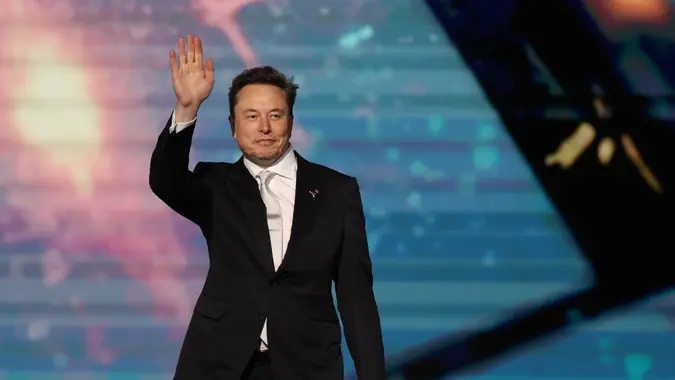
As AI becomes an increasingly integral part of daily life, Elon Musk believes it will become so powerful that people won’t need to save for retirement. On an episode of “Moonshots with Peter Diamandis,” Musk said, “Don’t worry about, like, squirreling money away for retirement in like 10 or 20 years” because it “won’t matter.”
The world’s richest man believes setting aside money for retirement is irrelevant because the workforce will completely change in a few short years, thanks to artificial intelligence (AI). He’s “confident by 2030, AI will exceed the intelligence of all humans combined,” but some experts disagree and encourage Americans to continue saving for retirement.
Musk Says AI and Robots Will Make Goods and Services Nearly Free
In an interview on “Verdict with Ted Cruz,” U.S. Sen. Ted Cruz’s podcast, Musk said that goods and services people need will be almost free. Musk explained that “tens of billions of robots that will make you anything or provide you any service you want for basically next to nothing.”
While that future might sound exciting, it doesn’t sound realistic to finance experts.
“Automation might lower the cost of gadgets or clothes, but it’s not going to make healthcare free, guarantee affordable housing or ensure that government policy stays stable,” said Danny Ray, founder of PinnacleQuote, “The Life Insurance Experts.”
Ray also noted that the idea that everything will be free someday misses a big point — access. “Even if services become cheap, access still depends on factors like who controls the tech, how it’s distributed, and the laws in place,” he said. “So banking on some future system to take care of you? That’s risky.”
Retirement Planning Still Matters Despite AI Advancements, Advisors Say
Technology can make some things less costly; however, it won’t magically fix issues like housing, healthcare or tax costs.
“Those are the big-ticket items that really shape whether retirement feels secure or stressful,” Ray said. “Every wave of new technology brought price drops in some areas but made other things more expensive.”
Saving for retirement isn’t about pessimism; it’s about realism. “You’re not betting against technology; you’re just giving yourself a buffer in case the future turns out slower or messier than expected,” Ray explained.
Experts Say Musk’s AI Predictions Don’t Replace Sound Financial Planning
While Musk has insight into how AI can potentially shape the future, telling people not to save for retirement isn’t realistic, according to Nicholas Juhle, Greenleaf Trust’s chief investment officer.
“That’s an easy (and irresponsible) declaration to make when you have a net worth of nearly $800 billion,” he said. “The implication is that artificial intelligence will be so smart that people somehow won’t need money in a few years from now? If you’re going to bet your financial security on that notion, you’re countering our entire historical experience and you had better be right.”
Musk might have an interesting viewpoint, but that shouldn’t be used as an excuse to stop saving for retirement, said Eric Mangold, CWS, founder of Argosy Wealth Management.
“No one has a crystal ball and making such a monumental life change to stop saving for retirement because of something that may or may not happen, to me doesn’t sound like a prudent financial move,” he said. “You probably don’t want to be the one who, on the day you want to retire, has nothing saved because of something someone said many years prior.”
AI Growth Doesn’t Guarantee Social Safety Nets for Retirement
While Musk argued that AI-driven abundance will make retirement savings obsolete, critics say technological growth alone won’t protect individuals financially.
Kaveh Vahdat, founder and CEO of generative AI company RiseAngle, believes AI could surpass collective human intelligence by 2030 but is wary of free services and programs to help people during retirement.
“It’s like saying that because the U.S. GDP is $30 trillion and there are many billionaires, you don’t need to save for retirement,” he explained. “Whether you should save for your retirement or not has to do with social systems that can support and protect you as an individual in the wake of AI growth.”
He added that there isn’t progress being made in that direction. “We not only don’t have any of those systems in place right now, but we also see zero headway in that direction from leading AI companies in terms of how they intend to distribute this increased wealth back to society or present plans for doing so to the government,” he said.
In Vahdat’s view, there are no serious steps being taken in this direction by any of the major AI players, including Musk. “For as long as this remains the case, no matter how much wealth is created by AI, it does not change the status of common folks,” he said
Bottom line: AI optimism isn’t a retirement strategy, and finance experts urge Americans to continue saving.
More From GOBankingRates