I’m a Mechanic: How You Can Tell If a Mechanic Is Overcharging You
 Written by
Laura Beck
Written by
Laura Beck
 Edited by
Molly Sullivan
Edited by
Molly Sullivan
Commitment to Our Readers
GOBankingRates' editorial team is committed to bringing you unbiased reviews and information. We use data-driven methodologies to evaluate financial products and services - our reviews and ratings are not influenced by advertisers. You can read more about our editorial guidelines and our products and services review methodology.

20 Years
Helping You Live Richer

Reviewed
by Experts

Trusted by
Millions of Readers
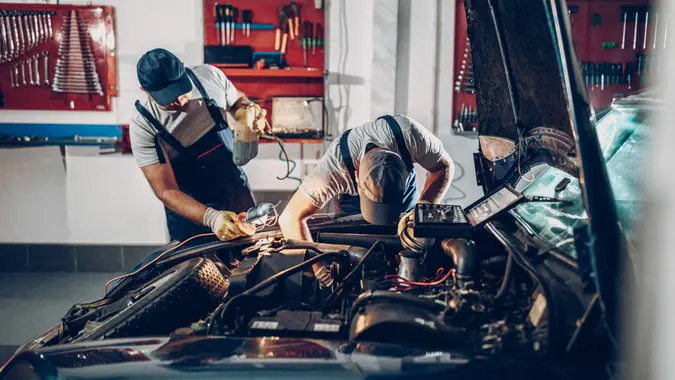
Walking into a repair shop when you don’t know anything about cars feels like getting quoted in a foreign language. You nod along, sign the estimate and hope you’re not getting ripped off.
Chris Pyle, a mechanic with JustAnswer, has been on both sides of this conversation. He knows what honest shops charge and what shady ones get away with. Here’s how to tell the difference.
The Problem Is You Don’t Know What Things Cost
The biggest issue is simple. You’re paying someone to fix something you can’t fix yourself.
“It is really hard to know if you are paying too much for a car repair, since for most car owners, fixing cars is not their skill level, thus they are paying a shop to do the work,” Pyle said.
You could get a second opinion at another shop, but now you’re out two diagnostic fees. You could look up the parts yourself to see if you can buy them cheaper online, but that doesn’t tell you if the labor charge is fair or if you actually need the repair in the first place.
The whole system relies on trust, which is exactly why some shops take advantage.
Labor Rates Vary More Than You Think
Labor is where shops make their money, and the range is massive.
“Labor rate is one of the big expenses, which can range from $90 an hour up to $250,” Pyle said. “Dealerships are the most expensive.”
Before you get mad about $200 an hour, understand what that rate covers. The mechanic working on your car doesn’t pocket all of it.
“Good techs are expensive to keep trained, keep employed, they have expensive tools, and the shop has insurance and bills to cover,” Pyle explained. “There are many employees in the shop making their income from the labor rate.”
A high labor rate doesn’t automatically mean you’re being scammed. A shop charging $100 an hour in a low-cost area might be fair. A dealership charging $250 in a major city is probably standard for that market.
Parts Come With Different Warranties
OEM parts cost more than aftermarket parts, but there’s a reason for the price difference.
“If they come from a dealer or an online car manufacturer’s website, they will have a tow, parts and labor warranty at any dealership,” Pyle said.
Aftermarket parts are cheaper, but the warranty only covers the part itself. And it’s usually only good at the shop that installed it.
“If they are aftermarket parts, they often have a warranty too, but it only covers the part, and often it is under the name of the independent shop that installed it,” Pyle said. “So the warranty is only good if you use that shop again to do the repeat repair.”
That matters if you’re not planning to go back to that shop or if you move. OEM parts have a warranty you can use anywhere.
“OEM parts are the most expensive due to their quality and the warranty that comes with it,” Pyle said.
Do Your Homework Before You Show Up
The shops that overcharge count on you not knowing what your car actually needs.
“If you feel like you are being taken advantage of, you will need to do some research, and you will need to know something about what your car needs,” Pyle said.
A shop might fix your air conditioning and then tell you that you also need brakes and a tune-up. Maybe you do. Or maybe those things can wait another 10,000 miles.
“You, the owner, need to keep maintenance records and do your own inspections to some degree to see if the additional recommended repairs are needed right now or 5,000 to 15,000 miles down the road,” Pyle said.
Keep a notebook in your glove box. Write down what got done and when. Check your brake pads yourself every few months. You don’t need to be a mechanic to see if they’re worn down or if your tires are bald.
Ask To See the Labor Guide
“All shops use a subscription service to look up repair guides and labor rates,” Pyle said. “You can ask to see the website showing repair X or Y calls for that exact labor rate they quoted.”
If a shop tells you something takes eight hours and charges you for eight hours, ask to see where that time estimate came from. Honest shops will show you. Shady ones will get defensive.
Use a Mechanic You Know Personally
This is Pyle’s best advice, even though it’s not always possible.
“If possible, use a tech or shop that you know personally, possibly outside of their job,” Pyle said. “Odds are they will treat you right to retain your friendship and trust.”
A mechanic who knows you’re going to see them at the neighborhood barbecue is a lot less likely to overcharge you or recommend work you don’t need.
They Should Explain Everything
The clearest red flag is a shop that won’t walk you through what’s wrong and why it costs what it costs.
“If a shop is not willing to thoroughly explain the parts and labor needed, or prove repair X or Y is needed, then I would not trust the quote or the job being done,” Pyle said.
Ask questions. A good mechanic will show you the worn brake pads, the leaking hose or whatever else is broken. They’ll explain why they’re recommending OEM versus aftermarket parts. They’ll break down the labor charge and show you where the estimate comes from.
If they rush you, talk over you or act annoyed that you’re asking questions, find a different shop.
More From GOBankingRates