7 Moves To Make Before April 15 To Shrink Your 2026 Tax Bill
 Written by
John Csiszar
Written by
John Csiszar
 Edited by
Rebekah Evans
Edited by
Rebekah Evans

Commitment to Our Readers
GOBankingRates' editorial team is committed to bringing you unbiased reviews and information. We use data-driven methodologies to evaluate financial products and services - our reviews and ratings are not influenced by advertisers. You can read more about our editorial guidelines and our products and services review methodology.

20 Years
Helping You Live Richer

Reviewed
by Experts

Trusted by
Millions of Readers
Although the April 15 deadline for filing 2025 returns is fast approaching, there are still several moves you have time to make to reduce your tax bill.
While some are available year-in and year-out, the passage of the One Big Beautiful Bill Act (OBBBA), along with annual IRS changes to various tax limits, mean that you can’t simply put your filing on autopilot. Here are several moves to consider before sending in your tax return.
Max Out Your IRA Contributions
If you’ve got a traditional IRA, you can continue making deductible contributions for tax year 2025 up until April 15, 2026. Remember to factor in both the $7,000 standard maximum contribution and the additional $1,000 in available catch-up contributions the IRS allows if you are age 50 or older. Deductibility may phase out at higher income levels if you or your spouse are covered by a workplace retirement plan.
Consider a SEP
If you’re self-employed, you still have time to fund a self-employed pension plan (SEP). In fact, you might even have more time, as the IRS allows SEP contributions until your business tax-filing date, including extensions. You can generally contribute up to 25% of your compensation to a SEP, although you’ll have to provide the same percentage for each of your qualifying employees.
Fund an HSA
If you had a qualified high-deductible health plan in 2025, you can contribute to a health savings account (HSA) until the April 15 cutoff as well. The IRS allows individuals to contribute up to $4,300, while families can set aside as much as $8,550. Those age 55 or older can contribute an additional $1,000.
Choose the Best Filing Status
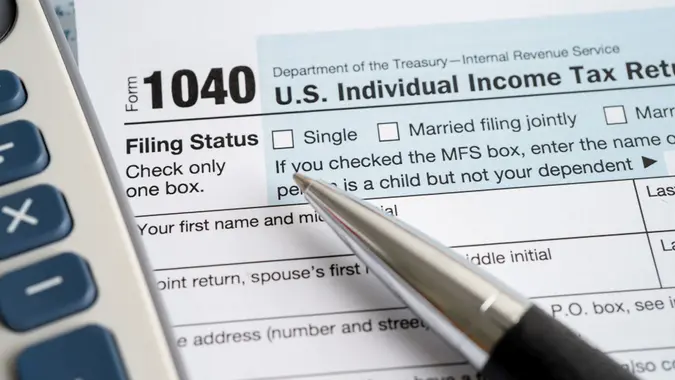
The standard deduction varies based on your filing status. Choosing the best filing status can significantly lower your taxable income. For tax year 2025, the IRS allows standard deductions of $15,750 for single filers but $23,625 for those filing as head of household.
Don’t Overlook Your Self-Employed Health Insurance Deduction
If you’re self-employed, the IRS allows you to deduct health, dental and qualified long-term care insurance premiums that you paid for yourself, your spouse and your dependents. This applies if you had freelance, consulting or other 1099 income in 2025. However, you generally cannot take this deduction if you were eligible for employer-subsidized health coverage.
Compare Standard vs. Itemized Deductions
Ever since the standard deduction was boosted by the Tax Cuts and Jobs Act of 2017, most filers have abandoned itemizing deductions. However, for 2025, the IRS said the OBBBA boosted the state and local tax exemption (SALT) to $40,000 from $10,000 in 2024, potentially opening the door for more taxpayers to itemize in 2025.
Start Early
The sooner you start to prepare your return, the easier it will be to identify mistakes and missed deductions. It can also alleviate some of the stress that comes from preparing your return correctly. Starting early also lets you model scenarios and choose the best ones.
More From GOBankingRates