Social Security Trust Fund Expected To Be Depleted by 2032: How Big the Benefit Cuts Could Be If Congress Does Nothing
 Written by
Daria Uhlig
Written by
Daria Uhlig
 Edited by
Jenna Klaverweiden
Edited by
Jenna Klaverweiden
Commitment to Our Readers
GOBankingRates' editorial team is committed to bringing you unbiased reviews and information. We use data-driven methodologies to evaluate financial products and services - our reviews and ratings are not influenced by advertisers. You can read more about our editorial guidelines and our products and services review methodology.

20 Years
Helping You Live Richer

Reviewed
by Experts

Trusted by
Millions of Readers
In its Budget and Economic Outlook: 2026 to 2036 report, the Congressional Budget Office projected that the Social Social Security Old-Age and Survivors Insurance trust fund will run out of money in 2032.
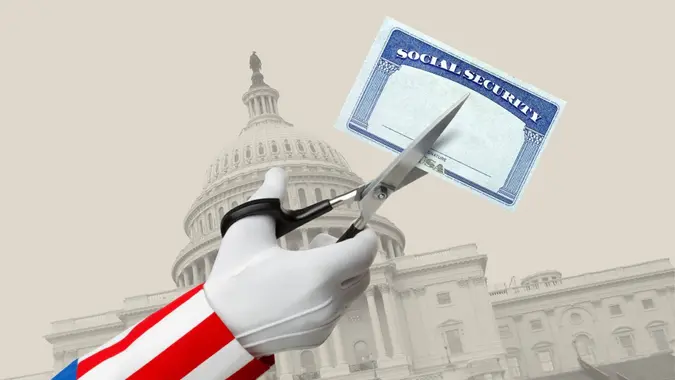
If the projection is correct and Congress fails to act, Social Security benefits could decrease 7% for the remainder of that year, and 28% from 2033 through 2036. That equals an initial cut of about $145 per month, increasing to $580 per month, for someone receiving the average retirement benefit of $2,071.
Also see how much Americans rely on Social Security in every state.
Why the Social Security Trust Fund Is Running Out of Money
The trust fund has three sources of income: payroll tax, income taxes on Social Security benefits and interest. Beginning in 2027, benefit payments will outpace income, gradually depleting the trust fund’s balance from $2.19 trillion this year to $384 billion in 2031 to $0 in 2032.
At that point, Social Security will be able to pay out only as much as it takes in — about 93% of benefits for part of 2032, and about 72% in 2033 and beyond.
How To Prepare for Cuts to Social Security
Cuts would immediately impact beneficiaries, so retirees should use these next several years to reduce their reliance on Social Security.
John Vandergriff, owner and wealth planner at Blue Ridge Wealth Planners in Knoxville, Tennessee, advised retirees to review their investment strategies and balance their portfolios for growth and stability.
“If you’re too conservative, you could risk running out of money,” he said. “However, if you’re too aggressive, it could mean losing much of your hard-earned savings.”
Vandergriff also recommended lowering your tax burden, as “smart tax planning can be worth more than a benefit increase.” One way to do that is to draw income from a tax-free Roth account, if you have one, being mindful of income thresholds that could make your Social Security benefits taxable.
For younger workers, the best approach is to treat Social Security as a component of retirement income, not the foundation.
“That begins with saving early and consistently through workplace retirement plans or personal IRAs, and maximizing employer matches whenever possible,” said Nick Hamilton, national manager of Alliant Retirement and Investment Services. “Younger clients also benefit from maintaining diversified, growth-oriented investment portfolios that can compound over several decades.”
Fortunately, financial plans for younger workers often assume that future Social Security benefits will be 70% to 80% of current projections. That way, “their plans remain sound even if adjustments occur,” Hamilton said.
Should You Claim Social Security Early To Offset Future Cuts?
In most cases, no. “Even if benefits are adjusted in the future, locking in a lower amount at 62 doesn’t usually lead to a better long-term outcome,” Hamilton said.
Vandergriff agreed, but noted that if you or your spouse has a shortened life expectancy, or you’ve retired early with no other source of income, “it may make sense to claim benefits early to ensure you get something from the system while you can.”
More From GOBankingRates