Here’s What Trump’s Executive Order on Single Family Home Sales Really Means for the Middle Class
 Written by
Dawn Allcot
Written by
Dawn Allcot
 Edited by
Zuri Anderson
Edited by
Zuri Anderson

Commitment to Our Readers
GOBankingRates' editorial team is committed to bringing you unbiased reviews and information. We use data-driven methodologies to evaluate financial products and services - our reviews and ratings are not influenced by advertisers. You can read more about our editorial guidelines and our products and services review methodology.

20 Years
Helping You Live Richer

Reviewed
by Experts

Trusted by
Millions of Readers
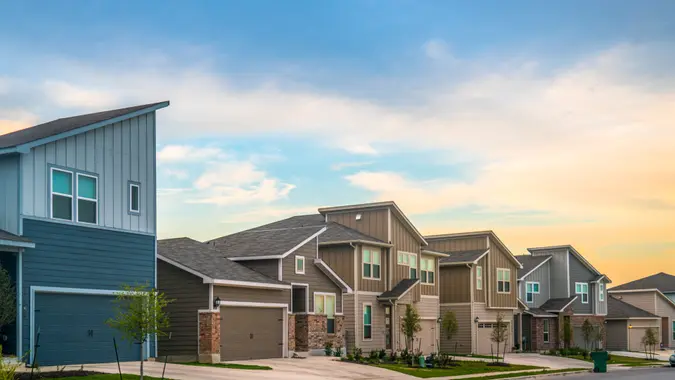
The housing affordability crisis persists into 2026. In spite of slight mortgage interest rate declines, 65% of households can’t afford a median-priced new home in their region, according to National Association of Home Builders data.
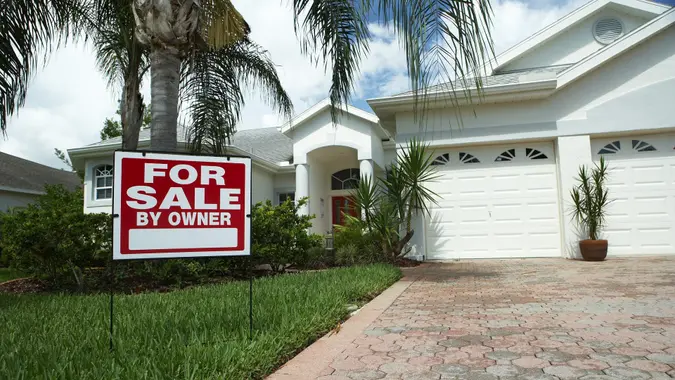
In an executive order, President Donald Trump urged government agencies to “issue guidance preventing relevant Federal programs from approving… sales of single-family homes to institutional investors,” with a goal of reducing competition and driving down home prices.
But how will that affect the middle class, especially amid a challenging housing market?
Brookings Research Finds ‘Little Impact’
The Brookings Institute recently dug deep to determine if the EO, and any resulting legislation, would impact home prices.
“It will do very little, because [institutional investors] are not a big enough sector of the housing market to make an economically meaningful difference to the typical middle-class household wishing to purchase,” said the report’s author, Joe Gyourko, Brookings Institute nonresident senior fellow.
The single-family rental (SFR) market is only 11% of total occupied housing stock; the share of institutionally owned single-family rental homes equals roughly 3% of all rental stock, according to the report.
Institutional investors are not the problem, according to Gyourko.
“The key factor behind the growing affordability problem is a diminished rate of new supply in markets with high housing demand,” he said.
Plus, SFRs are concentrated in the Sunbelt and Midwest markets, which means limiting institutional investing won’t have an impact in areas where housing prices are most elevated, including the Northeast and California.
The Other Side
Cody Schuiteboer of Best Interest Financial disagreed with the Brookings findings.
“Their analysis misses the fundamental truth that institutional investors disrupt local markets by outbidding individual families with all-cash offers,” he said. He’s watched first-time homebuyers in the Southeast lose bidding wars to investors offering 10% to 15% above the asking price.
“Removing this artificial demand will normalize price competition,” Schuiteboer said
Greg Reese, CEO of AmeriEstate, agreed that middle-class buyers struggle with financing.
“Restricting [institutional investors] could provide some relief to prices in suburbs where first-time homebuyers are competing against cash offers,” he said.
Negative Consequences for Retirees and Renters
In spite of the small percentage of SFRs owned by institutional investors, potential policy changes could have unintended consequences for retirees looking to liquidate their homes.
“Reduced institutional buyers can mean fewer renovated homes, leading many of those neighborhoods to remain stagnant longer with poor turnover and a lack of liquidity in people’s estates,” Reese said.
Schuiteboer pointed out that rents may rise in regions where institutional investors own SFRs.
“Locations impacted by institutional landlords are likely to see short-term rental prices increase by 4% to 7%,” he said.
However, Schuiteboer views this as an opportunity.
“Higher rents shift marginal renters towards homeownership,” he added.
Real Solutions
Experts agreed that increasing the inventory of entry-level homes through tax incentives for builders will drive prices down faster than rules against institutional investing. Expanded down payment assistance programs for the middle class and new zoning laws to allow for greater density housing can also help, Schuiteboer said.
Editor’s note on political coverage: GOBankingRates is nonpartisan and strives to cover all aspects of the economy objectively and present balanced reports on politically focused finance stories. You can find more coverage of this topic on GOBankingRates.com.
More From GOBankingRates